Ingredients and steps on one page. Print it, or choose “Save as PDF” in the print dialog.
Sekai Gohan
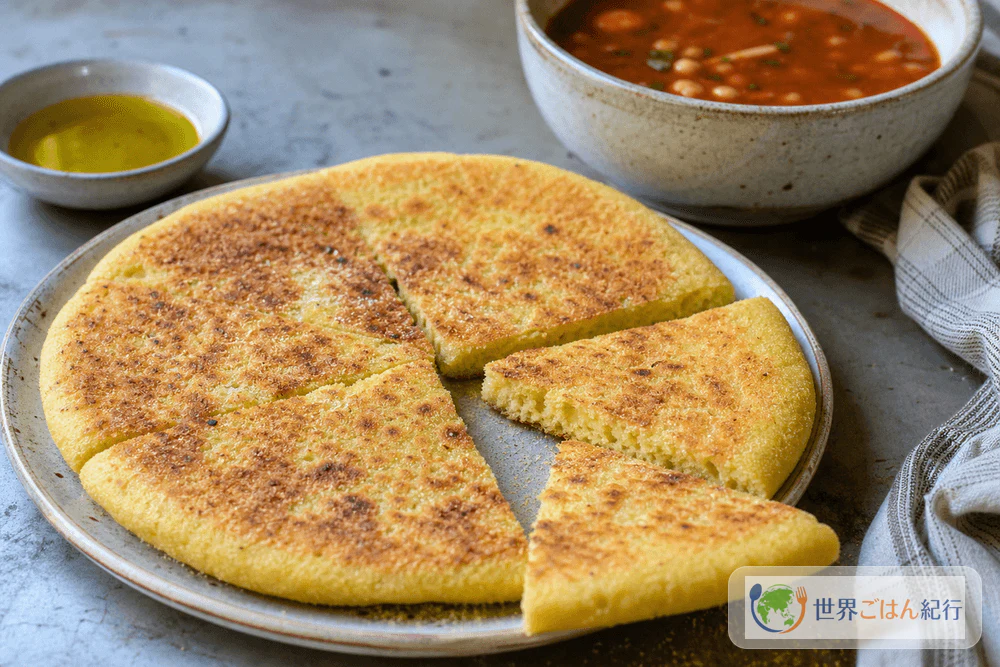
Kesra: Algerian Semolina Flatbread
Ingredients
Dough
| Ingredient | Amount | Substitutes & notes |
|---|---|---|
| Fine semolina | 260 g | Fine-ground durum wheat. The source of the aroma and the yellow color |
| Cake flour | 40 g | For a closer-to-traditional version, replace with 40 g fine semolina |
| Salt | 5 g | Just under 1 tsp. Mix evenly through the dough |
| Olive oil | 45 ml | 3 tbsp. For a milder aroma, a neutral oil such as untoasted sesame oil works |
| Lukewarm water | 150 ml + 20 ml extra | 35–40°C (95–104°F). Add the extra 5 ml at a time, only if dry flour remains |
Shaping and finishing
| Ingredient | Amount | Substitutes & notes |
|---|---|---|
| Semolina for dusting | 15 g | Dust the counter and surface lightly. Brush off excess before cooking |
| Olive oil for finishing | 1 tsp (5 ml) | 1 tsp. Brush thinly over the finished bread |
Steps
1Rub the oil into the flour
5 min / no heat
Put 9 oz (260 g) fine semolina, 1.5 oz (40 g) cake flour and 5 g salt in a bowl and mix for 30 seconds. Drizzle in 3 tbsp (45 ml) olive oil and rub it in with your fingertips for 2–3 minutes. When the flour looks evenly like damp sand, with no streaks of oil or dry white patches, the oil has been worked through.
2Add the water gradually and bring the dough together
6–8 min / no heat
Add 150 ml lukewarm water at 35–40°C (95–104°F) in three additions, pulling the flour up from the bottom with your fingertips. If you add the water all at once, the outside turns sticky while dry flour stays trapped inside. It's fine if it looks shaggy at first; gather it for about 3 minutes, then check how firm the dough is.
Only if dry flour remains at the bottom, add the extra water 1 tsp (5 ml) at a time. Stop when it holds together when squeezed, cracks on the surface slowly close when you press it out, and it doesn't stick to your hands. If you've added too much water, piling in cake flour will make it tough, so rest it for 5 minutes before deciding.
3Rest the dough
30 min
Rest at about 20–25°C (68–77°F).
Shape the dough into a ball and brush the surface thinly with 0.5 tsp (2 ml) of the finishing olive oil. Cover with a dry cloth or plastic wrap and leave at room temperature for 30 minutes. This isn't rising time; it's time for the semolina to absorb water so the dough cracks less when you shape it.
Even if it feels firm when you press it before resting, don't add water. After 30 minutes, if the surface feels moist and a fingerprint slowly springs back, move on. If the edges still crack like paper, smooth the surface lightly with wet hands and rest it another 10 minutes.
4Press into even rounds
6 min / no heat
Divide the dough in two and dust the counter lightly with the dusting semolina. Press it out with your palm into an 8-inch (20 cm) round, about 0.375 inch (8–10 mm) thick. Prick 12–16 holes in the surface with a fork to let air escape from the center before it puffs.
If the edge tears, pinch the crack closed with your fingers. Rather than a perfect circle, aim for a round that isn't thin in the middle and thick at the edge. Even thickness helps the center heat at the same pace as the rest.
5Cook the first side slowly
5–6 min / heavy skillet over medium-low heat
Preheat a heavy skillet over medium-low heat for 2 minutes, then lay the dough in without oil. Don't let the pan get hot enough to smoke. Leave it alone for the first 4 minutes, until the bottom has a light color and brown freckles. Once the edge has dried a little and the surface no longer looks floury, rotate it 90 degrees in the pan and cook 1–2 minutes more.
If only the bottom is coloring deeply, lower the heat before flipping. Flip too soon and the top won't have set, so the dough sticks to the pan. This isn't a bread where you scrape off the char; instead of deep color, get heat into the center.
6Flip and cook through to the center
4–5 min / medium-low heat
Flip with a spatula and cook 4 minutes more. Press lightly on the thick parts with a wooden spatula so the whole round stays in contact with the pan. It's done when both sides have mottled brown spots, the side feels springy when pressed, and the center no longer has the heavy push-back of raw flour.
Did you know?Some Algerian households cook kesra in a dedicated unglazed clay griddle (tajine). In a home kitchen, a heavy skillet kept at medium-low heat does the job well.
If the center still feels heavy but the surface has enough color, drop to low heat and, if you have a lid, cover for just 1–2 minutes to steam. When it's done, wrap it in a cloth and let it rest for 5 minutes, then brush thinly with the remaining 0.5 tsp (3 ml) finishing olive oil. Breaking it after the moisture inside settles, rather than cutting it right away, makes it taste less floury.