Ingredients and steps on one page. Print it, or choose “Save as PDF” in the print dialog.
Sekai Gohan
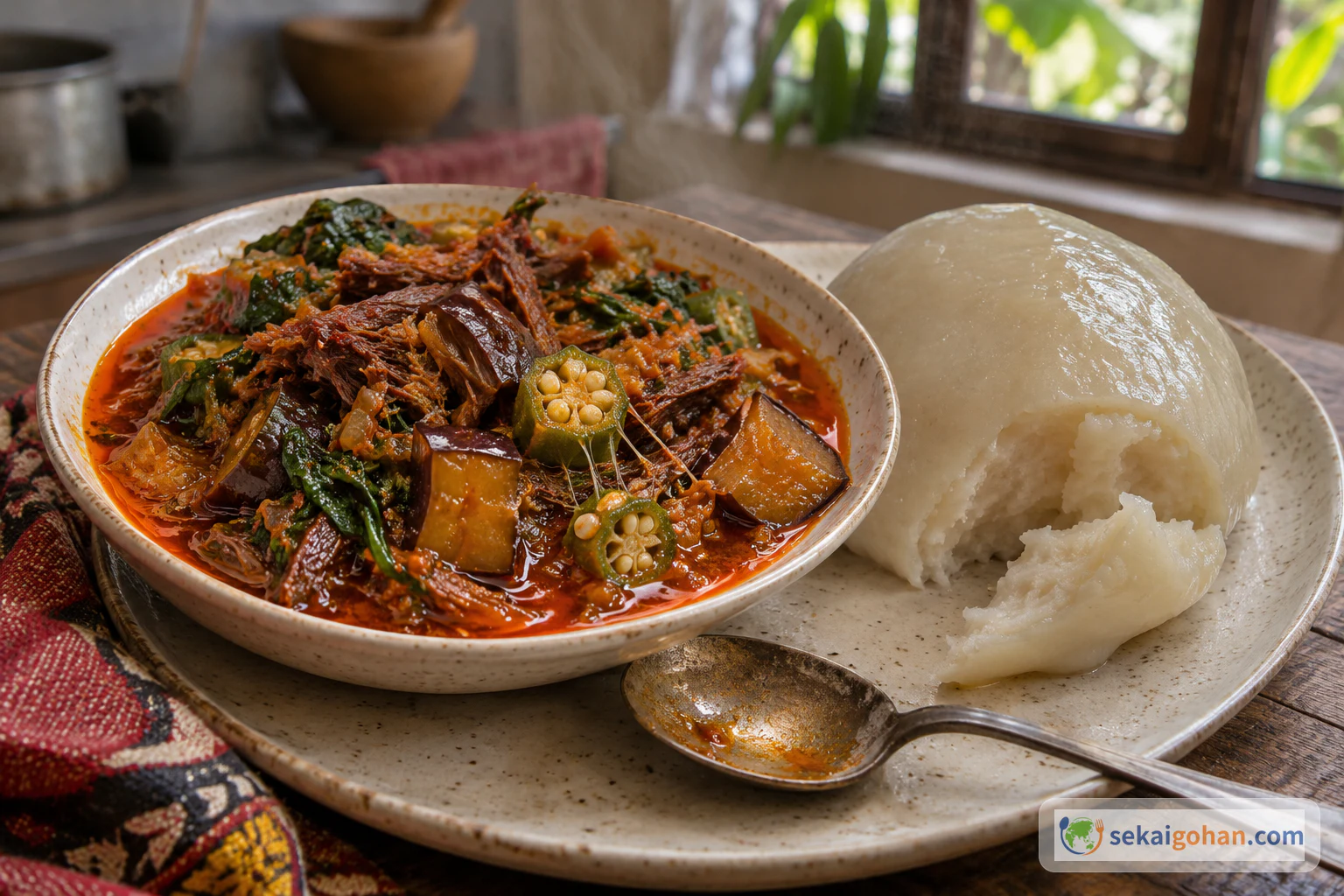
Calulú de Carne Seca and Funge de Bombó: Angolan Dried Beef Stew with Okra
Ingredients
Calulú de carne seca
| Ingredient | Amount | Role |
|---|---|---|
| Dried salted beef (carne seca) | 1 lb 2 oz (500 g) | The main ingredient; carries the salt and the meaty depth |
| Red palm oil (óleo de dendê) | 2 tbsp | Colour, aroma and richness at the base of the sauce |
| White onion, finely chopped | 1 | Sweetness for the base |
| Ripe tomatoes, chopped | 4 | Acidity and liquid; becomes the red sauce |
| Bay leaves | 3 | Rounds out the smell of the dried meat |
| Garlic cloves, chopped | 4 | Aroma |
| Water or unsalted chicken stock | 2½ cups (600 ml) | Braising liquid; stock adds savoury depth |
| Aubergine, in small cubes | ½ | Soaks up the cooking liquid |
| Spinach or cassava leaves | 5 oz (150 g) | Green colour and gentle bitterness |
| Okra, chopped into ½-inch (1 cm) pieces | 5 oz (150 g) | Body and the sticky threads in the sauce |
| Cassava flour (for thickening) | 1 tbsp | Final thickening |
| Water (for the slurry) | 1 tbsp | Dissolves the cassava flour |
| Salt and black pepper | To taste | Final seasoning, added at the end |
Funge de bombó
| Ingredient | Amount | Role |
|---|---|---|
| Cassava flour (fuba de bombó or farinha de mandioca) | 2 cups (about 220 g) | The body of the funge |
| Water | 4 cups (1 L) | Cooking water |
| Salt | ½ tsp | A light backbone of seasoning |
Steps
1Simmer the dried beef to draw out the salt
Bring a large pot of water to a boil and add the dried beef. When it returns to the boil, lower the heat, cover and cook for 1 hour. Drain the beef in a colander and discard the water, which now holds the salt you are pulling out. Taste a sliver; if it is still sharply salty, cover it with fresh water and keep simmering. The beef is ready when it gives a little under your thumb and the fibres begin to loosen.
2Soften the onion in palm oil
Set the heavy stew pot over medium heat and add the palm oil. When it has melted and loosened, add the chopped onion and stir for a few minutes. Keep the oil below smoking; if it starts to haze, pull the pot off the heat for a moment. The onion is done when it is translucent with faintly golden edges.
Palm oil burns before you expect it toRed palm oil loses its aroma and turns bitter once it smokes. Medium heat and a moving spoon keep the colour bright, and that colour carries through to the finished stew.
3Cook the tomatoes down
Add the chopped tomatoes and stir them through the onion and oil. Cover and cook for 10 minutes, stirring now and then so nothing catches on the bottom. The sour edge of raw tomato fades as the liquid cooks off. Move on when the tomato pieces have lost their corners and red oil begins to separate at the rim.
4Braise the beef slowly
Add the garlic and cook for 2 minutes, until it smells sweet. Add the drained beef and the bay leaves, stir, and pour in the water or stock. Bring to a boil, cover, and braise over low heat for 1 hour 30 minutes, adding hot water whenever the liquid no longer reaches the meat. Cook beef until its centre reaches 167°F (75°C) for at least 1 minute; without a thermometer, the pieces should split apart easily under a fork, with the liquid reduced by close to half.
5Add the aubergine, greens and okra
When the beef is tender, add the aubergine cubes, the greens and the okra. Push them under the liquid, cover and cook for 20 minutes. Lift the lid once halfway and shake the pot so the sauce moves through the vegetables. The vegetables are done when the okra shows sticky threads at its cut ends, the greens have wilted and the aubergine has darkened with sauce.
Okra goes in lateOkra's threads thicken the sauce, and long cooking melts them away. Add it only after the beef is tender, with the other vegetables, and the body stays in the pot.
6Thicken and season
Stir the cassava flour into the 1 tbsp water until smooth and pour it into the pot, stirring as it goes in. Season with pepper and a little salt, taste, and add more salt only if the beef needs it. Take off the lid and simmer for 15 minutes so the sauce reduces. It is done when the sauce leaves a thin film on the wooden spoon.
7Start the funge
In the second deep pot, bring the water and salt to a hard boil. Sprinkle in the cassava flour a little at a time with one hand while beating with the wooden spoon in the other, never stopping. Scrape the bottom and the corners as you go so no dry pockets hide there. Move on when all the flour is in and the mass has become a thick, smooth paste with no lumps.
Feed the flour in slowlyFunge goes lumpy when flour lands in a heap or the spoon stops moving. A thin stream and a spoon that never rests give a smooth, even dough.
8Work the funge until glossy, then shape it
Lower the heat and keep pressing and folding the funge against the side of the pot, for about 20 minutes in all. If it stays loose, keep cooking, or work in more flour 1 tbsp at a time. Wet your hands in the bowl of water and shape the funge into a dome on each plate. It is ready when it is glossy, the raw floury taste is gone, and it pulls away from the pot wall and hangs heavy on the spoon.
9Plate and serve
Set the dome of funge to one side of each plate. Ladle the calulu beside it so the sauce runs up against the funge, adding as much of the cooking liquid as you like. Put the beans in palm oil in a small dish alongside if you have them. Serve while the stew is still steaming and the red sauce is soaking into the edge of the funge.