Ingredients and steps on one page. Print it, or choose “Save as PDF” in the print dialog.
Sekai Gohan
Tô Recipe: Burkina Faso's Sorghum Porridge Staple with Okra Sauce
Ingredients
The tô
| Ingredient | Amount | Substitutes & notes |
|---|---|---|
| Sorghum flour (white sorghum flour) | 10.5 oz (300g) | 7 oz (200 g) cornmeal plus 3.5 oz (100 g) whole wheat flour can substitute |
| Water | 3¼ cups (800ml) | — |
| Salt | 1/2 tsp | Adjust to taste |
White sorghum flour is sold as a gluten-free ingredient at health food stores, large supermarkets, and online. It is sometimes labeled "milo flour" or "jowar flour." Red sorghum, the usual choice in Burkina Faso, has a distinctive astringency and reddish-brown color. White sorghum is easy to find and reproduces the essence of tô well. If you use cornmeal, mix in whole wheat flour for the grainy character close to sorghum.
Okra sauce (sauce gombo)
| Ingredient | Amount | Substitutes & notes |
|---|---|---|
| Okra | 10.5 oz (300g), about 20 pods | Frozen okra also works |
| Tomatoes | 2 (roughly chopped) | 7 oz (200 g) canned chopped tomatoes can substitute |
| Onion | 1 (minced) | — |
| Garlic | 3 cloves (minced) | — |
| Dried fish (stockfish) | 2 oz (50g) | 1 oz (30 g) dried anchovies or sardines can substitute |
| Palm oil | 3 tbsp | Neutral oil plus 1 tsp paprika can substitute |
| Soumbala (fermented néré seeds) | 1 tbsp | 2 tsp miso can substitute (a fermented umami stand-in) |
| Maggi bouillon cube | 1 | A stock cube also works |
| Chili (pili-pili) | 1–2 | Dried red chilies can substitute |
| Salt | 1 tsp | Adjust as you taste |
Steps
1Make the sorghum slurry
5 min
This first step decides how the tô turns out. Set aside 3.5 oz (100 g) of the 10.5 oz (300 g) sorghum flour in a bowl, add ¾ cup (200 ml) water, and mix well so no lumps form. This is the slurry. Use a whisk and mix until it is completely smooth and creamy. The remaining 7 oz (200 g) of flour will be used later.
The smoothness of the slurry sets the even texture of the tô. Even one lump left in leaves a gritty clump in the finished dish.
2Boil water and add the slurry
5 min
Put 2½ cups (600 ml) water in a heavy pot and bring it to a boil over high heat. Once boiling, lower to medium heat, and pour in the slurry from step 1 slowly while stirring constantly with a wooden spoon. If you pour it all at once, lumps sink to the bottom, so the key is to pour gradually while stirring.
Once all the slurry is in, keep stirring over medium-low heat for 5 minutes until it thickens. At this point it is still a loose porridge.
3Add the remaining flour and knead
15 min
Here is the heart of making tô. Add the remaining 7 oz (200 g) sorghum flour in 3–4 batches, working it in forcefully with a wooden spoon each time. The dough gets heavier with every addition and stirring becomes hard, but do not stop.
Kneading takes strengthIn Burkinabè homes, making tô is hard labor, and traditionally a long wooden stick (bâton de tô) is held in both hands and the whole body is used to knead. At home, use a thick wooden spoon and steady the pot with a cloth as you knead. Keep the heat low for 15 minutes, until no lumps remain and the whole mass is an even, chewy lump. The bottom scorches easily, so always scoop up from the bottom as you stir.
The ideal firmness is when the dough pulls cleanly away from the sides of the pot and, when you lift the spoon, slowly drops off. A good firmness is one that holds its shape when cut with a knife after cooling.
4Shape the tô
5 min
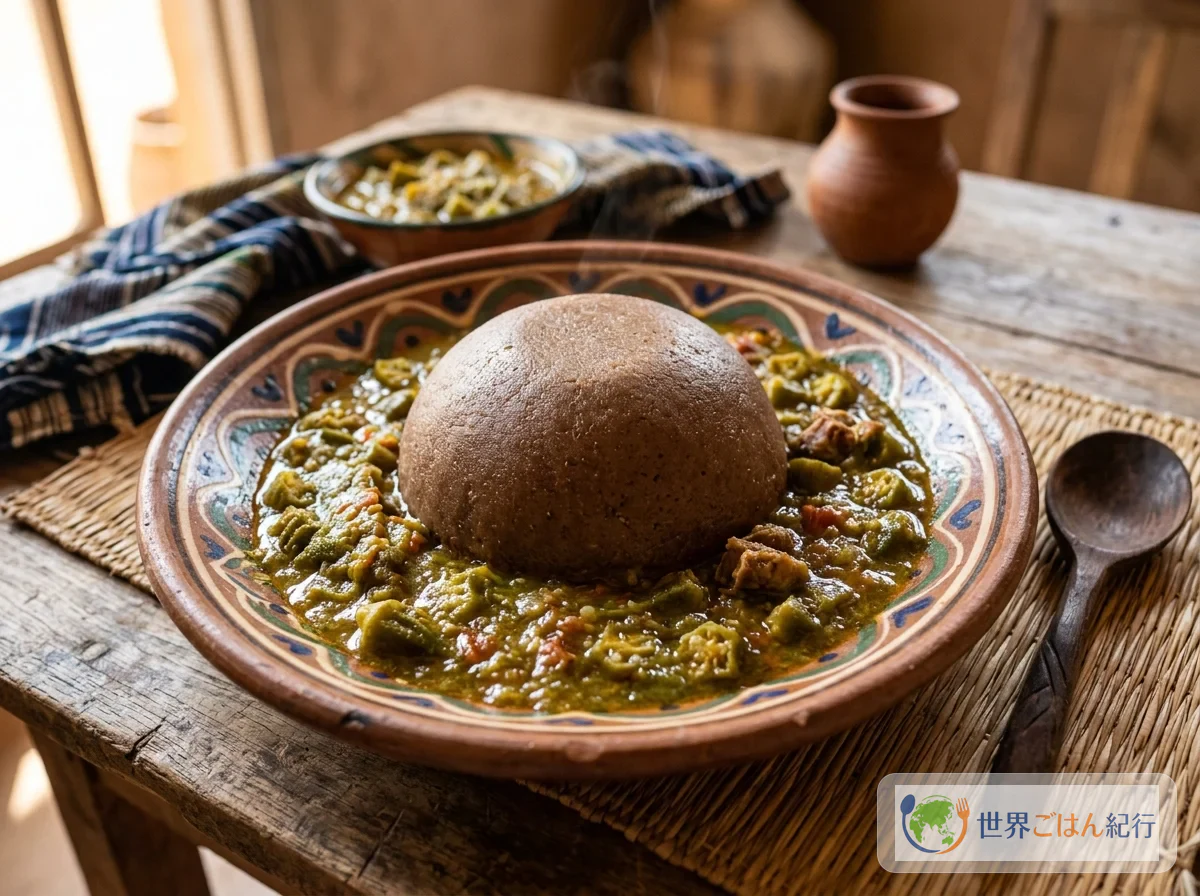
Take the kneaded tô off the heat and pack it into bowls or small dishes rinsed with water. In Burkina Faso it is served in gourd bowls called calabashes, but small bowls or teacups work. Wet the wooden spoon, press the tô to the rim of each bowl to remove air, and smooth the surface flat. Aim for a round dome about 7–8 cm across and 4–5 cm high. Turn it out onto a plate and you have a flat base and a smooth rounded top. For four servings, make four domes.
5Cut the okra sauce ingredients and sauté the aromatics
15 min
Trim the stems off the okra and cut into 0.25 inch (5 mm) rounds. The more finely it is chopped, the stickier the sauce, so mince it if you like a sticky sauce. Soak the dried fish in lukewarm water for 10 minutes, then flake it. If you use dried anchovies, remove heads and innards and tear them by hand.
Roughly chop the tomatoes. Mince the garlic and onion. Set the soumbala (or miso) in a small dish.
Put 3 tbsp palm oil in a heavy pot and heat over medium heat for 2 minutes. Add the onion and cook 5 minutes, then once translucent add the garlic and cook 1 more minute until fragrant.
6Add the tomatoes and okra and simmer
15 min
Add the tomatoes to the sautéed aromatics and cook for 5 minutes, crushing them with a wooden spoon. When the tomato moisture has cooked off and it forms a paste, add the okra.
Add the flaked dried fish, soumbala (or miso), bouillon cube, and chili, pour in ¾ cup (200 ml) water, and mix well. Cover and simmer over low heat for 10 minutes. The okra releases its slime and thickens the sauce. Taste and adjust with salt.
Controlling the okra's slimeThe thickness from okra is the lifeblood of Burkinabè sauces. To bring out the most stickiness, cover and steam-simmer after adding the okra. To keep it more restrained, keep cooking with the lid off. Heat for 10 minutes or more, since the okra's mucilage is released with cooking time and moisture.
7Serve
5 min
Place a dome of tô in the center of a plate and ladle plenty of okra sauce around it. The Burkinabè way is to tear off a piece of tô with the right hand, dip it in the sauce, and eat. Cutting off bite-size pieces with a spoon and coating them with sauce is just as good.