Ingredients and steps on one page. Print it, or choose “Save as PDF” in the print dialog.
Sekai Gohan
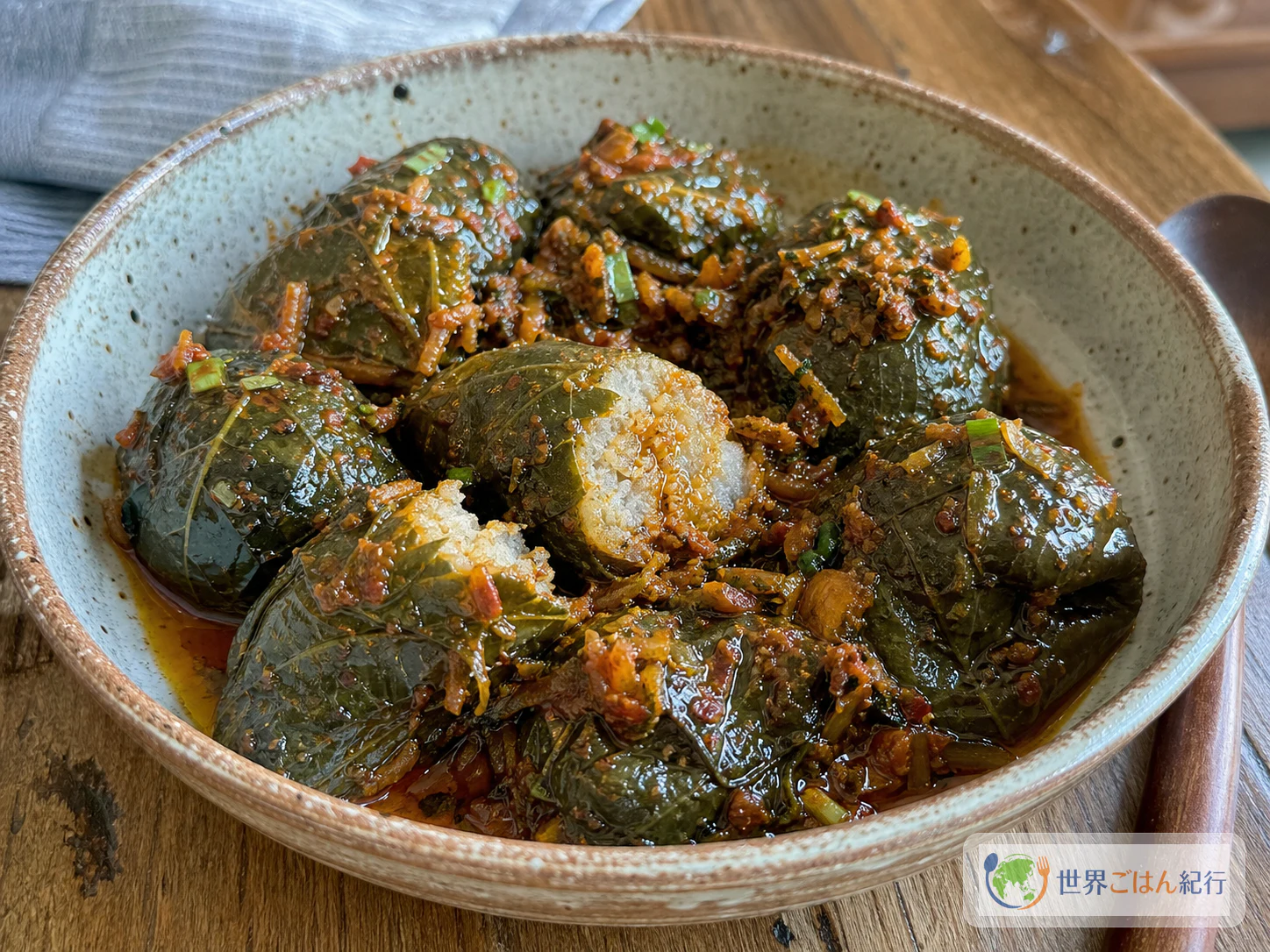
Ekpang Nkukwo Recipe: Leaf-Wrapped Taro Dish from Coastal Cameroon and Nigeria
Ingredients
The leaf packets
| Ingredient | Amount | Substitutes & notes |
|---|---|---|
| Taro | 2 lb (900 g) unpeeled, about 1.5 lb (650 g) peeled | Large ones if possible. Frozen taro releases water and makes the packets loose |
| Large leaves of komatsuna or bok choy | 24–30 | For spinach choose large leaves. Use torn leaves for the bottom of the pot |
| Potato starch | 1–2 tbsp | Only when the taro is watery |
| Salt | 1/3 tsp | For the taro paste |
| White pepper | 1/4 tsp | Black pepper also works |
For simmering
| Ingredient | Amount | Substitutes & notes |
|---|---|---|
| Dendê oil (edible red palm oil) | 3 tbsp | If the aroma is too strong, reduce to 2 tbsp and add 1 tbsp rice bran oil |
| Rice bran oil or canola oil | 1 tbsp | Makes the dendê oil less likely to scorch |
| Onion | 1/2 (3.5 oz / 100 g) | Finely chopped |
| Garlic | 2 cloves | Finely chopped |
| Scallions | 2 | Sliced thin. Keep a little for finishing |
| Dried shrimp | 25 g | Crush coarsely. If very salty, soak in water for 5 minutes and drain |
| Chili | 1/2, or 1/8 tsp chili flakes | Don't make it too hot. Keep it mild so people can add more at the table |
| Water or light chicken stock | 2¾ cups (650 ml) | Start with enough to cover about 70% of the packets |
| Salt | from 1/2 tsp | Adjust at the end, watching the saltiness of the dried shrimp |
| Bay leaf | 1 | Omit if you have none |
| Lime or lemon | 1/4 | A few drops at the end. Cuts the heaviness |
Steps
1Blanch the leaves until soft enough to wrap
10 min
Choose 24 to 30 large leaves and shave down the thick part of the stem with a knife. Boil about 1.5 quarts (1.5 L) water in a pot, add 1/2 tsp salt, and blanch the leaves for only 30 to 40 seconds. Keep the heat high, enough that the water doesn't stop boiling. When the leaves turn a deep green and are soft enough not to crack when folded, move them to cold water and wipe off the moisture. Torn or small leaves are laid on the bottom of the pot later.
2Grate the taro into a sticky paste
15 min
Wearing gloves, peel the taro, lightly rinse off the sliminess and wipe dry. Grate coarsely on a grater or in a food processor, and mix in 1/3 tsp salt, the white pepper and 1 tbsp of the crushed dried shrimp. No heat is used. If the paste falls slowly when scooped with a spoon, use it as is. If it spreads watery, mix in 1 tbsp potato starch, and if it is still loose add just 1 tbsp more.
3Place taro on a leaf and roll it long and thin
20 min
Lay a leaf shiny side down and place a heaping 1 tsp of taro paste a little toward you from the center. Fold in the left and right sides lightly and roll from the near side to the far side into a long thin packet. If made thick, the heat doesn't reach the center, so make it about the thickness of two thumbs. If the leaf is small, overlap two. Arrange the rolled packets seam side down on a tray.
4Slowly cook the aromatics in dendê oil
5 min
Put 2 tbsp dendê oil and 1 tbsp rice bran oil in a heavy pot and warm over medium-low heat for 1 minute. Add the onion, garlic and chili and cook for 3 minutes in quiet oil at about 160 °C (320 °F). Stop before the onion turns translucent and before the garlic browns. When the aroma of the red oil rises, lay torn or small leaves thinly on the bottom of the pot.
5Layer the packets and add water along the side of the pot
10 min
Arrange the packets radially on the bottom of the pot, and when the first layer is filled sprinkle on a little of the remaining dried shrimp. Stack a second layer the same way and place the bay leaf on top. Pour in 2¾ cups (650 ml) water or light chicken stock quietly along the side of the pot. It is enough if about 70% of the packets are covered. Raise to medium heat and warm for 8 to 10 minutes until small bubbles appear. A hard boil moves the packets and unrolls them.
6Simmer over low heat without moving them
25 min
As soon as it boils, lower to low heat, set the lid slightly ajar, and simmer for 25 minutes. The heat is such that only the edge of the pot bubbles quietly. Don't stir partway. When you want to move the flavor around, hold the lid down and tilt the pot lightly left and right. After 20 minutes take out just one, slice the packet 0.5 inches (1 cm) thick, and check whether the root at the center is translucent and fluffy, not a white raw batter. The sauce should flow slowly when you tilt the pot and cling in a light thickness to the surface of the packets.
7Adjust the oil and salt to finish
8 min
Drizzle in the remaining 1 tbsp dendê oil and add the scallions. Keep the heat low and cook 5 minutes, and taste when the sauce has gone slightly thick. Add salt 1/4 tsp at a time, stopping short of exceeding the saltiness of the dried shrimp. Turn off the heat and let it sit 3 minutes, and plate once the leaves and root have settled. A few drops of lime or lemon at the end soften the heaviness of the oil.