Ingredients and steps on one page. Print it, or choose “Save as PDF” in the print dialog.
Sekai Gohan
Fufu Recipe: What Fufu Is and How to Make Ghanaian Fufu at Home
Ingredients
Fufu
| Ingredient | Amount | Substitutes & notes |
|---|---|---|
| Cassava (peeled, frozen, for home cooking) | 500 g | About 1.1 lb. An edible product with heating instructions on the label. In the basic version, don't mix it with taro |
| Green plantains | 2 (about 400 g edible flesh) | About 14 oz. Weigh after peeling. Don't substitute ordinary ripe bananas |
| Salt | 1/4 tsp | Just enough to season lightly |
| Water (boiled separately) | 3–6 tbsp | Add 1 tbsp at a time while pounding. Don't use the cooking water |
| Water (for boiling the roots) | About 2 L | About 8 1/2 cups. Enough to keep the roots submerged; discard after use |
Before adding salt or water, pierce the roots with a fork. They're ready when no firmness remains at the center and they crush when pressed. Don't add all 6 tbsp of water at the start: mash first, then add 1 tbsp at a time while checking how the dough holds together. The soup carries the seasoning, so there's no need to add spices or sugar to the fufu.
Chicken light soup
| Ingredient | Amount | Substitutes & notes |
|---|---|---|
| Bone-in chicken thighs | 500 g | About 1.1 lb. Buy them already chopped into pieces. If boneless, cut into 3–4 cm (about 1 1/4–1 1/2 in) cubes |
| Ripe tomatoes | 4 (about 400 g) | Or 400 g canned diced tomatoes |
| Onion | 1 (about 200 g) | Half for the paste, half thinly sliced |
| Garlic | 4 cloves | 2 cloves to season the meat, 2 for the paste |
| Fresh ginger | 15 g | Half for seasoning the meat, half for the paste |
| Habanero or Scotch bonnet | 1/2–1 | For less heat, 1–2 small dried red chiles. The heat and aroma are not the same |
| Tomato paste | 2 tbsp | Ketchup adds sweetness |
| Water | 1.5 L | About 6 1/3 cups. If it reduces too much, add 100 ml at a time |
| Salt | Up to 2 tsp | 1 tsp to season the meat, the rest a little at a time at the end. Account for the salt in the bouillon |
| Dried shrimp | 2 tbsp | Crush finely for savory depth. Optional |
| Bouillon cube | 1 | Check ingredients and sodium. If omitted, adjust with salt at the end |
| Okra | 6 | A home-style option added at the end. Leave out if you want a thinner broth |
The "light" in light soup refers to the light body of the broth. It doesn't mean mild in flavor. The tomato, the ginger, the stock from the meat and the chile all stay in: a thin broth that keeps its aromatics is what defines this soup. Don't thicken it with starch, and don't overdo the okra. Prekese is an aromatic made from the fruit of Tetrapleura tetraptera, a plant in the legume family; it is not fermented lobster. It isn't required here, and the dried shrimp is used as a separate source of savory flavor.
To serve
| Ingredient | Amount | Substitutes & notes |
|---|---|---|
| Hard-boiled eggs | 2 | Halved, 1/2 egg per person. Optional |
| Avocado | 1 | Sliced and served on a separate plate. Optional |
Steps
1Prepare the roots and aromatics
15 min
This takes 15 minutes and uses no heat. Follow the product's instructions for thawing the cassava. Remove the tough fibrous core from the peeled edible cassava, then cut it into pieces of roughly 1–2 inches (3–5 cm). Peel the green plantains and cut them into 1 inches (3 cm) thick rounds. Coarsely chop the tomatoes and thinly slice half the onion. Put the tomatoes, the other half of the onion, 2 cloves garlic, half the ginger and the chile into a blender. Run it for 1–2 minutes, until you have a paste with no coarse chunks. To reduce the heat, use less chile. For a whole chile instead, simmer it and remove it, but don't combine that with the paste method.
2Season the chicken
5 min, plus 10 min resting in the refrigerator
This takes 5 minutes, plus 10 minutes in the refrigerator to let the flavors settle in. No heat is used. Sprinkle 1 lb (500 g) bone-in chicken thighs with 1 tsp salt, then grate in 2 cloves garlic and half the ginger and rub them in. Cut boneless meat into 1–1.5 inches (3–4 cm) cubes; use bone-in pieces as they were chopped when you bought them. Once the aromatics have coated the surface of the meat, don't leave the seasoned meat at room temperature for long; put it in the refrigerator. Wash hands and tools that touched raw meat, and don't serve the finished fufu on an unwashed dish.
3Simmer the light soup
About 40 min
This takes about 40 minutes. Put the chicken and 1.5 L water in a pot, bring to a boil over high heat and skim off the scum. Reduce to medium, and simmer for 15 minutes with the liquid bubbling gently at the sides of the pot. Then add the tomato paste and stir for 1 minute until it dissolves with no lumps. Add the vegetable paste, the sliced onion, the crushed dried shrimp and the bouillon. Simmer over medium to medium-low heat for 20 minutes. It's on track when the raw bite of the onion has faded, the broth has turned red and the meat is tender. If it reduces too much, add water 100 ml at a time. If using okra, cut it into 1–2 cm pieces, add it at the end and simmer for 3 minutes, until tender but still holding a little of its shape. Insert a clean thermometer into the thickest part of the chicken and check that it reaches 75°C (167°F) for at least 30 seconds. Don't let the tip touch the bone. Never decide the meat is cooked by color or juices alone. Add the remaining salt a little at a time, up to 1 tsp. The bouillon already contains salt, so taste before adding the rest.
4Boil the cassava and plantain
25–30 min
Plan on 25–30 minutes. If your product has pretreatment or cooking instructions, follow those first. Bring about 2 quarts (2 L) water to a boil in a pot, add the cassava and boil over medium to medium-high heat for 10 minutes. Add the plantain and boil for another 15–20 minutes. Keep the ingredients well submerged and the heat high enough to maintain a steady boil. They're done when a fork slides into the center without resistance and they crush when pressed. If they're still hard after cooking as directed, add 5 minutes at a time. Tenderness doesn't tell you the toxins are gone. Discard the cooking water and have clean water boiled separately for pounding.
5Mash and knead while hot
10 min
Plan on about 10 minutes. No heat is used. Put the hot, drained roots into a deep bowl and mash them with a masher or wooden spatula. Add 1/4 tsp salt, then add separately boiled water 1 tbsp at a time. Use 3–6 tbsp in total, adjusted to the state of the dough. Repeat mashing, turning with the spatula and pressing to knead, until it becomes a smooth mass with no visible lumps that springs back when pressed. Never add a lot of water at once. As long as lumps remain, keep mashing and kneading. Don't knead the hot dough with bare hands; use tools. Only press it together by hand once it's cool enough to handle.
6Divide into four and shape
3–5 min
This takes 3–5 minutes and uses no heat. Wet a clean small bowl with water and divide the dough into 4 equal portions. Once it's cool enough to handle, roll each portion with wet hands or by swirling it inside the bowl to form a ball about 8–10 cm across. It's ready when the surface is smooth and it doesn't immediately slump flat on the plate. While it's still hot, shape it with the bowl and spatula, not bare hands.
7Serve with the soup
2 min
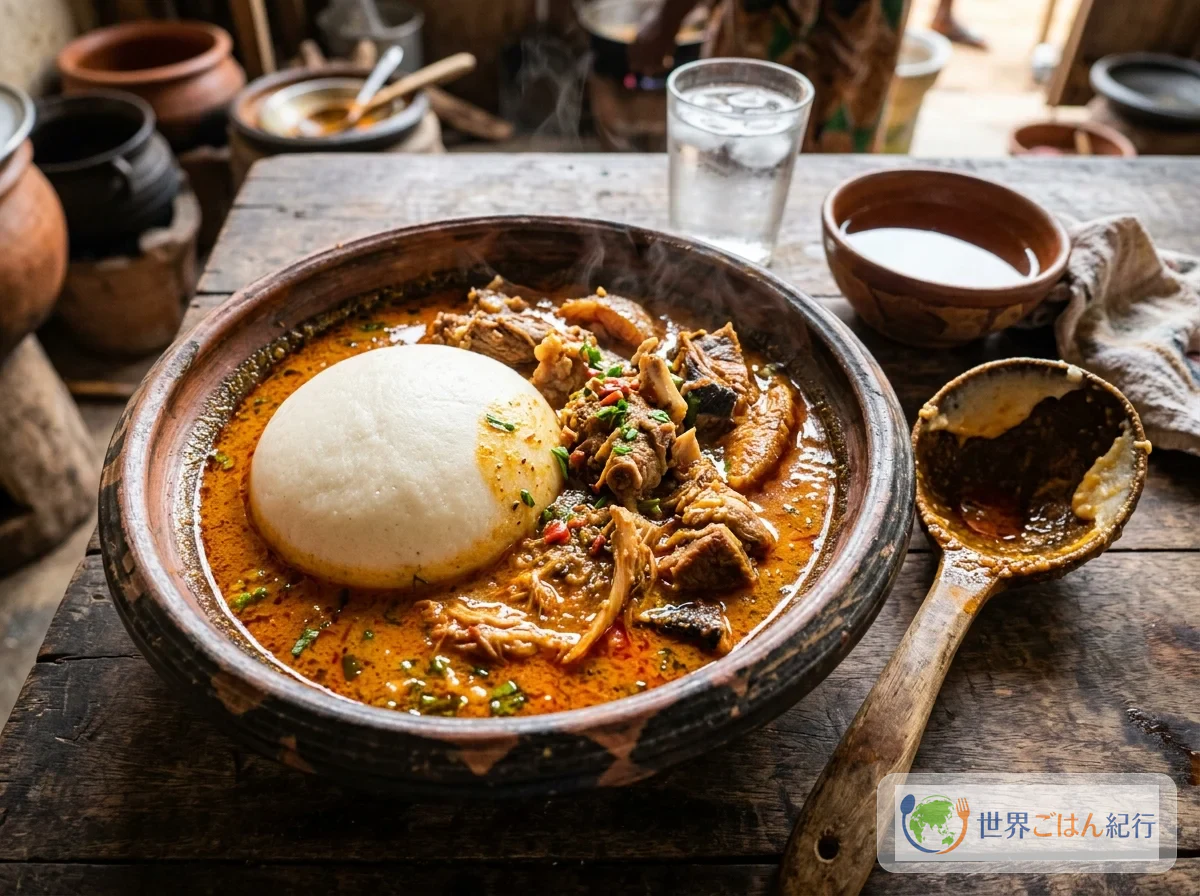
This takes 2 minutes, with the heat off. Ladle hot soup into deep bowls and set the fufu in the center. Divide the chicken into 4 portions; if using eggs, allow 1/2 egg per person. Start with enough soup to cover the lower half of the fufu, and keep the rest on hand so everyone can add more. Don't put your hands into broth or dough that's too hot; wait until it's at an edible temperature and eat a little at a time.