Ingredients and steps on one page. Print it, or choose “Save as PDF” in the print dialog.
Sekai Gohan
Taguella: Tuareg Sand-Baked Flatbread of the Sahara
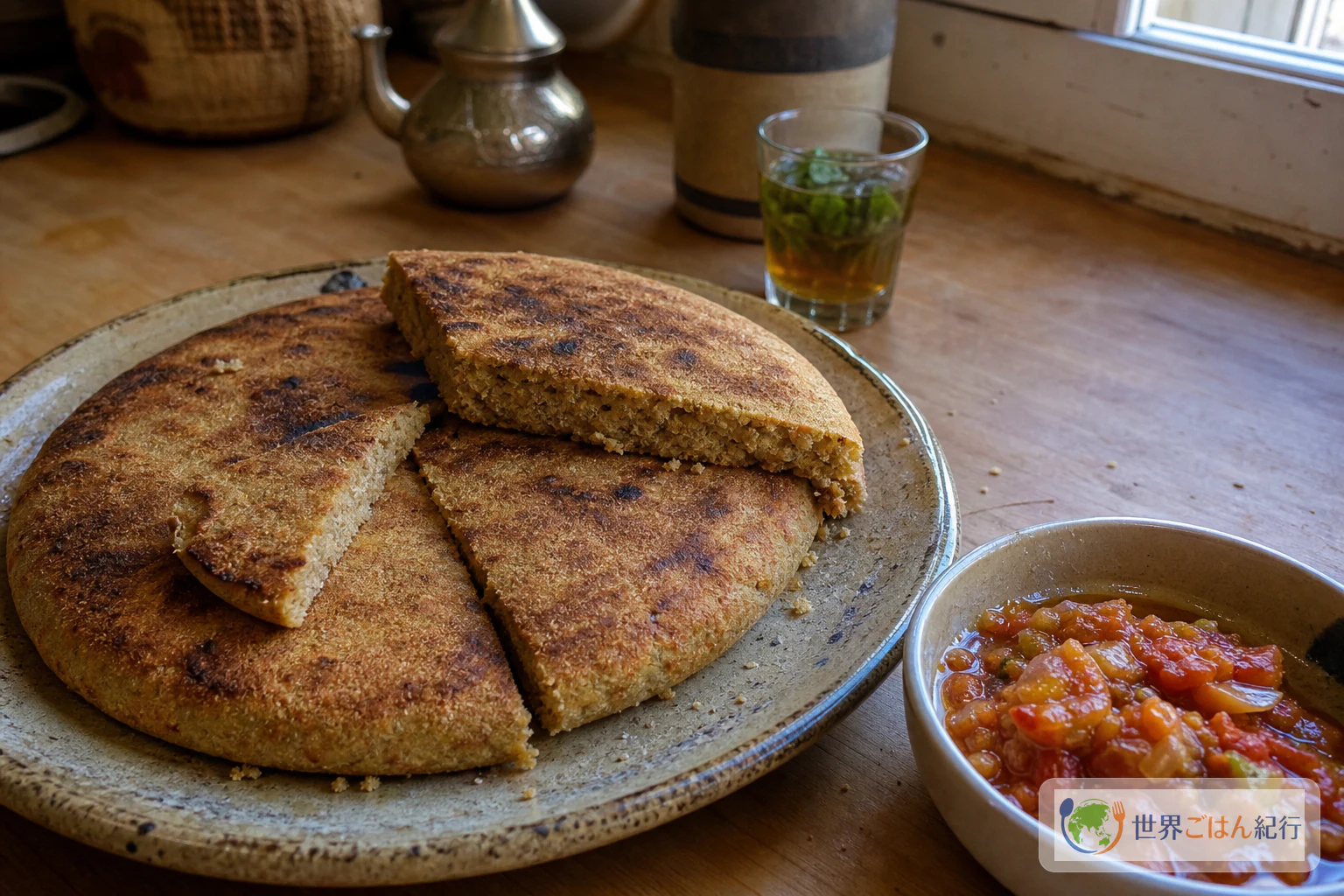
Ingredients
| Ingredient | Amount | Role |
|---|---|---|
| All-purpose flour | 260 g | The base of the dough. Cake flour alone cracks easily, so use all-purpose or half bread flour and half cake flour |
| Atta or finely milled whole wheat flour | 80 g | Adds wheat aroma and a rustic color. Ordinary whole wheat flour can also be used |
| Fine semolina | 60 g | Gives a grainy density. If you have none, increase the all-purpose flour by the same amount |
| Salt | 6 g | A little over 1 tsp. Brings out the sweetness of the flour |
| Lukewarm water | 230 ml | 35–40°C (95–104°F). Add 210 ml first and use the other 20 ml to adjust firmness |
| Semolina or all-purpose flour for dusting | 15 g | Dust the counter lightly when shaping |
| Water for finishing | 30 ml | Used to lightly brush off surface flour after baking |
Steps
1Combine the flour and salt
5 min
No heat is used. Put 9 oz (260 g) all-purpose flour, 2.75 oz (80 g) atta, 2 oz (60 g) fine semolina, and 6 g salt in a large bowl and mix 1 minute, scooping from the bottom with your fingers. The flour should be one even color with no grains of salt left in one spot. Breaking up lumps here shortens the kneading time after the water goes in.
2Add water a little at a time and bring it together
8 min
No heat is used. Add 1 cup (210 ml) of 35–40°C lukewarm water in 3 additions, drawing the flour together with your fingertips. It is fine if it is crumbly at first. Only if dry flour remains at the bottom after 5 minutes of kneading, add more lukewarm water 2 tsp (10 ml) at a time. Aim for a dough a little firmer than an earlobe that takes a shallow crack when pressed with a finger.
3Knead to even out the density
15 min
No heat is used. Turn the dough out and keep pressing with the heel of your hand and folding it back for 10 minutes. The surface need not be perfectly smooth; fine cracks are fine. What matters is that streaks of dry flour disappear and the color of the cross-section is even when you break it. If it is sticky, don't add dusting flour; rest it 2 minutes and then resume.
4Cover and rest
25 min
No heat is used. Form the dough into a ball, return it to the bowl, cover with a dry cloth, and rest 25 minutes at a room temperature of about 77°F (20–25°C). This is the time for the semolina and whole wheat to absorb water. Go on when a finger press leaves a shallow dent and the cracks on the surface don't widen much. Rushing it makes the edge split badly when shaping and leaves the center heavy after baking.
5Shape into a thick disk
8 min
No heat is used. Dust the counter lightly with 15 g flour and press the dough with your palms into a disk 8.5 inches (22 cm) across and about 1 inches (2–2.5 cm) thick. Too thin and it loses the density of taguella; too thick and heat doesn't reach the center. If the edge tears, pinch it closed with a wet finger, and press uneven thick spots from the center outward to even them out.
6Preheat the pot and oven
20 min
Set the oven to 425°F (220°C). Put the Dutch oven or heavy cast-iron pot in with its lid and preheat at 425°F (220°C) for 20 minutes. If baking on just a tawa or iron frying pan, preheat 5 minutes over medium-low heat and have a lid ready. You should feel strong heat when you bring a hand near the pot walls, without smoke. This is where you build the dry top-and-bottom heat that replaces sand baking.
7Bake one side to dry the surface
15 min
Oven at 425°F (220°C). Take out the hot pot, put in the dough, and cover. Bake 12 minutes in the 425°F (220°C) oven, then open the lid and check that the surface is white and dry and the edge is firm without puffing too much. On a tawa, bake covered 10 minutes over medium-low heat. If you smell only the bottom burning, the heat is too high; lower it.
8Flip and cook through to the center
18 min
Oven at 425°F (220°C), finishing with the lid off. Flip the dough with a spatula and bake 8–10 minutes at 425°F (220°C) with the lid off. It is done when the surface has mottled browning, the sides feel springy when pressed, and no white streaks of raw flour show when you break the center. If using a thermometer, aim for 199–205°F (93–96°C) at the center. Take it out, rest 5 minutes, and lightly brush off excess surface flour with a cloth dampened with 2 tbsp (30 ml) water.