Ingredients and steps on one page. Print it, or choose “Save as PDF” in the print dialog.
Sekai Gohan
Dholl Puri: Mauritian Split Pea-Filled Flatbread with Rougaille and Butter Bean Curry
Ingredients
Bean filling
| Ingredient | Amount | Substitutes & what to check |
|---|---|---|
| Yellow split peas | 6.5 oz (180 g) | Chana dal also works. Red lentils release more moisture |
| Water | 3 cups (700 ml) | For cooking the beans. Set aside ½ cup (150 ml) of the cooking liquid |
| Salt | 1/2 tsp | Added when cooking the beans |
| Turmeric | 1/2 tsp | Color and earthy aroma. Without it the yellow of the beans is weaker |
| Cumin seeds | 1 tsp | Toast before using. If ground, adjust starting from 3/4 of the amount |
| Black pepper | a little | Only when you want extra heat. Omit for children |
Dough
| Ingredient | Amount | Substitutes & what to check |
|---|---|---|
| All-purpose flour | 300 g | All bread flour tends to turn out tough. 240 g all-purpose plus 60 g whole wheat also works |
| Salt | 1/2 tsp | For the dough |
| Reserved bean cooking liquid | 150 ml | Cool to about 40°C (104°F) |
| Lukewarm water | 40–80 ml | Add a little at a time depending on how the flour absorbs |
| Neutral oil | 1 tbsp | Rice bran or light sesame oil also work |
| Flour for dusting | as needed | Too much makes the surface powdery |
Accompaniments
| Ingredient | Amount | Role |
|---|---|---|
| Butter beans (cooked) | 7 oz (200 g) | A bean curry in the style of cari gros pois. White beans also work |
| Tomatoes | 3 | For rougaille. Fully ripe gives a rounded acidity |
| Onion | 1 | Half each for the curry and rougaille |
| Garlic | 1 clove | For rougaille. Omit if you dislike it |
| Ginger | 10 g | For rougaille. Grated |
| Green chili | 1 | Omit to taste, or remove the seeds |
| Cucumber or carrot achar | as needed | Adds acidity and crunch. Store-bought is fine |
Steps
1Wash the beans and soak for 30 minutes
30 min
Put 6.5 oz (180 g) yellow split peas in a bowl and wash 2 to 3 times, changing the water. Once the powdery feel on the surface is gone, soak them in plenty of water for 30 minutes. If the room is hot in summer, soak them in the refrigerator. Drain when the bean corners are rounded when pinched and, when split with a fingernail, a little hard core remains in the center. Soaking overnight makes them too soft to turn into a powder filling.
2Cook the beans and set aside some of the liquid
20–25 min
Put 3 cups (700 ml) water, 1/2 tsp salt, 1/2 tsp turmeric and the soaked beans in a pot and bring to a boil over medium heat. Once boiling, lower to medium-low and simmer for 15 to 20 minutes with the surface barely trembling. Turn off the heat when the beans split when pressed with a finger but keep their outline, before the liquid turns yellow and cloudy. Set aside ½ cup (150 ml) of the cooking liquid, then drain the beans in a sieve and spread them in a thin layer on a wide plate. Leave for 10 minutes until the steam is gone, letting extra moisture escape.
3Grind the beans to a dry powder
10 min
Put 1 tsp cumin seeds in a dry skillet and toast over low heat for 1 to 2 minutes, rolling them, until fragrant. Put them with the cooled beans in a grinder or food processor and grind until you have a mix of fine crumbs and powder. Don't add water. The filling is ready when it holds together when pinched and crumbles when dropped on the counter. Divide into 8 and press lightly into small balls about 1 inch (2.5 cm) across. If large grains remain, grind briefly once more so they don't break through the rolled dough.
4Knead the dough with the bean liquid and rest
40 min
Cool 150 ml of the bean cooking liquid to about 40°C (104°F). Put 300 g flour, 1/2 tsp salt and 1 tbsp oil in a bowl, add the liquid and mix. While it is still floury, add only 40 ml lukewarm water. Knead with the palm of your hand for 5 to 7 minutes, until the flour grains are gone and the dough springs back slowly when pressed. Only if it doesn't come together, add lukewarm water 2 tsp at a time. Cover with a dry kitchen towel and rest 30 minutes at room temperature, then divide into 8 after resting.
5Wrap the beans in the dough and seal
15 min
Press each piece of dough out to 3 inches (8 cm) across and make a slight dip in the center. Place 25 to 30 g of bean filling on each, lift the edge and gather it at the top, and pinch the seam closed with your fingers. It's important not to leave air between the dough and the filling, but don't squash it hard and turn the beans into a paste. Place seam side down, cover with a cloth and wrap the rest the same way. If you used warm filling, rest 10 minutes even after wrapping to let the dough surface settle.
6Roll thin to 20–22 cm across
15 min
Dust the counter lightly with flour and set the dough seam side down. Press from the center outward with your palm, then roll briefly with the rolling pin to 20 to 22 cm (8 to 9 in) across and 2 to 3 mm thick. Rather than pressing hard in one direction, turn it 90 degrees each time and the circle keeps its shape. Bean grains showing through the surface are fine as long as there is no hole. If a hole opens, press it shut with your finger and cook it without rolling any thinner. Too much dusting flour scorches on the tawa, so brush off the excess by hand.
7Cook on the tawa 60–90 seconds per side
20 min
Preheat the tawa or heavy skillet over medium heat for 3 minutes. Test the heat: a drop of water on the surface should sizzle and disappear in 2 to 3 seconds. Lay the dough down and cook 60 to 90 seconds per side. Flip when small bubbles appear on the surface and light brown color and spots show on the underside. Cook the flipped side another 60 to 90 seconds, and brush on about 1/4 tsp oil thinly only if dry areas remain. If the heat is so strong that it darkens in about 30 seconds, drop to medium-low, and if spots don't appear, go back to medium temporarily. Wrap each finished dholl puri in a cloth so it doesn't dry out until the next one is done.
8Stack two and serve with curry
5 min
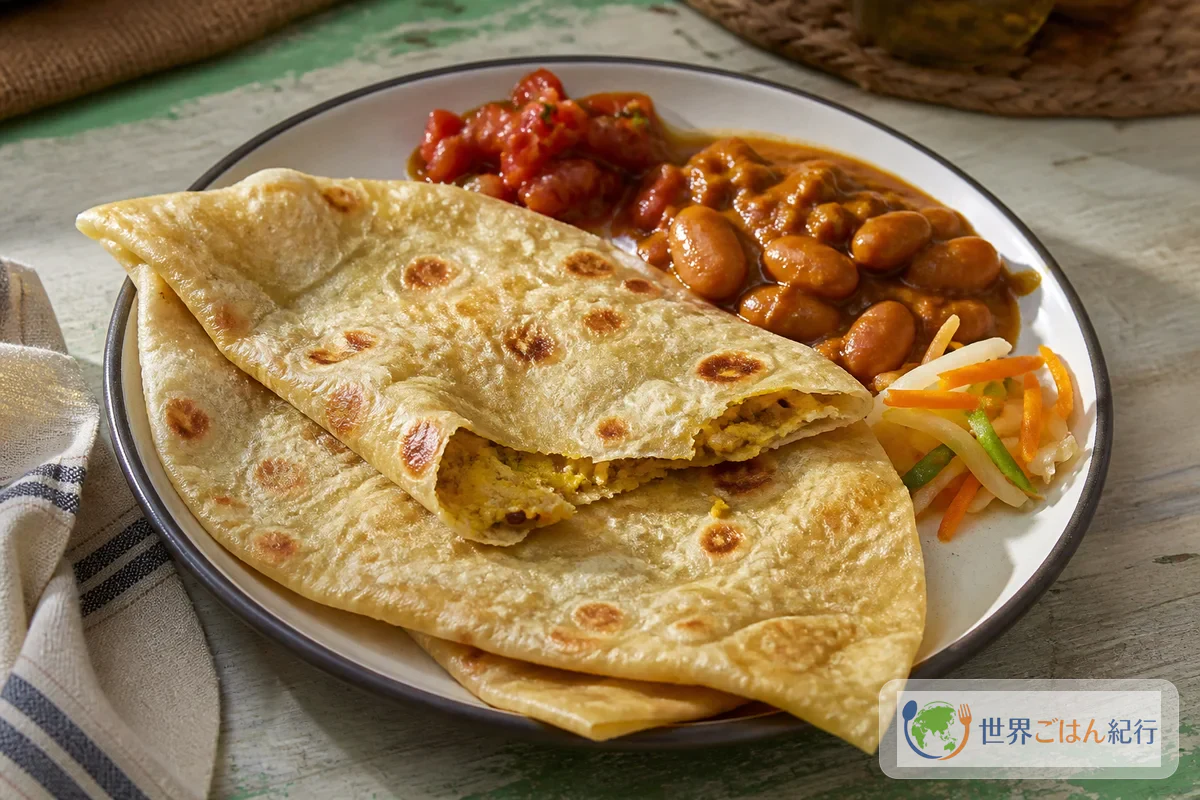
Stack two cooked pieces and serve with butter bean curry, rougaille and achar. You can also put a little curry on one piece and fold it, but sandwiching it between two lets the juices reach the whole dough so you taste the bean filling and the tomato's acidity together. Freshly cooked, the surface is supple; as it cools, the folds crack easily. Keep it covered with a cloth until just before it goes to the table.