Ingredients and steps on one page. Print it, or choose “Save as PDF” in the print dialog.
Sekai Gohan
Harcha: Moroccan Semolina Flatbread with a Crumbly Grain
Ingredients
Dough
| Ingredient | Amount | Substitutes & notes |
|---|---|---|
| Fine semolina | 9 oz (250 g) | A fine grind that still keeps grains of durum wheat. Do not replace it entirely with cake flour |
| Unsalted butter | 3.5 oz (100 g) | Melted before use. Don't simply swap in the separate oil-and-water formula |
| Milk | ½ cup (100 ml) | Keep another 1.5 tbsp (20 ml) ready for adjustment and add it 1 tsp (5 ml) at a time |
| Granulated sugar | 25 g | The sweetness of the dough. Serve sweet toppings on the side |
| Baking powder | 3 g | About 3/4 tsp. Don't simply swap in baking soda |
| Salt | 1.5 g | About 1/4 tsp. Weigh it, because the weight changes with grain size |
For shaping and serving
| Ingredient | Amount | Substitutes & notes |
|---|---|---|
| Semolina | 15 g | For dusting. Fine is fine. Do not add leftover dusting semolina to the dough |
| Jam | 1.5 oz (40 g) | A suggestion for serving 4. Not included in the nutrition estimate |
| Cheese | 2.75 oz (80 g) | When served in place of jam. Not included in the nutrition estimate |
Steps
1Work the melted butter into the flour
5 min
Put 9 oz (250 g) semolina, 25 g sugar, 3 g baking powder, and 1.5 g salt in a bowl and mix. Melt 3.5 oz (100 g) butter in a small pot over low heat, without boiling it or browning it. Cool it until you can handle it with your hand, then add it to the flour. Mix with a spoon until the whole thing is like damp sand. Moisten the grains evenly so no dry lumps of flour remain. Do not pull the dough or knead it long. Also avoid adding the milk first.
2Mix in the milk and rest
5 min
Add ½ cup (100 ml) milk and mix about 2 minutes, gather it into one mass, and rest it 5 minutes at room temperature. After 5 minutes, press it. It is ready when it holds its shape and does not flow. If it is dry and cracks, add milk 1 tsp (5 ml) at a time, up to 1.5 tbsp (20 ml) in total, and after each addition wait 1 minute and check again. The rest lets the flour absorb moisture; there is no yeast to ferment.
3Shape the dough into 8 rounds
8 min
Spread 15 g dusting semolina on parchment and divide the dough into 8 equal pieces. Press each by hand into a round about 3.5 inches (9 cm) across and 7 to 8 mm thick. Even it out so there are no thick spots. You don't need a cutter. If small cracks appear at the edge, pinch them together with your fingers. Don't add a lot of flour to stiffen the dough.
4Cook both sides over low heat
20–40 min
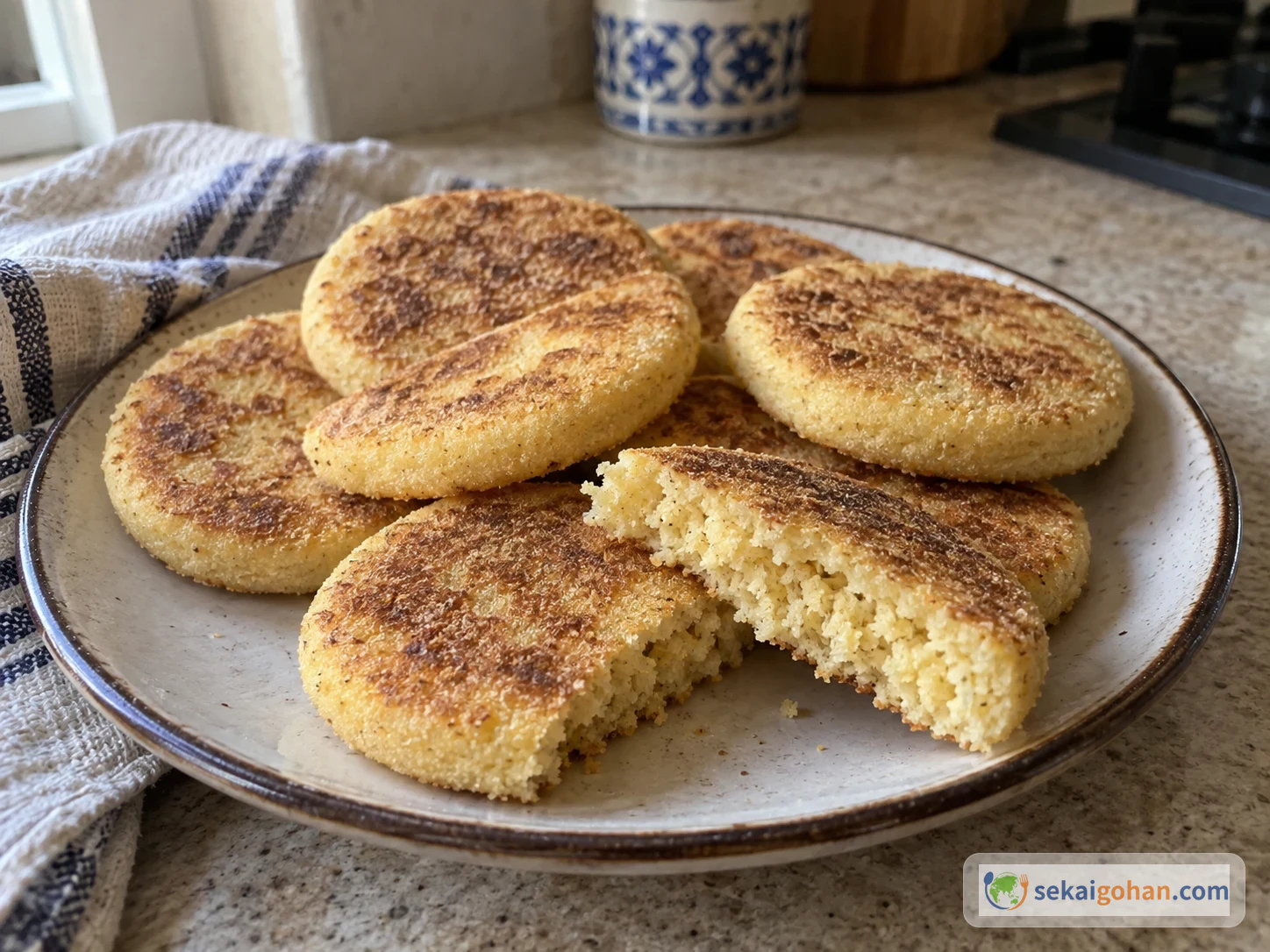
Preheat the skillet over medium-low heat for about 2 minutes, then lower to low before putting in the dough. Do not add extra oil. Use the spatula to lift only the dough from the parchment into the skillet; the parchment is not heated. Arrange 4 at a time and cook 5 to 10 minutes on one side, then flip and cook 5 to 10 minutes more. Cook 5 to 10 minutes a side; two batches together take 20 to 40 minutes. When the color goes from pale golden to medium golden and the surface and edges are dry and hold their shape, slide the wide spatula under and flip. Flip only once.
If it quickly turns dark brown, the heat is too high. Take it off the heat for a moment to lower the temperature, then continue over low heat. Before the second batch, remove any scorched grains left in the skillet, and don't add dough to an overheated pan.
To check doneness, let one piece cool a little and break it open. If there is no damp pasty dough at the center and the cross-section is a mass of grains, it is done. If the center is still raw, return it to low heat and add 1 to 2 minutes per side, then check again. Scorching cannot be fixed by continuing to cook.