Ingredients and steps on one page. Print it, or choose “Save as PDF” in the print dialog.
Sekai Gohan
Msemen Recipe: Morocco's Layered Flatbread
Ingredients
| Ingredient | Amount | Substitutes and use |
|---|---|---|
| All-purpose flour | 10.5 oz (300 g) | Less likely to spring back than bread flour alone, and less likely to tear than cake flour alone. If using cake flour, hold back 1.5 tbsp (20 ml) water to adjust |
| Fine semolina | 7 oz (200 g) | Fine-ground durum semolina. Do not substitute coarse couscous |
| Salt | 8 g | Mix evenly into the dough. Do not leave it out even with sweet accompaniments |
| Lukewarm water | 1¼ cups (300 ml) plus 1.5 tbsp (25 ml) if needed | About 30–35°C. Add 1 tsp (5 ml) at a time depending on how the flour absorbs |
| Mild vegetable oil | ¼ cup (80 ml) | Canola or rice bran oil, etc. Used for the work surface and for folding |
| Unsalted butter | 1.5 oz (45 g) | Soften at room temperature. To avoid dairy, replace with ¼ cup (80 ml) oil |
| Fine semolina (for folding) | 2 oz (60 g) | 1–2 tsp per piece. Scatter between the layers |
| Honey, amlou, olive oil, and so on | To taste | Served alongside after cooking. Amlou contains almonds |
Steps
1Bring flour and water together and give the first rest
10 min + 10 min rest / no heat
Put 10.5 oz (300 g) all-purpose flour, 7 oz (200 g) fine semolina, and 8 g salt in a bowl and mix with a whisk for 30 seconds. Pour in 270–280 ml of the 1¼ cups (300 ml) lukewarm water, mix from the bottom with your fingertips or a spatula, and stop when the dry flour has nearly disappeared. Because firmness changes with the flour brand, keep the reserve 1.5 tbsp (25 ml) water back.
When it comes together as a single, rough mass with streaks of flour here and there, cover the bowl with plastic wrap and leave it for 10 minutes. If you add water or flour in an attempt to make a smooth bread dough before resting, it becomes hard to adjust later. If dry flour remains on the bottom after 10 minutes, add the reserve water 1 tsp (5 ml) at a time and press it together.
2Knead until elastic, divide into 8, and rest
15 min + 30–45 min rest / no heat, around up to 77°F (20–25°C) room temperature
Move it to the work surface and, pushing forward with the heel of your hand, then folding it back, continue for 10–15 minutes. It is kneaded when the surface is nearly smooth and a fingerprint slowly springs back. You do not need to force it to a thin membrane, but if the pinched part tears right away, knead 3 minutes more.
Divide the dough into 8 equal portions and weigh each at about 3.5 oz (100 g). Round them with a taut surface, set them on a plate or tray lightly coated with oil, and coat each with oil. Cover with plastic wrap or a well-wrung damp cloth so they do not dry, and rest at room temperature for 30–45 minutes. You can move on when the dough spreads without resistance when pressed and the fingerprint does not spring back suddenly.
This rest is not for rising with yeast; it is time to settle the water in the flour and the tension of the gluten. On days when the room is cold, there is no need to warm it in a proofer.
3Stretch the dough thin and add fat and semolina
5 min per piece / no heat
In a small bowl, mix part of the ¼ cup (80 ml) vegetable oil with 1.5 oz (45 g) softened unsalted butter. Lightly oil the work surface and your hands, and set down just one rested portion. Press the center with your palm and pull the edges outward with your fingertips, spreading it into a thin sheet about 35–40 cm across. Go by thinness as well as size.
Make it thin enough that the color of the surface shows through beneath the dough, but do not pull so hard that you make holes. Put about 1 tsp of the fat in the center and spread it thinly over the whole with a brush or your fingers. Over that, scatter 1–2 tsp of the fine semolina for folding. If you pile the flour in one place, the layers become thick only there, so scatter it evenly to the edges.
If the dough springs back and rounds up, do not keep applying force; leave it for 5 minutes where it is and then stretch again. Adding dry dusting flour leaves white streaks after cooking and dilutes the fat between the layers.
4Fold left and right, then top and bottom, and rest the square
5 min + 10–15 min rest / no heat
Fold the left and right sides of the thin dough toward the center by a third each to make a long strip. Fold the lower third of the strip to the center and finally lay the upper third over it, and you have a square containing layers. If a corner is off, rather than pulling it straight with your fingertips, press the surface lightly to even out the thickness.
Set it fold-side down on a lightly oiled tray and finish the other 7 pieces in the same order. Cover with a cloth and rest 10–15 minutes. If you skip this rest, the folds spring back when you press them out, and the bread comes out thick only in the center.
If stuffing, put about 2 tsp of cooled filling in the center at this stage. Watery or hot fillings leak out at the seams, so do not use them. For your first time, make it plain, so you can check the layers and adjust the flour and heat.
5Spread to up to 8 inches (18–20 cm) and cook both sides over medium heat
3–4 min per piece / medium heat, surface around up to 375°F (170–190°C)
Heat a flat frying pan or a tava over medium heat for about 2 minutes. Spread the square of dough by hand to up to 8 inches (18–20 cm) and up to 0.25 inch (4–5 mm) thick and move it onto the hot surface without breaking the folds. As it cooks, keep it to where the surface dries smooth and turns golden while the layers in the middle still keep some softness. You do not need to pour on more oil, but on a dry iron plate brush on a very thin coat.
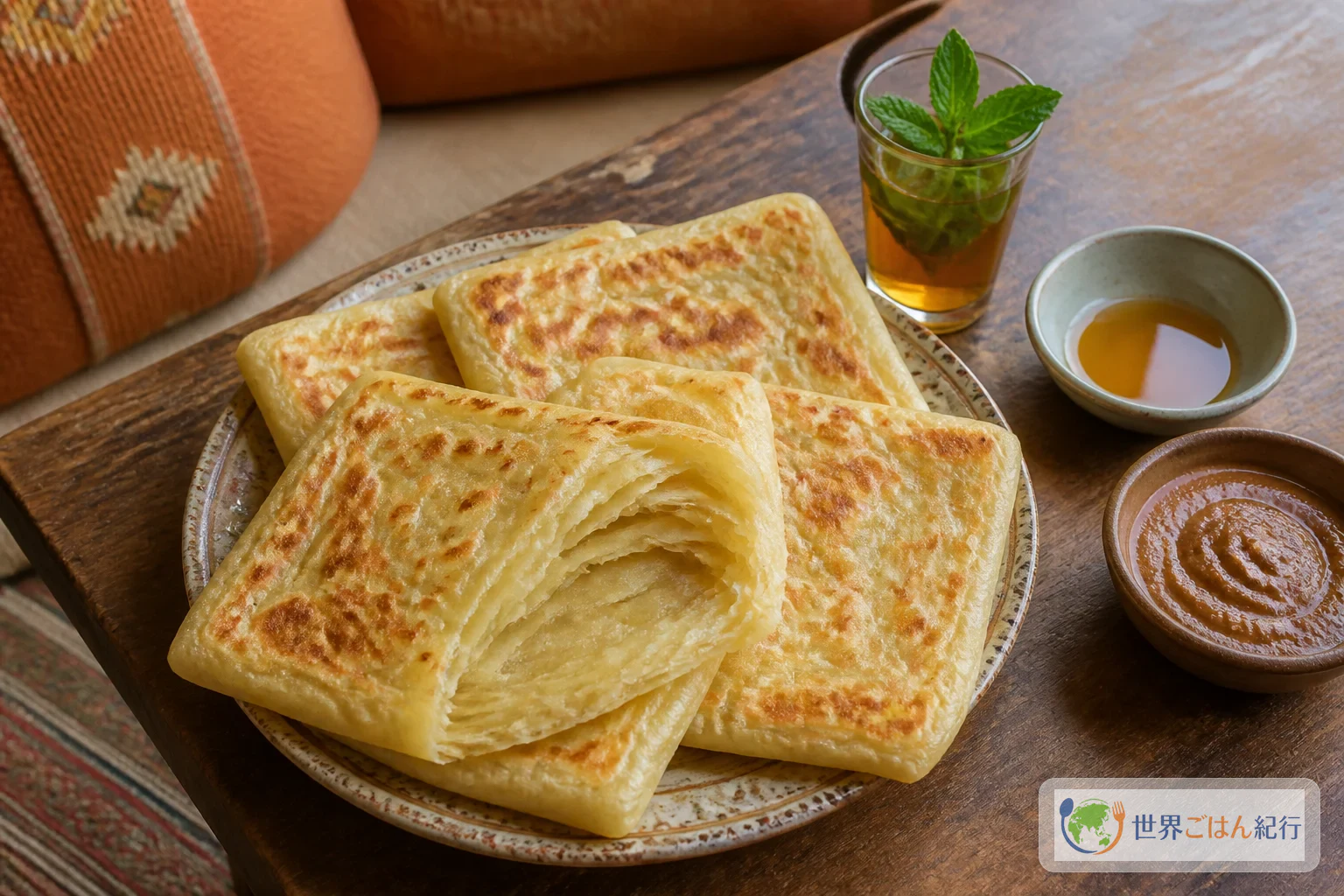
Cook one side for 30–60 seconds, and turn it after watching how the color develops. After that, turn it every 30–60 seconds for a total of 3–4 minutes, and it is done when golden to light brown spots have spread across the surface and no raw white line remains at the sides. If only the center puffs up, do not press it hard with the spatula; turn it once to seat it against the cooking surface and shift its position slightly.
If the color darkens within 30 seconds, the heat is too high. Lower to medium-low and let the heat reach the thick center slowly. Conversely, if it is still white after 4 minutes, the cooking surface is not hot enough or the dough is too thick.
6Release steam on a rack and serve while warm
5 min / no heat
Move the cooked msemen to a rack rather than stacking them on a plate. Leave them about 5 minutes to let surface steam escape, so heat does not get trapped and soften the layers. Just before eating, lay a cloth loosely over them to keep them from drying out as they cool.
Lift an edge lightly with your finger, and if the thin layers separate into several sheets, that is the sign that the fat and semolina worked. Do not pour honey or amlou over them just before they are done; put them in small dishes so the toastiness of the surface and the texture inside are kept.