Ingredients and steps on one page. Print it, or choose “Save as PDF” in the print dialog.
Sekai Gohan
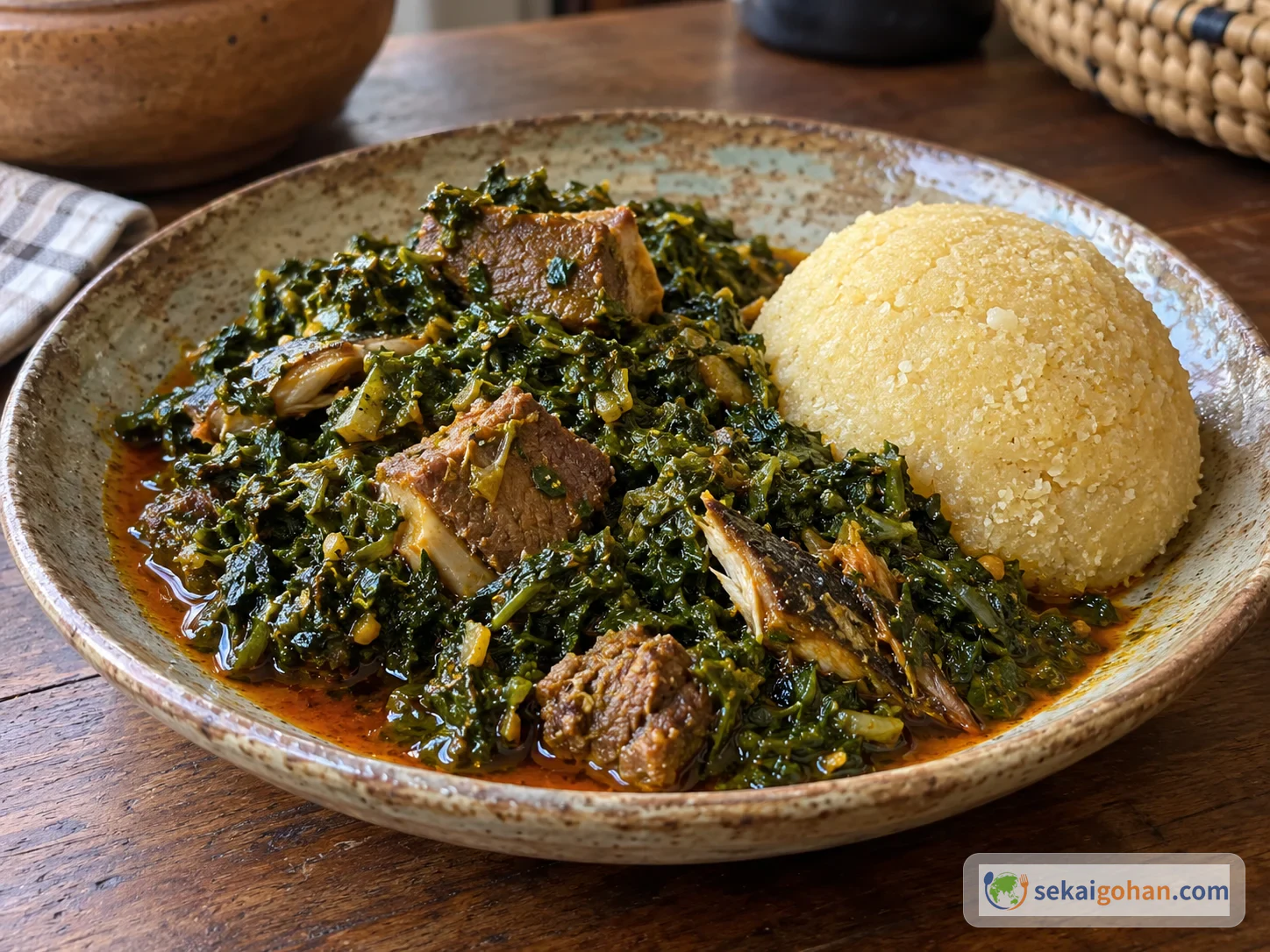
Afang Soup: Southern Nigerian Leafy Green Stew with Beef, Dried Fish and Red Palm Oil
Ingredients
Leaves and aromatics
| Ingredient | Amount | Substitutes & notes |
|---|---|---|
| Afang/okazi leaves (fresh, shredded) | 14 oz (400g) | Rehydrate dried leaves as the bag says, then check firmness and amount. Don't convert fresh weight to dried weight |
| Waterleaf | 9 oz (250g) | If you can't get it, use 9 oz (250g) lamb's lettuce or 9 oz (250g) spinach. Moisture and stickiness differ |
| Onion | 1.5 oz (40g) | Mince very fine |
| Chili | 2–5g | The standard version uses 15g Cameroon pepper, which is very hot. Start small and adjust |
| Ogiri | 15g (optional) | The fermented seasoning in the standard version. Skip it the first time. Add it later, once you know how strong the aroma is |
Meat, seafood and broth
| Ingredient | Amount | Substitutes & notes |
|---|---|---|
| Beef shank or beef shoulder | 1 lb (450g) | Cut into 3–4 cm cubes. Chicken thighs cook faster and give a lighter aroma |
| Stockfish or hard dried fish | 2.5 oz (70g) | Check for bones. Rehydrate as the label says, if the product needs it |
| Dried shrimp / crayfish | 2 tbsp | If it's powdered, check saltiness and grain size |
| Periwinkle (sea snail, prepared) | 2.75 oz (80g), optional | Omit if you can't get it. Don't use it if you have a shellfish allergy |
| Water or beef cooking liquid | 1¾ cups (400ml) | Start with a small amount, and adjust until the beef is tender and broth remains after the leaves go in. This amount is set for this recipe |
Oil and seasoning
| Ingredient | Amount | Substitutes & notes |
|---|---|---|
| Edible red palm oil | ¾ cup (200ml) | Designed to the lower end of the local recipe's 20 to 25 cl. To lighten the aroma, reduce to as little as ½ cup (150ml), but color and richness change |
| Salt | from 5g | Adjust at the end by the saltiness of the dried fish, dried shrimp, stockfish and ogiri. The standardized example is 5g |
| Stock cube | 1 | An ingredient from All Nigerian Recipes. Cubes differ in saltiness by product, so don't add all the salt first |
Steps
1Wash the leaves, shred them fine and manage the moisture
15 min
No heat is used. Wash the waterleaf, drain it, and shred it 2 to 3 mm wide. Shred fresh afang/okazi finely in one direction, or crush it coarsely with a small amount of water. Rehydrate dried leaves as the bag says, then squeeze them hard. Aim for fine ribbons that don't drip when squeezed in your hand. If too much water comes out, press with paper towels, and add less water when the leaves go in the pot.
TipCut 2 to 3 mm wide, but don't make a complete paste. If you use a blender, use only a small amount of water, and don't blend until it becomes a green liquid. Cut thick pieces of leaf finer, or they stay hard in the mouth even after the last 5 minutes of cooking.
2Simmer the beef and stockfish in a small amount of water
30–35 min
Put 1 lb (450g) beef, half the finely chopped onion, the stock cube and 1¾ cups (400ml) water in a pot over medium heat. When it boils, skim and lower to low heat. Rinse the stockfish, 2.5 oz (70g), as the label says, if the product needs it, and add it once a skewer slides through the beef. Then simmer 5 more minutes. When a skewer passes through the beef and about 100 to 150ml of broth remains, it's going well. Check for small fish bones. If the broth is about to run out, add 3.5 tbsp (50ml) boiling water at a time before it does, and don't scrape the scorched bottom. Cook the beef until the center reaches 167°F (75°C) for at least 1 minute.
3Make the dried shrimp, chili and onion fine
5 min
No heat is used. Grind 2 tbsp dried shrimp to a coarse powder, chop the chili, and finely chop the remaining 1.5 oz (40g) onion. Large pieces of dried shrimp season only part of the pot, and if you grind them too far and they get damp, they stick to the bottom. You're ready when the onion is 2 to 3 mm and the dried shrimp is a coarse powder that crushes under a finger. If the powder gets damp, grind fresh dried shrimp just before it goes in the pot. If you avoid crustaceans, leave out the dried shrimp and use only the fish and beef stock.
4Build the aromatic base in red palm oil
7 min
Keep the heat medium-low. Warm ¾ cup (200ml) red palm oil in a pot, and add the onion, chili and dried shrimp before it smokes. Cook until the onion turns translucent, the aroma of the dried shrimp rises, and the oil is a deep red-orange. Use fine bubbles, not smoke, as your signal. When fine bubbles rise and there's no smoke or burnt, bitter smell, move on. If smoke appears, turn off the heat, take the pot off the burner, and start over. Don't use the scorched aromatics, and don't try to save them by scraping.
CautionDon't heat red palm oil until it smokes. Putting in moist onion makes the oil spatter, so wear long sleeves and work with your face away from the pot. Also avoid pouring a lot of water directly into a pot of oil; add the beef cooking liquid a little at a time after lowering the heat.
5Return the beef, fish and broth to the aromatic oil
10 min
Bring it to a boil once over medium heat, then go back to medium-low right away. Add the beef, stockfish and remaining broth from step 2 to the pot from step 4, and add the periwinkles here if using them. You're there when the oil no longer floats alone on the surface, a red-orange broth thinly coats the wooden spoon, and the meat and oil have come together. If the oil separates, stir over low heat until the foam settles. If the broth is too thick, add boiling water 1 tbsp at a time. Remove bones and shell fragments now.
6Add the leaves, simmer briefly and set the salt
7–10 min
The heat is medium-low. When the pot boils, add the waterleaf, the afang/okazi, and the ogiri if using, in that order, and turn once from the bottom with a wooden spoon. Simmer 3 to 5 minutes after the leaves sink, about 5 minutes in all. You're done when the afang is tender, the color of the leaves hasn't dulled too far, and the broth doesn't pool but leaves the trail of the wooden spoon briefly. Add salt at the end, and check that the center of the meat and the seafood are cooked through. If it's watery, take off the lid and cook off moisture over medium-low heat for only 3 to 5 minutes. If the leaves are still hard, add 3.5 tbsp (50ml) boiling water, then simmer 2 minutes at a time and check.
7Serve with a staple and check the thickness of the pot
5 min
Turn off the heat and rest the pot 5 minutes. Serve with eba, semolina fufu, cassava fufu, amala, pounded yam, or plain white rice. Ideally, a little red palm oil floats on each plate, and the leaves, beef and fish fit into one mouthful. You can eat it with a spoon the first time, but since this dish is scooped up with the staple, check the thickness. If the broth still spreads after resting, return it to the pot, take off the lid, and cook it down over medium-low heat for 2 to 3 minutes.