Ingredients and steps on one page. Print it, or choose “Save as PDF” in the print dialog.
Sekai Gohan
Jollof Rice: West Africa's Tomato-Red One-Pot Rice, Nigerian Style
Ingredients
Tomato base (blended)
| Ingredient | Amount | Substitutes & notes |
|---|---|---|
| Canned diced tomatoes | 1 can (14 oz / 400 g) | 5–6 ripe fresh tomatoes also work. If they taste very sharp, add a pinch of sugar |
| Red bell pepper | 1 (5.5 oz / 150 g) | The source of jollof's sweetness and body. Don't skip it |
| Onion | 1/2 (3.5 oz / 100 g) | For the blender, separate from the onion you'll sauté |
| Habanero or Scotch bonnet | 1/2–1 | The core of the heat. If you can't find one, use 3 small dried red chiles plus 1 tsp ground red chile |
| Garlic | 3 cloves | — |
| Ginger | 1 knob (15 g) | — |
For cooking the rice
| Ingredient | Amount | Substitutes & notes |
|---|---|---|
| Long-grain rice (basmati or jasmine) | 2 rice cups (300 g) | 1 Japanese rice cup = 180 ml. Short-grain rice isn't suitable; use a long-grain rice that isn't sticky |
| Onion, thinly sliced | 1 (200 g) | For sautéing |
| Tomato paste | 3 tbsp | Key for color and savory depth |
| Vegetable oil (or peanut oil) | 4 tbsp | Palm oil is traditional. Peanut oil works too |
| Chicken bouillon | 1 cube | Maggi cubes are the classic choice in West Africa. Any bouillon cube is fine |
| Bay leaves | 2 | — |
| Dried thyme | 1 tsp | Or 3–4 sprigs fresh thyme |
| Curry powder | 1 tsp | Curry powder is a standard seasoning in Nigeria |
| Paprika | 1 tsp | For color and sweetness |
| Salt | 1 tsp, then to taste | — |
| Water | 200 ml | About 3/4 cup plus 1 tbsp. Adjust depending on how wet your tomato base is |
Steps
1Make the tomato base
5 min
Remove the stem and seeds from the red bell pepper and cut it into chunks. Cut the 1/2 onion into chunks too. Put the canned tomatoes, bell pepper, onion, 3 cloves garlic, the knob of ginger and the habanero (seeds and all) in a blender and blend until completely smooth. Aim for a fully smooth purée after 30 seconds to 1 minute.
A silky purée with no bits left gives you evenly colored rice. A food processor works if you don't have a blender. If your blender struggles, add about 2 tbsp water to help it along.
2Sauté the onion and reduce the tomato base
30 min
In a heavy pot (ideally a Dutch oven), heat 4 tbsp oil over medium heat and sauté the sliced onion for 8–10 minutes, until golden brown. Stir now and then so it doesn't burn.
Once the onion is golden, add 3 tbsp tomato paste and fry for 2–3 minutes. When the paste turns from a dark brick red to a bright red and the oil starts to separate from it, it's ready. Frying the paste well is the foundation of jollof's color and flavor.
Now pour in all of the blended tomato base. Cook over medium-high heat for 15–20 minutes, until you can see the bottom of the pot when you stir. As you stir with a spatula and cook off the liquid, the base concentrates, the onion and tomato blend together and oil rises to the surface. You're looking for a heavy sauce that clings to the spatula, where a line drawn across the bottom of the pot holds for about 5 seconds. Reducing it until oil floats on top is what makes or breaks jollof rice.
Cook off the tomato's acidityIf the base isn't reduced enough, the finished rice will taste sour. The ideal thickness is when a line traced across the bottom of the pot with a spatula doesn't close for 5 seconds. Fresh tomatoes hold more water, so extend the reducing time to 25–30 minutes if you use them.
3Add the spices and rice
5 min
Add 1 tsp curry powder, 1 tsp thyme, 1 tsp paprika, 2 bay leaves, 1 bouillon cube and 1 tsp salt to the reduced tomato base and mix well. Taste it at this point: it should seem a little too salty, because the rice will absorb the salt along with the liquid.
Drain the 2 cups of long-grain rice, which you've rinsed and soaked for about 30 minutes, and add it to the pot. Stir thoroughly from the bottom so every grain is coated in the tomato base. Add 200 ml water and stir everything once more before covering.
Use long-grain riceShort-grain rice such as Japanese Koshihikari is too sticky for jollof rice. It turns out mushy, without the separate, fluffy grains you want. Use basmati or jasmine rice, available at most supermarkets, international grocers and online.
4Seal with foil and the lid, then cook
30 min
This is the most important step in jollof rice. Lay a sheet of aluminum foil snugly over the pot and put the lid on top. This extra step traps all the steam inside.
Turn the heat down to low and cook for 25–30 minutes without lifting the lid even once. Fold the foil down along the rim of the pot and trim any part sticking out from under the lid to about 1 inch (2–3 cm). If you open the lid partway through, steam escapes and the rice won't cook properly. After about 10 minutes, you should start to smell the sweet aroma of tomato.
How to get the crispy bottomThe real treat in jollof rice is the thin toasty layer on the bottom of the pot. In Nigeria it is called "bottom pot," and it is prized for its toasty flavor, much like the socarrat of a paella. Turn the heat up to medium for only the last 5 minutes of cooking and a thin, crisp crust will form on the bottom. To avoid burning it, turn off the heat as soon as you hear it start to crackle.
5Rest and finish
10 min
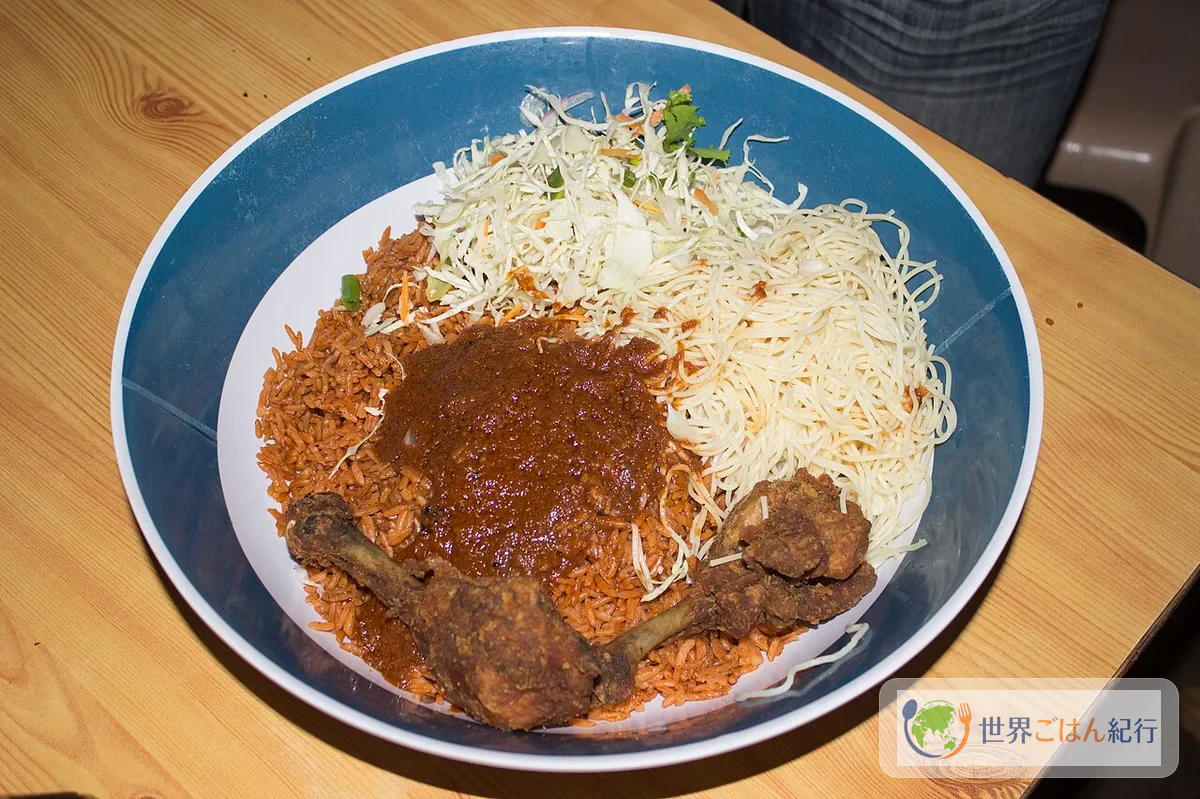
Turn off the heat and let the rice rest, covered, for 10 minutes. When you remove the lid and foil after resting, the aroma of spices rises with the red-tinged steam. If the grains are evenly red and there's no liquid left at the bottom of the pot, you've nailed it. Fluff the rice gently with a fork. A fork rather than a rice paddle keeps the grains whole and separate.
Remove the bay leaves, taste, and add a little salt if needed. Spoon onto plates and serve.
When you open the lid, the rice should be evenly red with every grain separate. If you see a lot of white grains, use a bit more tomato base next time.