Ingredients and steps on one page. Print it, or choose “Save as PDF” in the print dialog.
Sekai Gohan
Thieboudienne Recipe: Senegal's National Dish of Fish, Vegetables, and Tomato Rice
Ingredients
Fish and basics
| Ingredient | Amount | Substitutes & notes |
|---|---|---|
| White fish (whole or fillets) | 1 lb (500 g) (2–3 pieces) | Sea bream is best. Swordfish, sea bass, or cod also work. Authentic versions use thiof, a prized local fish |
| Vegetable oil | 4 tbsp | Authentic versions use palm oil (huile de palme). Substitute a neutral sesame oil or canola oil. Olive oil is too strongly flavored and not suitable |
| Onion (large) | 2 | 1 finely chopped (for the rof), 1 cut in wedges (for the stew) |
| Garlic | 6 cloves | Half goes in the rof and half in the broth |
| Tomato paste | 4 tbsp (about 2.5 oz / 70 g) | Canned tomato paste. Not ketchup (it contains sugar) |
| Water | 1.5 quarts (1.5 L) | If you can get fish heads or bones, make a stock first for a much better result |
| Salt | 2 tsp | Adjust at the end |
| Black pepper | 1/2 tsp | Coarsely ground |
Rof: the spice paste
| Ingredient | Amount | Substitutes & notes |
|---|---|---|
| Italian parsley | 1 bunch (1 oz / 30 g) | Authentic versions use flat-leaf parsley (persil plat). Curly parsley also works, but Italian parsley has a softer aroma |
| Garlic | 3 cloves | Grated or pasted |
| Scotch bonnet pepper | 1/2 | Substitute habanero or 3 dried red chilies. Authentic thieboudienne is spicy. If you do not like heat, use 1 dried chili |
| Dried shrimp (powdered) | 1 tbsp | The key to the savory depth. Substitute 1 tbsp bonito flake powder if you have none |
| Bouillon cube | 1 | Stock cubes are a staple in Senegal. A consomme cube also works |
| Salt | 1/2 tsp | — |
Vegetables (adapt to the season)
| Ingredient | Amount | Substitutes & notes |
|---|---|---|
| Cabbage | 1/4 | Cut into 4 wedges. In Senegal, a cabbage is cut whole into quarters |
| Carrots | 2 | Cut thick (halve crosswise, and halve thick ones lengthwise) |
| Eggplant | 2 | Remove the stem and halve lengthwise. Close to the bitter eggplant (jaxatu) used in Senegal |
| Okra | 6 | Remove only the stem and add whole |
| Sweet potato | 1 (7 oz / 200 g) | Cut into 1 inches (3 cm) rounds. Authentic versions use cassava (manioc). The sweetness of sweet potato is surprisingly good |
| Pumpkin | 7 oz (200 g) | Cut into 1 inches (3 cm) cubes. Authentic versions use pumpkin (giraumon) too |
Rice
| Ingredient | Amount | Substitutes & notes |
|---|---|---|
| Rice | 3 rice-cooker cups (450 g) | Ordinary white rice is fine. For more authenticity, use Thai broken rice. After washing, drain for 30 minutes |
Steps
1Make the rof
5 min
Coarsely chop the Italian parsley leaves and put them in a food processor (or mortar) with 3 cloves garlic, 1/2 Scotch bonnet (seeded), the dried shrimp powder, 1 bouillon cube, and 1/2 tsp salt, and grind to a paste. If it is too dry, add 1 tbsp water. A bright green paste means it is right.
2Stuff the fish with rof
Make 3–4 slits about 1 inches (2 cm) deep on both sides of the fish. Press half of the rof into the slits with your fingers. Set aside the remaining rof for the broth. Sprinkle the fish with a little salt and leave at room temperature for about 15 minutes.
3Pan-fry the fish
10 min
Heat 4 tbsp oil in a large pot (5 liters or more) over medium-high heat. Add the fish and cook each side for 3–4 minutes until golden brown. The fish breaks easily, so turn it only once. Once browned, take it out onto a plate. This oil becomes the base of the broth, so do not wash the pot.
4Make the sofrito
10 min
In the same pot's oil, cook 1 finely chopped onion over medium heat for 5 minutes. When translucent, add 3 cloves minced garlic and cook 1 minute, then add 4 tbsp tomato paste. Keep cooking 3–4 minutes until the paste blends with the oil and its raw smell turns sweet. Then add all the remaining rof and stir for 30 seconds.
5Simmer the vegetables
30 min
Pour in 1.5 quarts (1.5 L) water and bring to a boil over high heat. Add the vegetables that take longest to cook first: carrots, sweet potato, and pumpkin. When it boils, lower to medium heat and simmer for 15 minutes. Then add the eggplant, cabbage, and okra and simmer 15 minutes more. When the vegetables have taken in the flavor of the broth, remove all the vegetables whole and keep them warm on a plate.
6Return the fish to pass on its flavor
10 min
Return the fried fish to the broth left after the vegetables are removed. Simmer on low heat for 10 minutes to let the fish take in the broth. Do not stir; simmer quietly so the fish does not break. After 10 minutes, gently take the fish out as well and add it to the plate of vegetables. The fish is done when its surface has taken on the broth's red oil, the center is warm, and the flesh is plump again. Keep the broth at a small, gentle bubble and do not let it boil hard, so the fish does not break.
7Cook the rice
25 min
Taste the broth and adjust with salt and pepper. It is important that it is well seasoned at this point (the rice absorbs the savoriness of the broth, so slightly strong is right). Put 3 cups of washed and drained rice directly into the broth. Ideally the broth sits 1–2 cm above the surface of the rice. Add water if short. Bring to a boil over high heat, lower to low, cover, and cook for 20–25 minutes. Do not lift the lid during that time. It is done when the rice has absorbed all the liquid and a crust (xoon) has formed on the bottom of the pot.
The crust is the best part of thieboudienneThe browned crust on the bottom of the pot (xoon in Wolof, pronounced "shon") is the most prized part of thieboudienne. Carefully peel off the crisp layer of rice and serve it for a textural accent. To make the crust, raise the heat to medium for the last 5 minutes of cooking, and when you hear crackling, turn off the heat and steam for 5 minutes.
8Serve
5 min
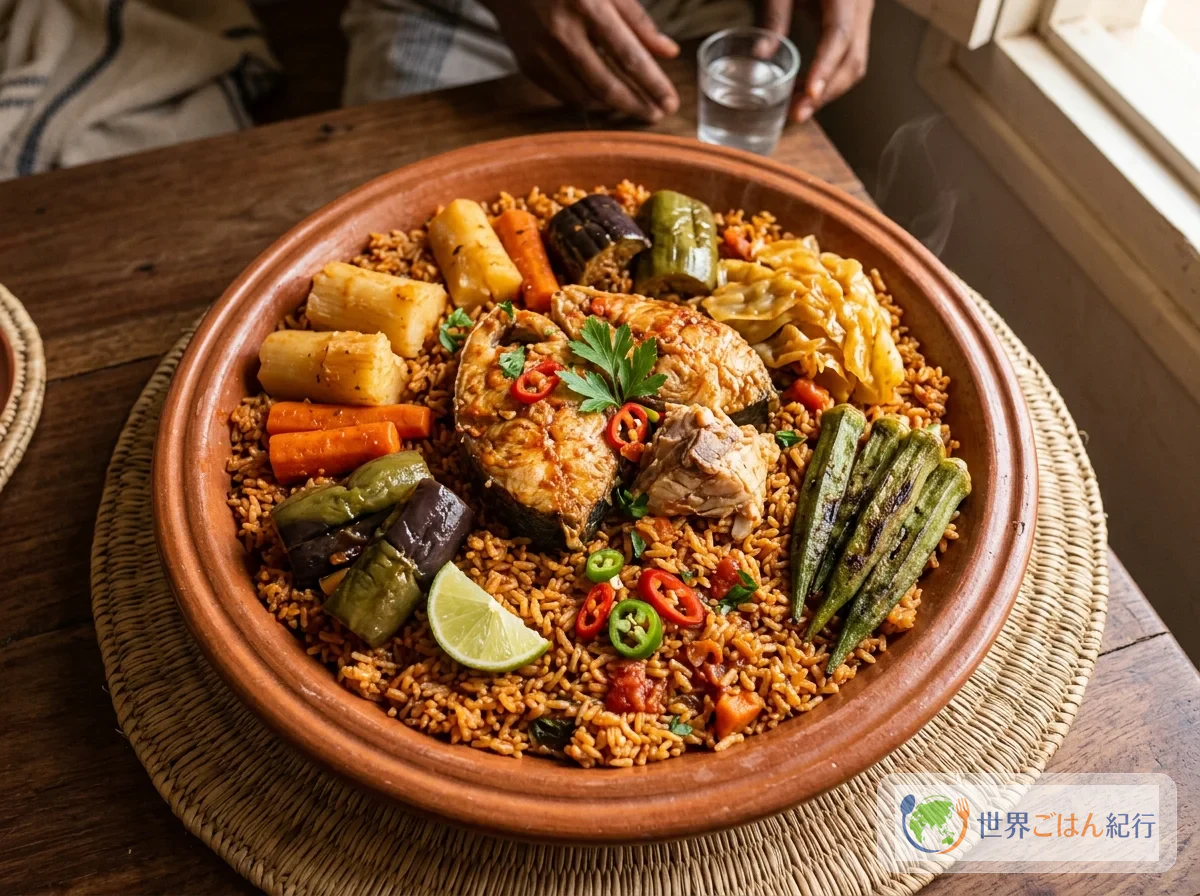
Mound the rice on a large round platter. Put the fish in the center and arrange the vegetables colorfully around it. Serve the crust at the side of the platter. Garnish with lemon wedges and halved Scotch bonnet to finish.