Ingredients and steps on one page. Print it, or choose “Save as PDF” in the print dialog.
Sekai Gohan
Canjeero Recipe: Somalia's Fermented Breakfast Pancake
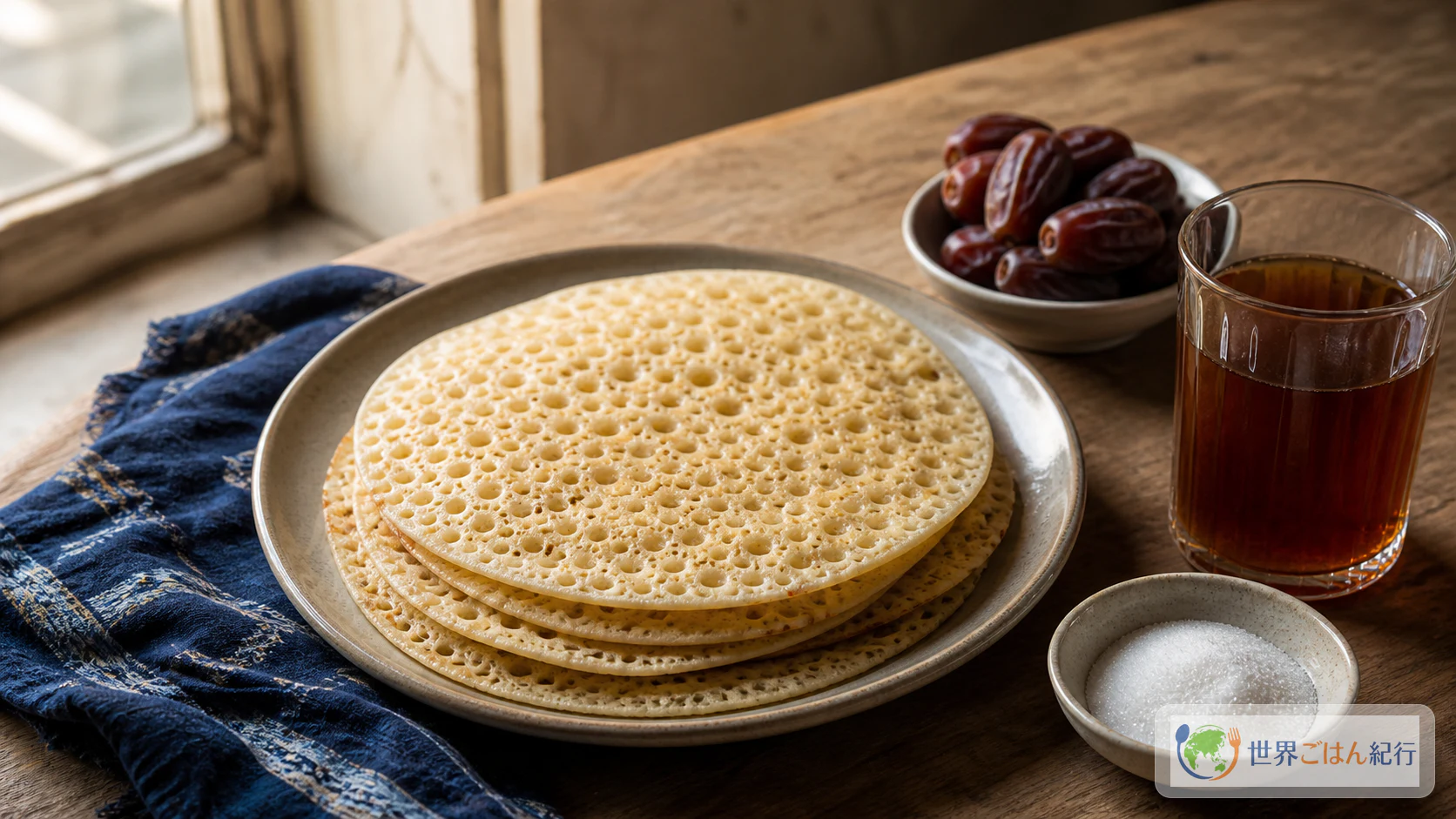
Ingredients
| Ingredient | Amount | Role and how to choose |
|---|---|---|
| Fine white corn flour (corn flour) | 3.5 oz (100 g) | Gives a light, holey texture and the sweetness of grain. It is not cornstarch |
| White sorghum flour | 2.75 oz (80 g) | Adds toasty aroma and a faint earthiness. Sift out coarse particles |
| Cake flour or all-purpose flour | 9 oz (250 g) | Helps the batter spread and keeps the one-sided bread from tearing |
| Instant dry yeast | 3 g | An aid to get fermentation started consistently at home |
| Sugar | 20 g | A modest amount that suits both a sweet breakfast and savory sides |
| Salt | 5 g | Seasons the batter |
| Baking powder | 4 g | A home aid for getting holes. Can be omitted if fermentation is thorough |
| Lukewarm water | 3 cups (750 ml) total | The first 1 cup (250 ml) at 100°F (35–38°C); the rest can be room temperature |
| Vegetable oil for cooking | 1 tbsp (15 ml) | For the first thin coating and for adding more when needed |
| Unsalted butter or vegetable oil for finishing | 20 g | For serving with sugar and tea |
Steps
1Build a fermentation base with part of the flour
1 hour
Put 3.5 oz (100 g) fine white corn flour, 2.75 oz (80 g) white sorghum flour, and 3 g instant dry yeast in a bowl and pour in 1 cup (250 ml) lukewarm water at 100°F (35–38°C). Break up the lumps with a whisk to make a smooth liquid slightly heavier than a potage. Cover loosely with plastic wrap or a lid and rest it for 1 hour in a spot at 82°F (25–28°C).
When fine bubbles appear on the surface and the batter flows slowly as you tilt the bowl, move on. Even if there are no bubbles at all, do not add water right away if the yeast has only just gone in. If the room is cold, extend by 30 minutes and then check the surface.
2Add the water and ferment overnight
20 min + 8–12 hours
To the fermentation base, add 9 oz (250 g) cake flour or all-purpose flour, 20 g sugar, 5 g salt, and 4 g baking powder. Add the remaining 2 cups (500 ml) water in 3–4 portions, whisking for about 5 minutes. The target is a smooth, loose cream that falls in a thin ribbon when lifted and whose trace disappears in a few seconds. Do not knead it like bread dough.
Do not fill the bowl more than about four-fifths. Set the lid slightly ajar and leave it at 68–82°F (20–28°C) for 8–12 hours. Lean toward 12 hours at around 68°F (20°C) and toward 8 hours in a warm room. When bubbles of various sizes cover the surface and the smell has changed from sweet flour to a yogurt-like sourness, it is ready to cook. Do not decide by fermentation time alone; look at the bubbles and the smell together.
Somali households use natural fermentation or a portion of the previous batter. Dry yeast and baking powder help keep the batter consistent in a home kitchen, but they are not standard local ingredients.
3Heat the cooking surface and test the first one
10 min
Stir the fermented batter gently from the bottom until it returns to a uniform loose cream with no separated liquid visible. Heat an 8-inch (18–20 cm) lidded frying pan over medium heat for 2–3 minutes and spread 1/2 tsp oil thinly. Do not heat it until it smokes, because then only the bottom sets first; stop when the oil moves freely.
Scoop ½ cup (80–100 ml) batter with a ladle and cook a small first one to check the thickness. If the batter does not spread from the center and stops at about 4.5 inches (12 cm) across, add water 1 tbsp at a time. If instead it runs all the way to the edge and looks as if it will tear, mix in 1 tbsp cake flour and rest for 10 minutes.
4Pour in a spiral from the center outward
3 min per piece
Set the bottom of the ladle gently at the center of the pan and push the batter outward in a circle. Stop after two or three turns from the center and finish by tracing the outer edge. Touching it repeatedly crushes the bubbles and leaves only the thick parts underdone, so once you have poured, keep your hands off.
You have succeeded if you get a circle 7.5 inches (15–19 cm) across and 0.125 inch (2–3 mm) thick, the surface sets from translucent to white, and small holes increase from the center to the edge. If only the outside is thick, make the first turn slightly wider rather than reducing the batter by 2 tsp (10 ml) from the next piece. Changing the area you pour over evens out the texture more easily than abruptly changing the amount of batter.
5Set the surface with steam under the lid
2–3 min
As soon as you pour the batter, cover with the lid and wait over medium heat. When the shine on the surface disappears, heat has reached the bottom of the holes, and the edge has dried slightly, remove the lid. The underside is pale golden, the top is white to light beige, and it springs back softly when pressed with a finger. Do not flip it.
If liquid still remains on the surface after 3 minutes, put the lid back and give it another 30–60 seconds over medium-low heat. If the bottom starts to darken, lower the heat and finish with steam under the lid. Opening and closing the lid drops the temperature, so limit yourself to one check at the end for each piece.
6Stack and let the heat and moisture settle
5 min
While the cooked canjeero is still warm and pliable, stack them on a plate with the holey side up. Cover with a dry cloth or a large plate and rest for 5 minutes. Oiling each piece one by one would clog the holes and make the flour smell heavy, so serve the fat just before eating.
For breakfast, serve unsalted butter or vegetable oil, sugar, and sweet tea. For a savory version, put eggs, a stir-fried meat stew, or a thin soup alongside. It is done when the outside bends slightly as you fold it and the holey side catches the juices.