Ingredients and steps on one page. Print it, or choose “Save as PDF” in the print dialog.
Sekai Gohan
Kisra: Sudanese Fermented Sorghum Flatbread
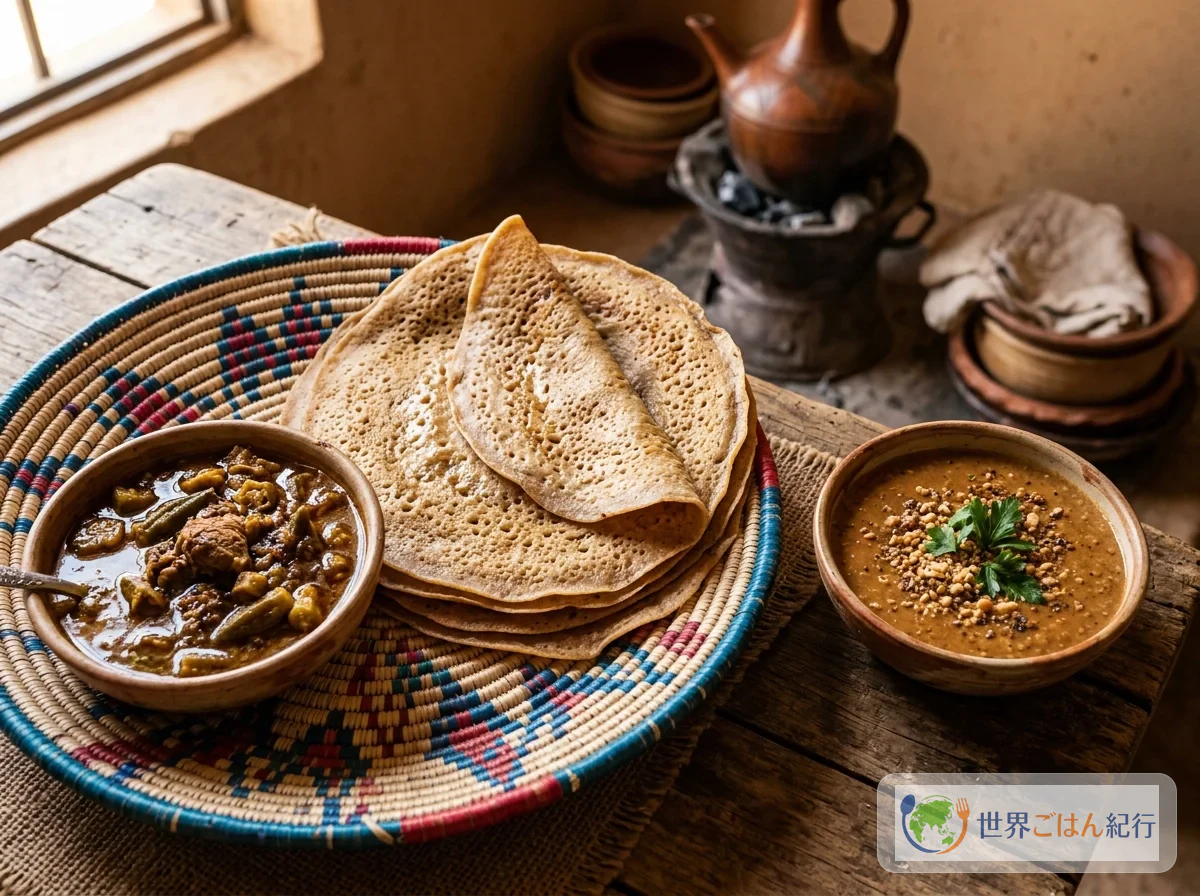
Ingredients
Kisra batter
| Ingredient | Amount | Substitutes & notes |
|---|---|---|
| Sorghum flour | 10.5 oz (300 g) | 7 oz (200 g) whole wheat flour plus 3.5 oz (100 g) buckwheat flour can stand in (to reproduce the grain character) |
| Lukewarm water (95–104°F / 35–40°C) | 2 cups (500 ml) | The temperature that encourages fermentation matters |
| All-purpose flour | 1.75 oz (50 g) | A binder. Omit to make it gluten-free |
| Salt | 1/2 tsp | — |
| Neutral oil | 1 tbsp | To keep the crêpes from sticking when baking |
Fermentation starter (optional)
| Ingredient | Amount | Notes |
|---|---|---|
| Plain yogurt | 2 tbsp | Speeds up fermentation. Can be omitted |
Accompaniment (mulah niamiya)
| Ingredient | Amount | Substitutes & notes |
|---|---|---|
| Beef (stew cut) | 10.5 oz (300 g) | Bone-in meat adds savoriness |
| Onion | 2 (finely chopped) | — |
| Canned tomatoes | 1 can (14 oz / 400 g) | 4 fresh tomatoes also work |
| Peanut butter (unsweetened) | 3 tbsp | Peanut paste also works |
| Okra | 8 | Essential for thickening. Frozen is fine |
| Garlic | 3 cloves | — |
| Neutral oil | 2 tbsp | — |
| Bouillon cube | 1 | — |
| Salt and pepper | as needed | — |
| Ground cumin | 1 tsp | — |
| Ground coriander | 1 tsp | — |
| Cayenne pepper | 1/2 tsp | Adjust the heat to taste |
Steps
1Mix the sorghum flour with water
5 min
Put 10.5 oz (300 g) sorghum flour and 1.75 oz (50 g) all-purpose flour in a large bowl and whisk well, adding 2 cups (500 ml) lukewarm water (95–104°F / 35–40°C) a little at a time. To avoid lumps, work it first with a small amount of water and add the rest gradually. Aim for a batter slightly thinner than crêpe batter, one that pours smoothly.
Add 1/2 tsp salt, and if you want to speed up fermentation, add 2 tbsp plain yogurt.
2Ferment the batter
12–24 hours
Cover the bowl with plastic wrap and leave it at room temperature (up to 86°F; 25–30°C) for 12–24 hours. In Sudanese homes it is traditional to add leftover batter from the day before to the next batch as a "starter," which steadies the fermentation. In a home kitchen, yogurt can stand in for the starter.
As fermentation proceeds, small bubbles float on the surface of the batter and it gives off a slightly sour smell. This is evidence that lactic acid bacteria are active. Seeing bubbles is the sign that fermentation is done. If fermentation is insufficient, the kisra flavor is flat, and if it goes too far, the sourness becomes too strong.
How to judge fermentationWhether kisra fermentation is just right is judged by smell and the amount of bubbles. A light, fresh sourness like yogurt is right. If it smells strongly sour like cheese, it has over-fermented. Over-fermented batter can be softened by stirring in an extra 1.75 oz (50 g) of fresh sorghum flour.
3Adjust the thickness of the batter
3 min
After fermentation, the batter has more water and is a little looser. The ideal thickness is one where, when you scoop some with a spoon and let it fall, it drops in an unbroken thin ribbon about 2–3 mm wide. If it is too thick, add 1–2 tbsp water; if too thin, add 1–2 tbsp sorghum flour.
4Bake thin in a frying pan
2–3 min per crêpe
Heat a nonstick frying pan or a crêpe pan well over medium heat. Soak a paper towel with oil and wipe the pan with a thin coat.
Pour one ladle of batter into the center of the pan and immediately tilt the pan to spread it over the whole surface. Or spread it in circles with a crêpe spreader (a T-shaped spatula). In Sudanese homes, a large iron griddle called a dokka is used and the batter is spread quickly with the palm of the hand.
Bake over low to medium heat for 2–3 minutes, until the edges lift naturally and the surface is dry. Kisra is baked on one side only. There is no need to flip it.
Tips on donenessBaking on one side is correct for kisra. The sign it is done is that the surface is completely dry and the edges lift naturally from the pan. You do not need to brown it. If you bake it too long it turns crisp and breaks when you tear it to dip into the stew. It is best to keep it moist and flexible.
5Stack the baked kisra
10 min
Peel the baked kisra carefully from the pan and stack them on a plate. The ideal is to stack them while the surface is dry, the edges are naturally lifted, and the whole is moist and soft. In Sudanese homes, freshly baked kisra is piled in a basket woven of bamboo or palm leaf.
Until all the batter is used, repeat: oil the pan again, pour the batter, spread it, and bake over low to medium heat. 10.5 oz (300 g) of flour makes about 12 kisra.
6Make the mulah (stew)
40 min
Kisra alone does not make a meal. In Sudan it is always eaten with a stew called mulah (mulah / ملاح). Here is how to make the most common one, "mulah niamiya" (niamiya stew).
Heat 2 tbsp oil in a pot and cook the chopped onion over medium heat for 8 minutes, until golden brown. Add the garlic and cook for 2 minutes, then add the cumin, coriander, and cayenne and cook for 1 minute.
Add the beef cut into bite-size pieces and cook for 5 minutes until browned on the surface. Add the canned tomatoes, ¾ cup (200 ml) water, and the bouillon cube, and bring to a boil. Lower the heat, cover, and simmer for 30 minutes.
7Add the okra and peanut butter
10 min
Cut the okra into 0.5 inches (1 cm) pieces and add it to the stew. Dissolve 3 tbsp peanut butter in 2 tbsp lukewarm water, add it to the stew, and stir well. Simmer another 10 minutes over low heat, and when the thickness of the okra and the richness of the peanuts have melted into the stew, it is done. Adjust with salt and pepper.
8Serve
3 min
Spread 3–4 kisra on a large platter and mound the mulah in the center. In the Sudanese way, you tear the kisra by hand and dip it in the mulah to eat. You can also roll it up with a fork.