Ingredients and steps on one page. Print it, or choose “Save as PDF” in the print dialog.
Sekai Gohan
Ugali: How to Make East Africa's Stiff Maize Staple
Ingredients
Ugali
| Ingredient | Amount | Substitutes & notes |
|---|---|---|
| White maize flour (corn flour) | 400 g | A fine grind is best (about 14 oz). Not the same as cornstarch |
| Water | 800 ml | Roughly twice the flour by volume is the basic ratio (about 3 1/3 cups) |
| Salt | 1/2 tsp | Optional. Often left out in Tanzania |
Sukuma wiki (sautéed greens, side dish)
| Ingredient | Amount | Substitutes & notes |
|---|---|---|
| Kale (or collard greens) | 1 bunch (about 300 g) | Komatsuna or bok choy also work (about 10 oz) |
| Onion | 1, thinly sliced | — |
| Tomatoes | 2, roughly chopped | — |
| Garlic | 2 cloves, minced | — |
| Vegetable oil | 2 tbsp | — |
| Salt | 1 tsp | Adjust to taste |
| Black pepper | A pinch | — |
| Lemon juice | 1 tbsp | Drizzle over at the end |
Nyama choma (grilled meat, side dish)
| Ingredient | Amount | Substitutes & notes |
|---|---|---|
| Beef (round or rump) | 400 g, bite-size pieces | Goat is the classic in East Africa. Chicken works too (about 14 oz) |
| Salt | 1 tsp | — |
| Black pepper | 1/2 tsp | — |
| Lemon juice | 2 tbsp | — |
| Garlic | 2 cloves, grated | — |
| Paprika | 1 tsp | — |
| Vegetable oil | 1 tbsp | — |
East African ugali uses white maize flour (also sold as white corn flour or maize meal). Cornstarch is pure extracted starch and won't work for ugali. Look for it at African or Caribbean grocery stores, or online under names like "ugali flour" or "white maize meal." If you can't find it, Italian white polenta flour (farina di mais bianca) is a good substitute. Yellow cornmeal (the kind used for polenta) works too, though the color will be different.
Steps
1Bring 3¼ cups (800 ml) water to a boil over high heat, 3–5 minutes
While the water heats, weigh out 14 oz (400 g) maize flour and have it ready in a bowl. When steam is rising strongly and large bubbles keep coming up from the bottom of the pot, turn the heat down to medium and slowly sprinkle in about 1/3 of the flour (4.5 oz (130 g)) over 2–3 minutes.
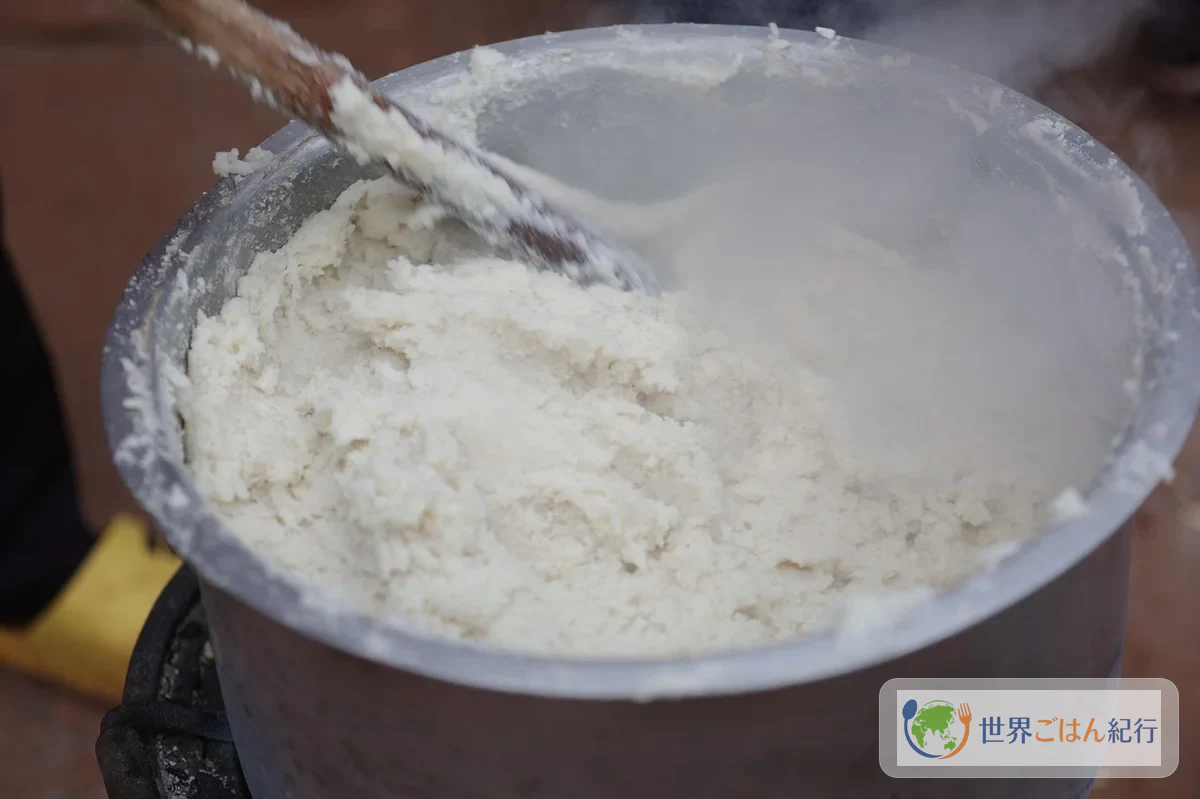
Add the flour little by little with one hand while stirring constantly with a wooden spoon (mwiko) in the other. The key is to sprinkle it in rather than dumping it all at once, so no lumps form. At this point it should look like a loose porridge.
2Cook over low heat for 3–5 minutes, until evenly pasty
Bubbles will start to blurp up at this stage. Keep stirring with the wooden spoon so the bottom doesn't scorch. It's ready when the whole pot has thickened, the powdery white streaks are gone, and the bubbles pop in a steady "plop, plop" rhythm.
3Add the remaining flour (about 9.5 oz (270 g)) in 2–3 additions and work it with all your strength
This is the most physically demanding step. Each addition of flour makes the mass stiffer, and it takes real effort to move the spoon. Keep working it until it no longer sticks to the bottom of the pot and gathers into a single mass on the spoon. Allow 5–8 minutes.
4When the mass is smooth and springy, turn off the heat, cover and let it steam for 2 minutes
This resting time drives off excess moisture and evens out the texture. After steaming, the mass should move as one piece when you shake the pot.