Ingredients and steps on one page. Print it, or choose “Save as PDF” in the print dialog.
Sekai Gohan
How to Make Brik: Tunisian Fried Pastry with an Egg Inside
Ingredients
| Ingredient | Amount | Role and substitutes |
|---|---|---|
| Malsouka or frozen spring roll wrappers | 4 sheets (about 8 inches (20 cm) across) | No malsouka? Use spring roll wrappers. For phyllo, use two sheets together |
| Canned tuna (in oil) | 5 oz (140 g) net | Drain the oil well. If packed in water, pat dry thoroughly |
| Potato | 7 oz (200 g) | Peel and cut into 1 inches (2 cm) dice. Boil and mash coarsely |
| Egg | 4 | 1 per sheet. To avoid a soft yolk, cook through to the center |
| Capers | 20 g | Rinse quickly and drain. Adds acidity and saltiness |
| Flat-leaf parsley | 1 oz (30 g) | Finely chopped. Regular parsley works too |
| Harissa | 20 g | About 5 g per piece. Start with half and adjust the heat |
| Ground coriander | 2 g | Gives the base aroma. If you have none, leave it out and do not add extra harissa |
| Salt | 1 g | Reduce according to the saltiness of the tuna and capers |
| Black pepper | 0.5 g | Mix into the whole filling |
| Frying oil | about 2½ cups (600 ml) | In a deep pot about 8 inches (20 cm) across, aim for oil 1 inches (2 cm) deep |
| Lemon | 1/2 | Cut into wedges and squeeze over the freshly fried brik |
Steps
1Boil the potatoes
12 min
Peel the potatoes and cut them into 1 inches (2 cm) dice. Put them in a small pot with water to cover and a pinch of salt, and bring to a boil over medium heat. Once boiling, lower to medium-low and boil for 8–10 minutes. When a fork goes through to the center without resistance, drain and leave for 2 minutes. If moisture remains, the filling turns loose inside the pastry, so return the pot to low heat for just 20 seconds to drive off the water.
Mash coarsely with a fork while hot. A small mound should remain when you turn the fork, and it should break up easily when pressed with a finger. Do not mash it completely; leaving lumps of about 0.25 inch (5 mm) keeps the texture of the filling when the egg is broken.
2Mix the filling and cool it
8 min
In a bowl, put the coarsely mashed potatoes, drained tuna, capers rinsed and drained, finely chopped parsley, ground coriander, salt, and black pepper. Add 20 g harissa too, and mix without mashing the potatoes too much.
Divide the filling into 4 and cool it to a temperature you can touch. The mixing is done when the filling holds in one mass and no liquid remains at the bottom of the bowl. If hot filling is put on the pastry, the pastry suddenly turns damp and tears easily. If you see liquid at the bottom of the bowl, do not add more tuna; press the surface of the filling lightly with paper towels.
3Put the filling on the pastry
5 min
Thaw frozen pastry as the package says. Do not take out all the sheets at once; when you put one on the counter, return the rest to the bag or cover them with a cloth that will not dry them. For round malsouka, put one quarter of the filling on the near third and make a slight hollow in the center. For a spring roll wrapper, shape the filling into a triangle about 1 inches (2 cm) in from one side of the square.
If the mound of filling is too high, the egg will run to the edge when you place it. A low mound about 1 inches (2 cm) thick, rather than thinly spread, is less likely to tear after folding.
4Break in the egg and fold into a triangle
4 min
Crack the egg once into a separate small dish, check that no shell has got in, and then slide it into the hollow of the filling. With malsouka, fold the open side over the egg so it forms a triangle. Fold a spring roll wrapper the same way and press the edge closed with a dry finger.
When egg white touches the edge, it acts like glue that joins the pastry layers. There is no need to brush water on the fold. Only if the pastry is dry, trace a little egg white along the inside of the edge and press. Shaping is done when the edges of the triangle overlap flat, the egg white stays clear and does not run, and the fold does not spring back when pressed with a finger. Because you fry as soon as it is wrapped, do not fold all 4 first and stack them.
5Fry one at a time in 170 to 175 degrees C oil
5 min
Pour oil into a deep pot about 8 inches (20 cm) across and heat it to 170 to 175 degrees C. If you have no thermometer, a scrap of pastry that immediately forms fine bubbles is the guide. Slide the brik into the oil from the edge, one at a time.
Fry the first side for 60 to 90 seconds, and when the edge is a pale golden, turn it with a wide spatula. The other side takes about 45 to 60 seconds. When the bubbles on the pastry go from large and rough to fine and the color reaches the corners of the triangle, lift it onto a rack. To keep a soft yolk, do not fry past a total of 2 to 3 minutes; put color before time.
To set the white and yolk, lower the heat a little and fry about 4 minutes in total. It varies with thickness and oil temperature, so break open a corner of the first piece and check that the white is not clear.
6Drain and serve with lemon
2 min
Move the brik from the 170 to 175 degrees C oil to a rack and drain for just 1 minute, while the heat of frying remains, until most of the surface oil has fallen off and the bubbles on the pastry have disappeared. If you place them on paper, lay them out without stacking. Freshly fried, the pastry has not fully set, so move it to a plate right away and serve with lemon.
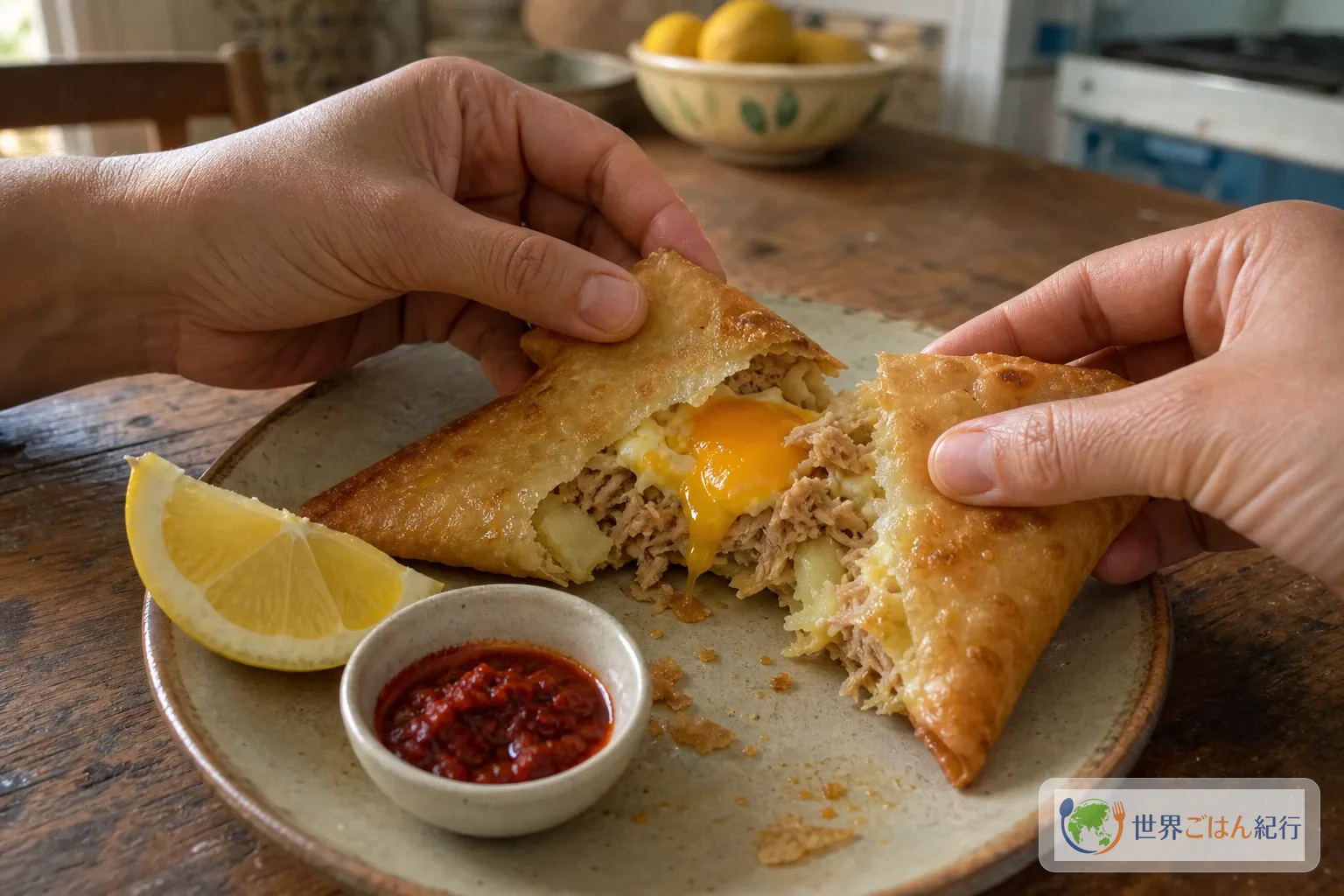
Breaking the corner with chopsticks lets you check the layers of the pastry and the state of the yolk. If the yolk runs, tilt the plate, squeeze on a little lemon, and coat the tuna and potato with the yolk. If you fried it firm, hold the triangle in your hand and eat it while listening for the sound of the pastry.