Ingredients and steps on one page. Print it, or choose “Save as PDF” in the print dialog.
Sekai Gohan
Tunisian Fish Couscous (Couscous au Poisson): A Harissa-Scented Coastal Family Dish
Ingredients
| Ingredient | Amount | Role and substitutes |
|---|---|---|
| White fish (cod, sea bream, etc.) | 1 lb (500 g) | 1.5–2 inches (4–5 cm) pieces. Choose a firm-fleshed fish |
| Couscous (medium or regular grain) | 8.5 oz (240 g) | Dry grains. For the rehydrating kind, follow the package |
| Onion | 5.5 oz (150 g) | The sweetness of the red broth. Slice thinly |
| Red bell pepper | 3.5 oz (100 g) | Sweetness and color. 1 red pepper if you don't have it |
| Carrot | 3.5 oz (100 g) | Gives the broth body. Half-moons 0.5 inches (1.5 cm) wide |
| Zucchini | 5.5 oz (150 g) | An easy coastal summer vegetable. Eggplant also works |
| Chickpeas (cooked, canned) | 4 oz (120 g) | Texture and savoriness. Drain before using |
| Garlic | 2 cloves | The base of the aromatic oil |
| Tomato paste | 1 oz (30 g) | Sourness and color. With canned tomatoes, cook off the moisture |
| Harissa | 15–20 g | Heat and chili aroma. Adjust the salt by product |
| Caraway seeds | 2 g (just under 1 tsp) | A cool aroma. Cumin alone won't be the same |
| Cumin powder | 2 g (1 tsp) | An earthy, warm aroma |
| Paprika powder | 2 g (1 tsp) | Adds color without adding heat |
| Turmeric | 1 g (1/3 tsp) | The color of the broth. Can be left out |
| Water or unsalted fish stock | 2¼ cups (550 ml) | Check the saltiness of the fish stock |
| Olive oil | 3 tbsp (45 ml) | 2 tbsp (30 ml) for the aromatic oil, 1 tbsp (15 ml) for the couscous |
| Salt | About 6 g | Guide: 2 g for the fish, 4 g for the broth, adjusted by tasting |
| Black pepper | A little | To season the fish |
| Lemon | 1/2 | For acidity at the end |
| Parsley | 10 g | For plating. Roughly chop the leaves |
Steps
1Cut the fish and vegetables
15 min
Thaw the white fish in the refrigerator and press the surface dry with paper towels. Cut into 1.5–2 inches (4–5 cm) pieces, coat with 2 g salt and black pepper, and return to the refrigerator until you begin cooking. Cod breaks easily, so don't cut it too small. Sea bream or Spanish mackerel also work with the skin on. Keep cutting boards and knives that held raw fish apart from the utensils for vegetables.
Cut the onion 0.25 inch (5 mm) wide, the red bell pepper into 0.5 inches (1.5 cm) pieces, the carrot into thin half-moons and the zucchini into 1 inches (2 cm) pieces. Mince the garlic, and drain the chickpeas and pat the surface dry. If you use root vegetables, cut them to a size that cooks at the same time as the carrot.
2Open up the onion and spices in oil
8–10 min
Put 2 tbsp (30 ml) olive oil in a heavy pot and cook the onion and red bell pepper over medium heat for 6–8 minutes. When the onion is translucent and a light color has formed on the bottom of the pot, add the garlic, caraway seeds, cumin, paprika and turmeric. Stir for about 30 seconds, and when the aroma rises add the tomato paste and harissa and cook 1–2 minutes over medium-low heat.
Move on when the oil has turned red and the sour smell of the tomato paste has changed to a sweet one. If the spices blacken on the bottom or smoke, turn off the heat and add 2 tbsp water. If the scorching spreads, move everything to a different pot so the bitterness doesn't reach the broth.
3Make the red broth with vegetables and chickpeas
12–15 min
Pour 2¼ cups (550 ml) water or unsalted fish stock into the pot and scrape the bottom with a wooden spoon. Bring to a boil over high heat, lower to medium-low and simmer the carrot for 8 minutes. Add the zucchini and chickpeas and cook another 5–7 minutes, until the centers of the vegetables still have a little bite. Boil too hard and the vegetable edges break down, and the broth turns cloudy when the fish goes in.
The broth is ready when the liquid flows from a spoon and fine bits of tomato settle on the bottom. Before adding 4 g salt, taste the saltiness of the fish stock you used. Set aside about 1 cups (270 ml) of the hot broth in a separate heatproof bowl for the couscous to absorb, and leave enough in the pot to come about a third of the way up the fish. If the broth is short, add boiling water and adjust the seasoning before the fish goes in.
4Swell the couscous with hot broth
5–10 min
For store-bought couscous meant to be rehydrated in hot liquid, put 8.5 oz (240 g) dry grains in a heatproof bowl and pour in 1 cups (270 ml) of the reserved hot broth and 1 tbsp (15 ml) olive oil. Stir everything once right away, cover with a lid or plastic wrap, and leave for 5 minutes. Fluff with a fork from the bottom, letting in air; if the centers of the grains are hard, add hot broth 1 tbsp at a time and rest 2 minutes each time. If the package gives an amount of liquid, follow that.
To finish couscous labeled for steaming the local way, work 1 tbsp (15 ml) olive oil and ¼ cup (80 ml) water into the grains a little at a time, rest 10 minutes, and steam for 15 minutes. Return it to the bowl, mix in ½ cup (100 ml) hot broth, and steam another 10 minutes until the surface of the grains swells. Grain size and pretreatment differ by product, so if the package has no steaming instructions, don't put it in the steamer. Rehydrate instead.
5Return the fish to the broth and cook through
6–10 min
Over medium-low heat, let the broth in the pot tremble quietly and arrange the fish so the pieces don't overlap. With about a third of the fish's height touching the broth, cover and simmer 6–8 minutes for 1.5 inches (4 cm) pieces, or 8–10 minutes for thick fillets. Instead of turning the fish partway, spoon the broth over it 2–3 times. Boiling hard splits the flesh and sticks the skin to the bottom of the pot.
Break open the thickest part: it is done when it has no translucency, is white through the center, and the layers flake when pressed with chopsticks. If you use a thermometer, check for 63°C (145°F) or higher at the center. Push the cooked fish to the edge of the pot, taste the broth, and adjust with salt, lemon juice and harissa a little at a time. Don't reuse the tasting spoon after it's been in with the fish.
6Plate with fish and broth over the couscous
5 min
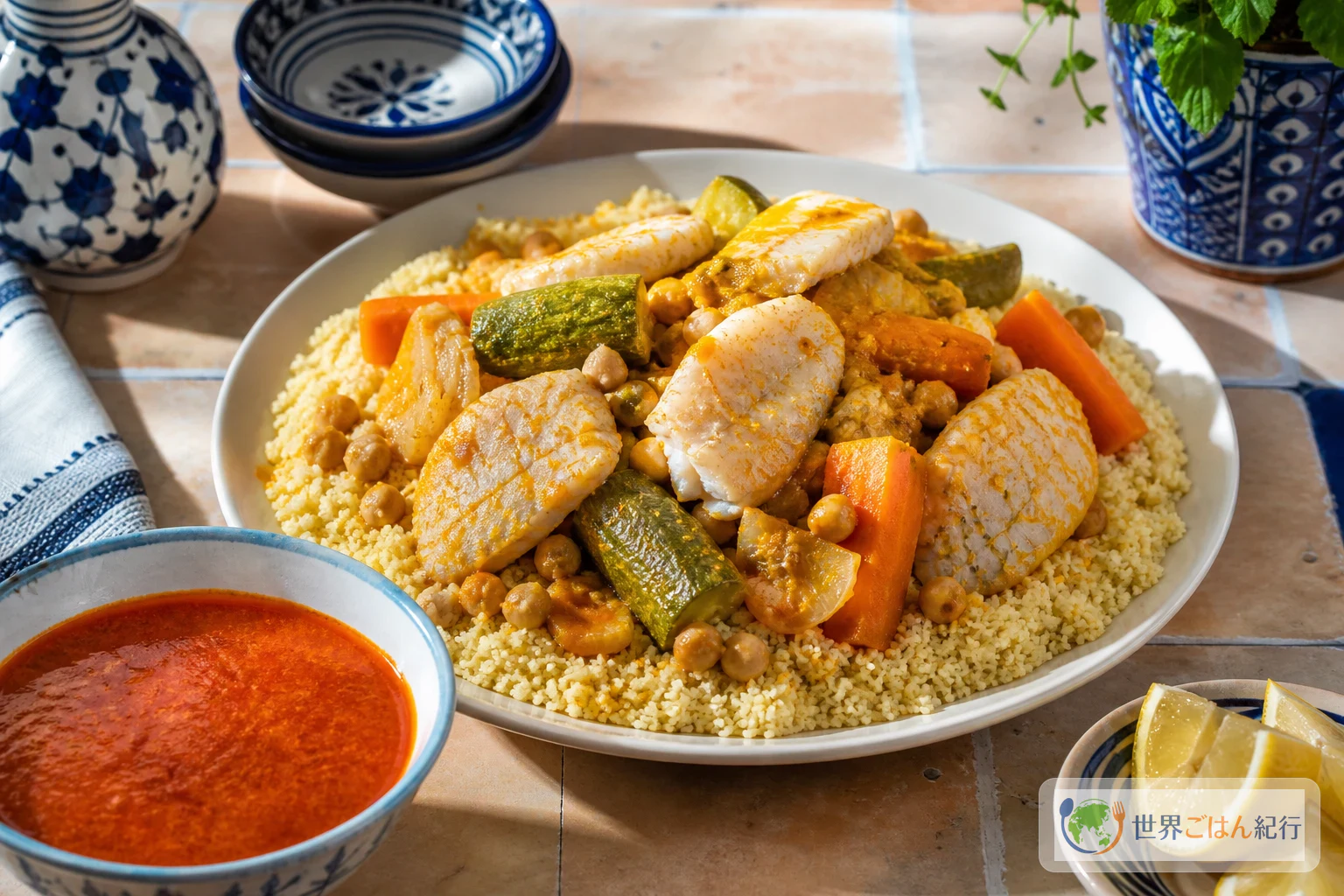
Fluff the couscous again with a fork and mound it in the center of a large platter. Make a slight hollow in the middle, set the fish, carrot, zucchini and chickpeas on top, and first ladle over just a little broth. Serve the rest of the broth in a separate bowl so each person can adjust the firmness of the grains and the heat. Scatter 10 g parsley, add lemon and serve while hot.
If you pour all the broth over from the start, the grains keep absorbing it and get heavy. Taking a bite of fish before squeezing lemon, and mixing in a little of the reserved harissa if the heat is short, lets you taste the sweetness and the sourness of the white fish separately.