Ingredients and steps on one page. Print it, or choose “Save as PDF” in the print dialog.
Sekai Gohan
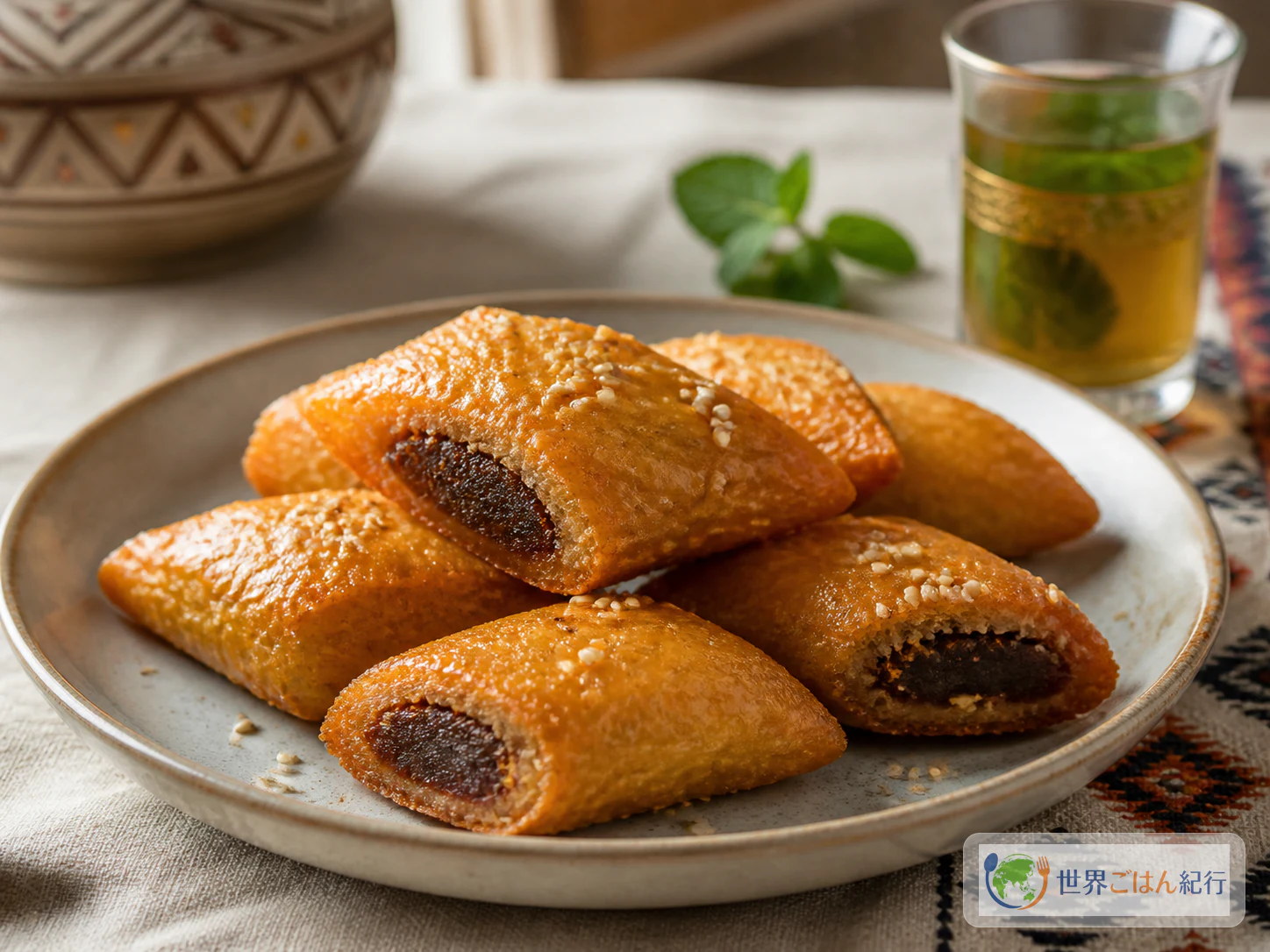
Makroud: Tunisian Date-Filled Semolina Pastry
Ingredients
Semolina dough
| Ingredient | Amount | Substitutes & what to check |
|---|---|---|
| Medium-ground semolina | 10.5 oz (300 g) | Fine-ground in the same amount. It absorbs quickly, so add the water in the second half |
| Unsalted butter or ghee | 2.75 oz (75 g) | Melt the butter before using. Ghee on days you want a stronger aroma |
| Salt | 2 g | Tightens the sweetness of the dough |
| Orange flower water | 1.5 tbsp (20 ml) | Food-grade labeled. 2 g lemon zest can substitute |
| Lukewarm water | ½ cup (100 ml) | Keep 1.5 tbsp (20 ml) aside as an extra and add after looking at the dough |
Date filling
| Ingredient | Amount | Substitutes & what to check |
|---|---|---|
| Soft pitted dates | 9 oz (250 g) | Date paste in the same amount. Rehydrate hard dates with 1 tbsp (15 ml) hot water |
| Olive oil | 2 tsp (10 ml) | One with a mild aroma |
| Ground cinnamon | 2 g | Tightens the sweetness of the filling |
| Grated orange zest | 2 g | Don't include the white part |
| Cloves | 0.2 g | If you dislike them don't leave them out; use 3 g cinnamon |
Honey syrup and finishing
| Ingredient | Amount | Substitutes & what to check |
|---|---|---|
| Honey | 4 oz (120 g) | A mild-flavored one |
| Granulated sugar | 1.5 oz (40 g) | Don't cut by much, to keep the syrup's concentration |
| Water | ¼ cup (60 ml) | Thins the honey |
| Orange flower water | 1 tbsp (15 ml) | Added after turning off the heat |
| Lemon juice | 1 tsp (5 ml) | Tightens the aftertaste of the syrup |
| Frying oil | 3¼ cups (800 ml) | A neutral oil such as canola |
| White sesame seeds | 10 g | For finishing. Leave out if you avoid sesame |
Steps
1Form the date filling into a rope
15 min
Chop 9 oz (250 g) dates into 0.25 inch (5 mm) pieces with a knife and combine with 2 tsp (10 ml) olive oil, 2 g cinnamon, 2 g orange zest and 0.2 g cloves. If using hard dates, sprinkle with 1 tbsp (15 ml) hot water, warm at 600 W for 40 seconds, and press with a fork. Or warm paste over low heat for just 3 minutes. Turn off the heat when the filling is warm, holds together when pressed with a finger, and has no oil floating on the surface. Make two ropes, 0.5 inches (1.5 cm) in diameter and about 12 inches (30 cm) long, so it can be divided into 20 pieces, and let them cool slightly. If the filling is sticky, chill it in the refrigerator for 10 minutes rather than adding flour to firm it up.
2Let the semolina absorb the fat
10 min
Melt 2.75 oz (75 g) unsalted butter or ghee over low heat and turn off the heat before it steams. Pour over 10.5 oz (300 g) semolina and 2 g salt, and rub together with your fingertips for about 5 minutes. The guide is that the whole mixture is like damp sand, and when squeezed it holds its shape for a moment and then crumbles. Add 1.5 tbsp (20 ml) orange flower water and ½ cup (100 ml) lukewarm water in 3 portions, pressing together with a spatula. Don't knead it toward a glossy bread dough; stop when no white flour is visible. If large cracks remain, add the reserved water 1 tsp (5 ml) at a time.
3Rest the dough and make the syrup
65 min
Divide the dough in two, cover with a dry cloth or plastic wrap and rest at a room temperature of 20–25°C for 60 minutes. Meanwhile, put 4 oz (120 g) honey, 1.5 oz (40 g) granulated sugar and ¼ cup (60 ml) water in a small pot and warm over medium heat for 3–4 minutes. When the sugar has dissolved and fine bubbles continue on the surface, turn off the heat and add 1 tsp (5 ml) lemon juice and 1 tbsp (15 ml) orange flower water. Boiling after adding the flower water drives off the aroma, so keep the syrup warm over low heat or rewarm it just before use. The rested dough is ready when, pressed with a finger, only the edge cracks slowly and the center does not return to powder.
4Wrap the filling and cut into diamonds
25 min
Divide the dough into 2 ropes and roll each to about 12 inches (30 cm) long and 1 inches (2.5 cm) in diameter. With a chopstick or similar, make a groove 0.5 inches (1 cm) deep in the center, lay one rope of date filling in each, and close the edges of the dough. Place seam side down and press lightly into a band 0.5 inches (1.5 cm) thick. If you have a 12 inches (30 cm) rolling pin, press from the center outward to even the thickness; if not, use your palms to even it. Cut on the diagonal into 20 diamonds 1 inches (3 cm) wide. If the filling pokes out from the ends it will easily run into the oil, so pinch both ends closed with your fingers after cutting.
5Fry in 350°F (170°C) oil
15 min
Put 3¼ cups (800 ml) frying oil in a deep pot and heat over medium heat to 350°F (170°C). Without a thermometer, drop in a small piece of dough and check that it sinks to the bottom, then rises slowly with fine bubbles. Add up to 6 pieces at a time and fry 2 minutes on one side, then turn and fry 1–3 minutes. When the surface is a deep golden color, the corners hold, and the line of filling shows through, lift to a rack. When the oil temperature drops the shell absorbs oil, and when it rises too high only the outside darkens. If the bubbles are weak just after adding, reduce how many go in at once; if strong bubbles continue, lower the heat and return to 350°F (170°C).
6Dip in warm syrup
10 min
Warm the syrup over low heat, without boiling, and bring it back to a warm state. Add the freshly fried makroud one at a time and roll about 10 seconds in total, 5 seconds per side. The guide is a thin sheen on the surface, with syrup not running off onto the plate in quantity but only a few drops falling after it is set on the rack. Sprinkle with 10 g white sesame seeds and cool for 30 minutes before eating. The shell breaks easily while hot, so don't keep touching it with chopsticks; move it once the syrup starts to set.