Ingredients and steps on one page. Print it, or choose “Save as PDF” in the print dialog.
Sekai Gohan
Katogo Recipe: Uganda's One-Pot Matooke and Beans
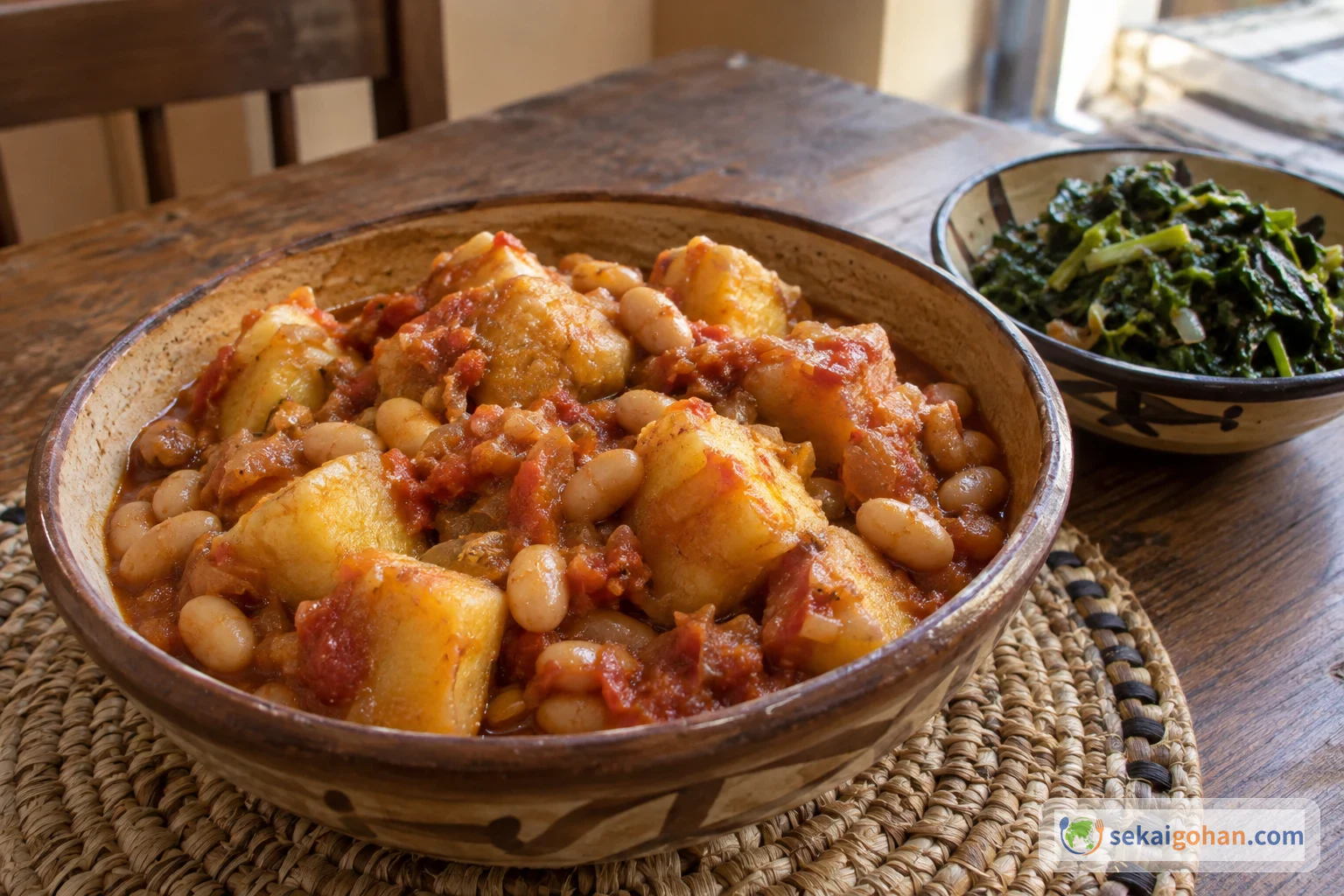
Ingredients
The katogo
| Ingredient | Amount | Substitutes & notes |
|---|---|---|
| Green cooking bananas (green plantain, in place of matooke) | 2.75 lb (1.2 kg) with peel (6–8) | Skin should be green and hard. Do not use yellow dessert bananas |
| Cooked white beans or kidney beans | 14 oz (400 g) | Drain canned or packaged ones. Cook local raw beans soft in a separate pot first |
| Onion | 1 (about 7 oz (200 g)) | 0.25 inch (5 mm) dice. Red onion also works but changes the sweetness |
| Tomatoes | 3 (about 1 lb (450 g)) | Chop ripe ones. For low-moisture varieties, add 3.5 tbsp (50 ml) water |
| Ghee or vegetable oil | 1 tbsp (15 ml) | Ghee is closer to the local flavor. For oil, rice bran or canola, for example |
| Water | 2 cups (500 ml) | Adjust from the amount that half-covers the bananas and leaves stew on the bottom of the pot |
| Salt | 1 1/2 tsp (about 9 g) | Reduce to match the salt in the beans. Don't add it all at the start; adjust at the end |
Finishing and side
| Ingredient | Amount | Substitutes & notes |
|---|---|---|
| Leafy greens | 7 oz (200 g) | Spinach, kale, komatsuna and so on. Boil or sauté separately |
| Cilantro | 10 g | An optional finish matching Viva! Uganda's serving suggestion. Omit if you dislike it |
| Green chili | 1 (about 5 g) | Optional. Add with the tomato only if you want heat |
| Banana leaves | 2 | Optional. Lay on the bottom of the pot if you want to add fragrance. The main recipe works without leaves |
Steps
1Cut the cooking bananas
10 min
Wash 2.75 lb (1.2 kg) of green cooking bananas with peel and cut off both ends. Make a lengthwise slit in the peel with a knife, peel, and cut into half-moons or large rounds about 1.5 inches (4 cm) thick. Cutting thick at 1.5 inches (4 cm) evens out the cooking between the center and the outside. Bananas with yellow skin, soft flesh or a strong sweet smell are not right for this dish. After cutting, wipe off the moisture, don't leave them long at room temperature, and keep them in a bowl until the aromatic base is ready. If the cut surface has dried and darkened, slice off a thin layer and check the usable part.
2Simmer the tomato and onion
12–15 min
Put 1 tbsp (15 ml) ghee or vegetable oil in a heavy pot and fry 7 oz (200 g) onion over medium heat for 5–7 minutes. When the onion is translucent and only the edges are a light golden brown, add 1 lb (450 g) tomatoes cut into 0.5 inches (1 cm) dice and 1/2 tsp salt. Cook over medium heat for 5–7 minutes until the corners of the tomato are gone, the sauce is thick and cohesive, and the trace of the wooden spoon remains for a moment. Don't drive the water off too much on high heat; leave a thin layer of liquid on the bottom of the pot. If the onion looks about to scorch, add 1 tbsp water at a time so no black scorch gets into the sauce.
TipEven if the tomato is very watery, don't reduce it completely here; leave a thin liquid on the bottom of the pot. The thickness of the stew can be corrected later with water, but the bitterness of scorching cannot be undone. Take away the raw smell of the aromatics before adding the cooking bananas.
3Let the beans take on the stew
10 min
Add 14 oz (400 g) well-drained cooked beans and 1¼ cups (300 ml) water to the pot and boil over medium heat for 5 minutes. Lower to medium-low, cover and cook 5 more minutes. Move on when the beans are warm through to the center and the stew has turned reddish brown. To keep the bean skins intact and turn only the stew reddish brown, just run the wooden spoon once around the bottom of the pot. If you use raw beans, soften them completely in a separate pot rather than in this step, and add the same amount. If there is not enough liquid and the beans stick to the bottom, add 3.5 tbsp (50 ml) boiling water at a time and move them before they scorch.
4Layer the cooking bananas and simmer
20–25 min
Layer the cut cooking bananas on top of the beans, add ¾ cup (200 ml) water to make about 2 cups (500 ml) in total from the bottom of the pot. The liquid should touch half to 70% of the bananas. Submerging them completely makes them break down and more watery. Cover and cook over medium heat for 5 minutes, and when steam rises, lower to medium-low and simmer for 15–20 minutes. Turn them gently from the bottom just once midway, and stop when the stew clings thinly to the bananas, a fork goes through but the corners of the rounds remain. If it dries out, add 3.5 tbsp (50 ml) boiling water at a time; if there is too much liquid, remove the lid and cook 5 minutes over low heat. Do not stir hard.
TipDon't stir the bananas repeatedly; shake the pot back and forth or pass a wooden spoon along the bottom just once. If the liquid is too little it scorches, too much and the sauce is thin, so adjust in units of 3.5 tbsp (50 ml) of boiling water. If you use leaves, lay softened banana leaves on the bottom of the pot in an amount that the leaves don't sit in water the whole time. The main recipe works without leaves.
5Bring the stew together and serve
5 min
Remove the lid and adjust the liquid over low heat for just 3–5 minutes. Turn off the heat before the corners of the bananas begin to break down, and add the remaining 1 tsp salt while tasting. Aim for a stew that thinly remains on the spoon while the outline of the ingredients shows. It should run when scooped with a spoon, and the trace when poured back onto the bottom should remain for about 2 seconds. Cook 7 oz (200 g) greens separately, and serve cilantro (10 g) or green chili (5 g), if using, at the time of plating. Do not crush the pieces of matooke completely; keep the skins of the beans and the cut faces of the bananas, and serve warm. If the bananas have broken down, don't stir; just turn off the heat and spoon the stew and beans over the top to leave a difference in texture.