Ingredients and steps on one page. Print it, or choose “Save as PDF” in the print dialog.
Sekai Gohan
Nai Wong Bao: Cantonese Steamed Custard Buns (奶黃包)
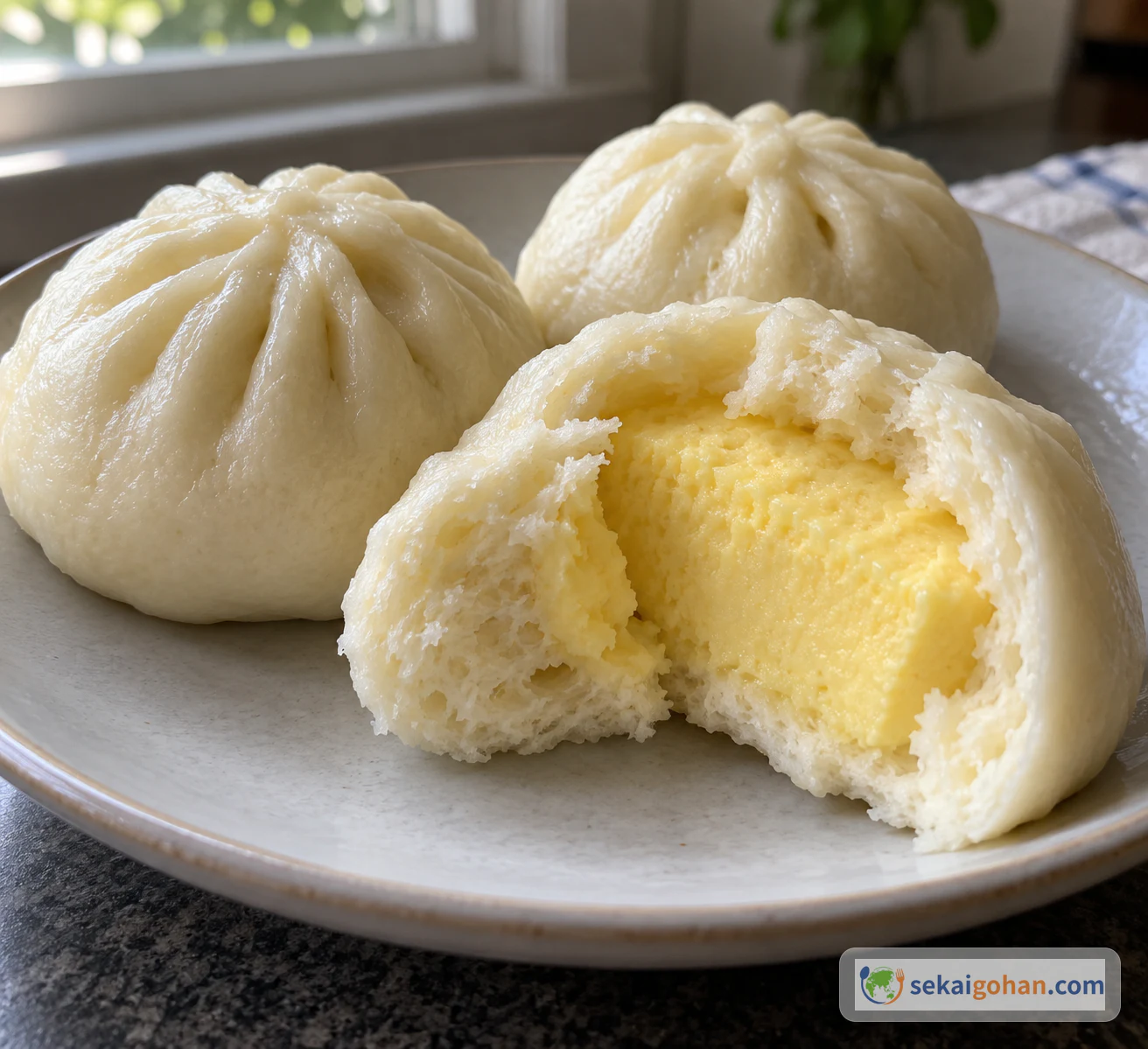
Ingredients
| Ingredient | Amount | Role |
|---|---|---|
| Custard filling (for 12 buns) | ||
| Eggs | 2 | Whole eggs, beaten first with the sugar. Don't switch to yolks only |
| Powdered sugar | 60 g | Sweetens the filling. Kept separate from the dough's 22 g |
| Milk | 60 ml | Filling milk. Kept separate from the dough milk |
| Heavy cream | 45 ml | Richness in the custard |
| All-purpose flour | 25 g | Helps thicken the custard. Kept separate from the dough's 235 g |
| Cornstarch | 30 g | Thickener. Cornstarch only; do not add wheat starch as well |
| Dry milk powder | 30 g | Milky flavor and body |
| Melted butter | 30 g | Stirred in before cooking |
| Dough (for 12 buns) | ||
| Yeast | 2 g (1 tsp) | Leavening |
| Warm water | 1/4 cup | For dissolving the yeast |
| All-purpose flour | 235 g | Body of the dough. Bleached all-purpose flour, for a soft, white bun |
| Powdered sugar | 22 g | Light sweetness in the dough |
| Salt | 1/4 tsp | Seasoning |
| Coconut milk | 45 ml | Liquid and flavor in the dough |
| Milk | About 45 ml (depends on humidity) | Add 1 tbsp at a time. Stop when the dough is smooth, even if milk is left |
Steps
1Set up the water bath
Pour water about 2 inches deep into a medium-to-large deep pot. Bring it to a boil, then lower the heat to a gentle simmer. Use a pot that your heatproof mixing bowl can sit in. Keep it at a gentle simmer while you mix the custard.
2Mix the custard base
In the mixing bowl, beat the 2 eggs with the 2 oz (60 g) of powdered sugar on low speed for about 1 minute. Add the filling's ¼ cup (60 ml) of milk and 3 tbsp (45 ml) of heavy cream, and mix for just a few seconds. Sift in the filling's 25 g of all-purpose flour, 1 oz (30 g) of cornstarch and 1 oz (30 g) of dry milk powder, then mix until no lumps remain. The dough's milk and coconut milk are not used here, and don't add wheat starch as well. Stir in the 1 oz (30 g) of melted butter until the mixture is smooth.
3Thicken and cool the custard
Set the bowl in the simmering water bath. Stir quickly and continuously until the mixture becomes a thick custard, then take it off the heat. In a stainless steel bowl this takes about 1 minute; a thicker bowl can take longer, so judge by thickness, not the clock. Take the bowl out of the water bath, cover the custard so its surface doesn't dry out, and let it cool completely. It needs to be fully cool before you can portion it and wrap it.
4Activate the yeast
Dissolve the 2 g of yeast in the 1/4 cup of warm water. Leave it for 10–15 minutes, then check that bubbles have formed on the surface.
5Mix the dough, adding milk a spoonful at a time
Put the yeast mixture in the stand mixer with the dough hook running on low. Add the dough's 8.5 oz (235 g) of all-purpose flour, 22 g of powdered sugar, 1/4 tsp of salt and 3 tbsp (45 ml) of coconut milk. Then add the milk 1 tablespoon at a time, using about 3 tbsp (45 ml) as a guide. Stop when the dough is smooth and no longer sticks to your hands or the bowl. Humidity changes how much you need, so stop when the dough is ready, even if milk is left.
6Proof the dough for the first time
Cover the dough with a dry kitchen towel and let it proof for 1 hour. It is ready when it has grown to about 2.5 to 3 times its original size.
7Portion the custard and cut the parchment
While the dough proofs, divide the cooled custard into 12 equal portions and roll each into a ball. Cover the balls so they don't dry out. Then cut 12 pieces of parchment paper, each 4 × 4 inches. You should end up with twelve custard balls and twelve parchment squares.
8Knock out the air and divide the dough
After the proof, return the dough to the mixer and mix for 2–3 minutes to release the air. Turn the dough out onto a clean, lightly floured surface and divide it into 12 equal pieces. Keep the pieces you aren't working on covered with the dry towel so they don't dry out.
9Roll, fill and pleat the buns
Roll one piece at a time into a 4-inch disk, making the edges a little thinner than the center. Place a custard ball in the center of the disk. Gather the edge into pleats and pinch the top closed. Repeat with the remaining pieces until you have 12 closed buns.
10Set the buns on parchment and proof them a second time
Place each wrapped bun on its own parchment square and arrange them on the steamer rack. At this point they have not had their second proof and are not cooked. Put warm water in the steamer, set the rack with the buns in place and cover with the lid. With the heat off, let the buns proof for 30 minutes.
11Steam, rest and serve
Turn the heat to medium and start timing 12 minutes as soon as the heat goes on. The time it takes the water to heat up is part of those 12 minutes, so don't wait for a boil before starting the timer. Keep the lid on. After 12 minutes, turn off the heat and leave the lid closed for 5 minutes so the buns settle. Then take off the lid and serve the buns warm.