Ingredients and steps on one page. Print it, or choose “Save as PDF” in the print dialog.
Sekai Gohan
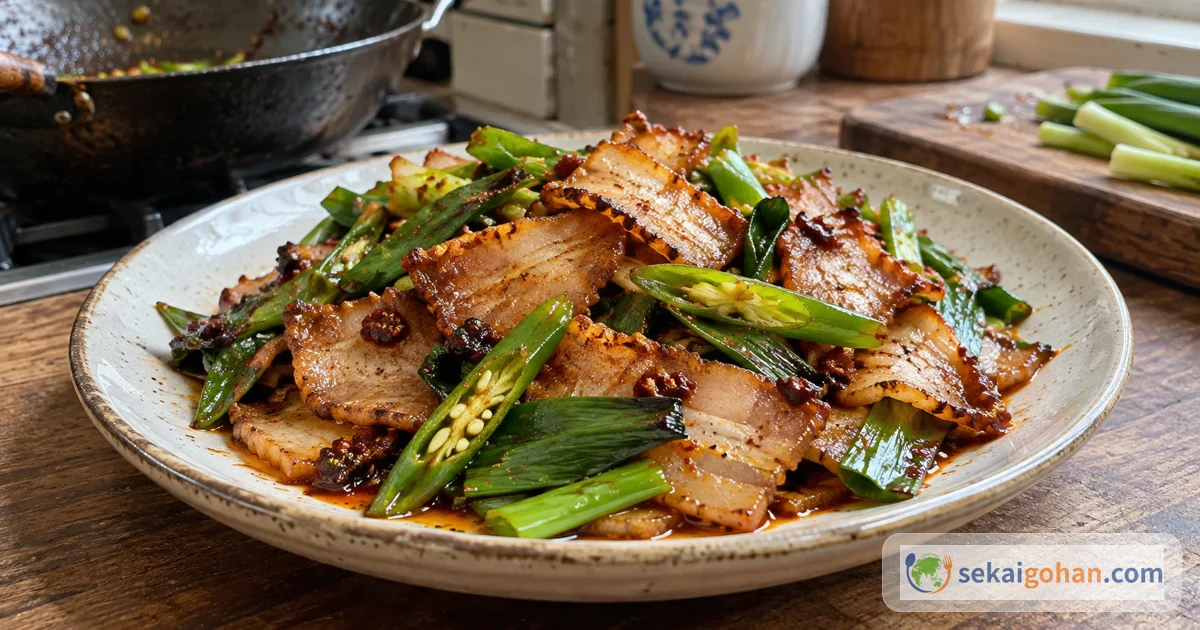
Hui Guo Rou (回锅肉): Sichuan Twice-Cooked Pork Belly with Doubanjiang and Garlic Shoots
Ingredients
Simmering the pork
| Ingredient | Amount | Substitutes & notes |
|---|---|---|
| Pork belly (block) | 1 lb (450 g) | Always buy it as a block. Skin-on is even better |
| Ginger | 2 slices | Sliced |
| Water | 2 quarts (1.9 L) | Enough to cover the meat |
Stir-fry
| Ingredient | Amount | Substitutes & notes |
|---|---|---|
| Neutral oil | 2 tbsp | Use in 2 portions of 1 tbsp |
| Doubanjiang | 1 1/2 tbsp | Sichuan Pixian doubanjiang is recommended |
| Garlic | 2 cloves | Sliced |
| Green chilies (long) | 2 | Seeded and cut into 1.5 inches (4 cm) lengths. Shishito-type peppers or bell pepper also work |
| Green garlic | 1 bunch | On the diagonal, 2 inches (5 cm) lengths. If none, 1 scallion |
| Shaoxing wine | 1 tbsp | Sake also works |
| Soy sauce | 1 tsp | — |
| Sugar | 1/4 tsp | — |
Steps
1Simmer the pork belly as a block
Bring 2 quarts (1.9 L) water to a boil over high heat in a medium pot and put in the pork belly as a block with 2 slices of ginger. When it returns to a boil, lower to low heat and simmer about 30 minutes at a heat that barely shivers the surface. It is done when a chopstick slides in easily and the color of the meat has turned whitish all the way through. Skim off any scum that rises along the way.
2Cool under running water and cut the vegetables
Take the simmered pork out and run water over it for about 1 minute to cool the surface. Cooling firms the meat and makes it easier to slice thin. Meanwhile, cut the green garlic on the diagonal into 2 inches (5 cm) lengths, seed the green chilies and cut into 1.5 inches (4 cm) lengths, and slice the garlic. Do not slice the pork yet. If you cut it ahead, the surface of the meat dries out.
3Slice the pork 0.125 inch (3 mm) thick
Just before stir-frying, slice the pork into slices about 0.125 inch (3 mm) thick. Cut across the grain so each slice has both fat and lean. If it is too thick it will not curl when seared over high heat, and if it is too thin it will fall apart in the stir-fry, so keep the thickness as even as you can. Count on 2–3 minutes to finish cutting.
4Sear the pork over high heat
Heat a wok over high heat until it begins to smoke faintly. Add 1 tbsp neutral oil, spread the sliced pork out, and sear about 90 seconds. When the fat turns translucent and seeps out and the edges of the meat curl and take on a light browning, lower the heat to medium-low and take the pork out for now. The edges curling into the shape of a lamp dish is the guide for this step.
5Stir-fry the doubanjiang and garlic
Add the remaining 1 tbsp oil to the wok and, keeping the heat at medium-low, add 1 1/2 tbsp doubanjiang and stir-fry about 30 seconds. When the oil has turned a vivid red and the doubanjiang smells fragrant, add the sliced garlic and stir-fry another 30 seconds. If the doubanjiang begins to blacken on the bottom, take the wok off the heat at once to lower the temperature.
6Return the pork and vegetables and stir-fry over high heat
Return the heat to high, add the pork you took out, the green chilies, and the green garlic all at once, and toss together briskly for about 1 minute. Move on when the red oil coats the pork evenly, the green of the garlic shoots is vivid, and the edges of the meat still carry a toasty browning. Overcooking the vegetables loses their crisp texture.
7Season and finish
Add 1 tbsp Shaoxing wine, 1 tsp soy sauce, and 1/4 tsp sugar and mix about 30 seconds to blend the flavors. Turn off the heat when the garlic shoots have wilted and the green chilies are cooked but still have a little bite, and plate at once. The guide for doneness is a glossy sheen on the surface of the pork and a thin spread of red oil on the bottom of the plate.