Ingredients and steps on one page. Print it, or choose “Save as PDF” in the print dialog.
Sekai Gohan
Cantonese Lotus Seed Mooncakes with Salted Egg Yolk (月餅, Yuèbǐng)
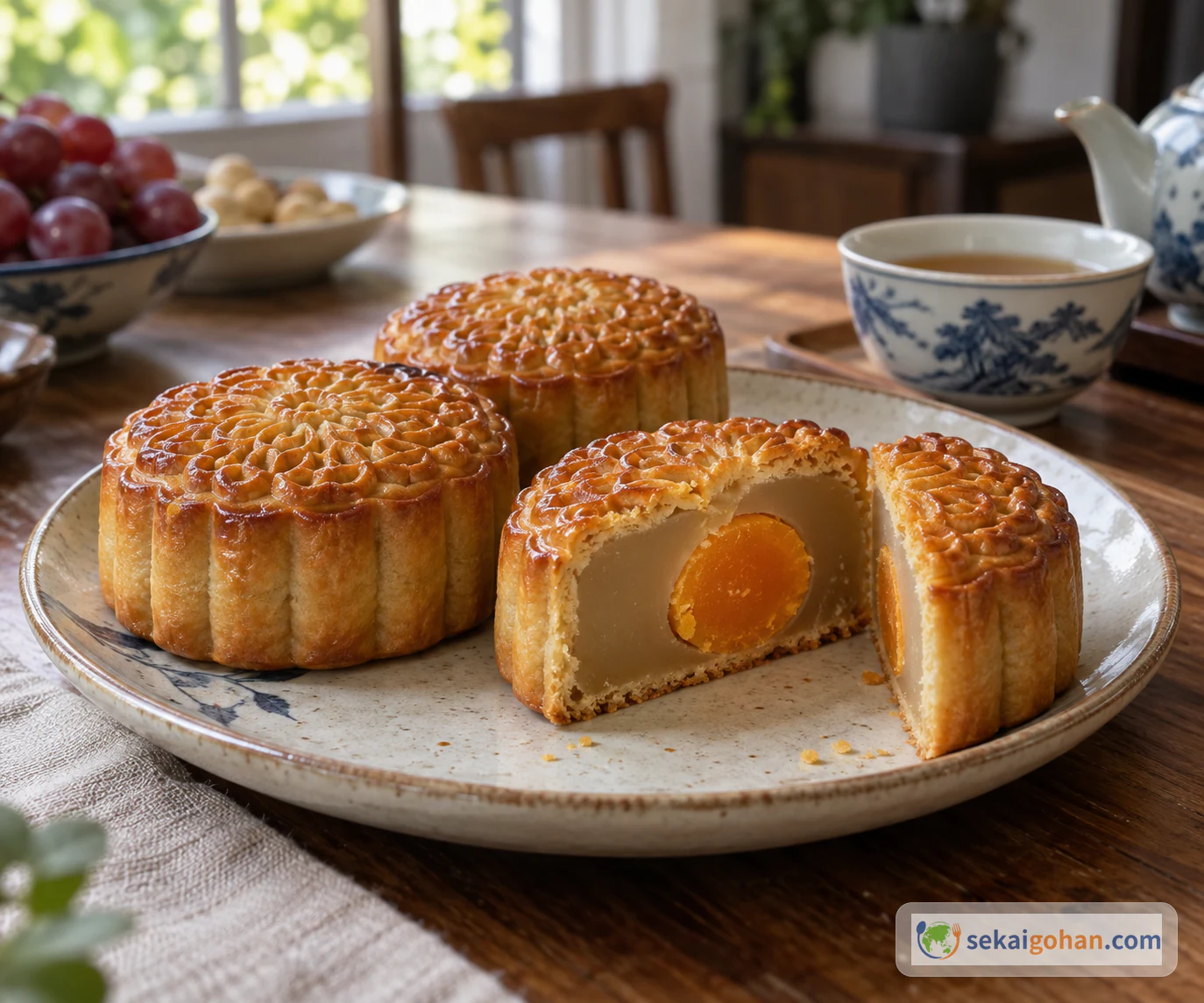
Ingredients
Golden syrup (made ahead)
| Ingredient | Amount | Role |
|---|---|---|
| Granulated sugar | 8 oz (1 cup + 2 tbsp) | The sugar for the syrup |
| Water | 1/2 cup | For the syrup |
| Lemon juice | 1/2 lemon | Added once the syrup boils |
Lotus seed paste
| Ingredient | Amount | Role |
|---|---|---|
| Dried lotus seeds | 12 oz | The base of the paste. Split seeds save time; whole seeds need the green germ removed |
| Water | 4 cups | For boiling the seeds. Reserve the cooking liquid |
| Powdered sugar (icing sugar) | 1 2/3 cups | Sweetness and body of the paste |
| Peanut oil or corn oil | 1 1/4 cups | Makes the paste smooth and cohesive |
| Maltose | 1/3 cup | Stickiness and moistness |
Center
| Ingredient | Amount | Role |
|---|---|---|
| Salted duck egg yolks, cooked, individual | 12 | One per yolk cake |
Dough
| Ingredient | Amount | Role |
|---|---|---|
| Golden syrup (from above) | 140 ml | Measured from the cooled syrup, not the whole batch |
| Peanut oil or corn oil | 1/3 cup | The fat in the dough |
| Lye water (food-grade alkaline water) | 1 tsp | A defining element of the Cantonese skin |
| Flour | 1 3/4 cups, plus extra for dusting | The dough; dusting flour for shaping and the mold |
Egg wash
| Ingredient | Amount | Role |
|---|---|---|
| Egg yolk (chicken) | 1 | For the surface |
| Water | 3 tbsp | Thins the yolk |
Steps
1Make the golden syrup the day before
Put the granulated sugar and water in a saucepan and dissolve over medium heat. When it comes to a boil, add the lemon juice, turn the heat to low, and simmer without stirring for 60–70 minutes. You are aiming for a light amber color, and a syrup that is about as thick as honey once it cools. Don't let it darken into caramel. Hot syrup can spatter and burn, so keep your face back from the pot.
Let the syrup cool completely before measuring out the ½ cup (140 ml) you need for the dough.
2Remove the germ, soak, and boil the lotus seeds
If your lotus seeds are whole, split them and remove the small green germ from the center before soaking; it is the source of bitterness. Rinse the seeds and soak them in water overnight.
The next day, rinse the seeds and put them in a pot with the 4 cups of water, making sure they sit below the surface. Bring to a boil, then lower the heat and simmer for 30 minutes. Turn off the heat when the seeds are soft but not yet falling apart. Don't discard the cooking liquid; set it aside for the next step.
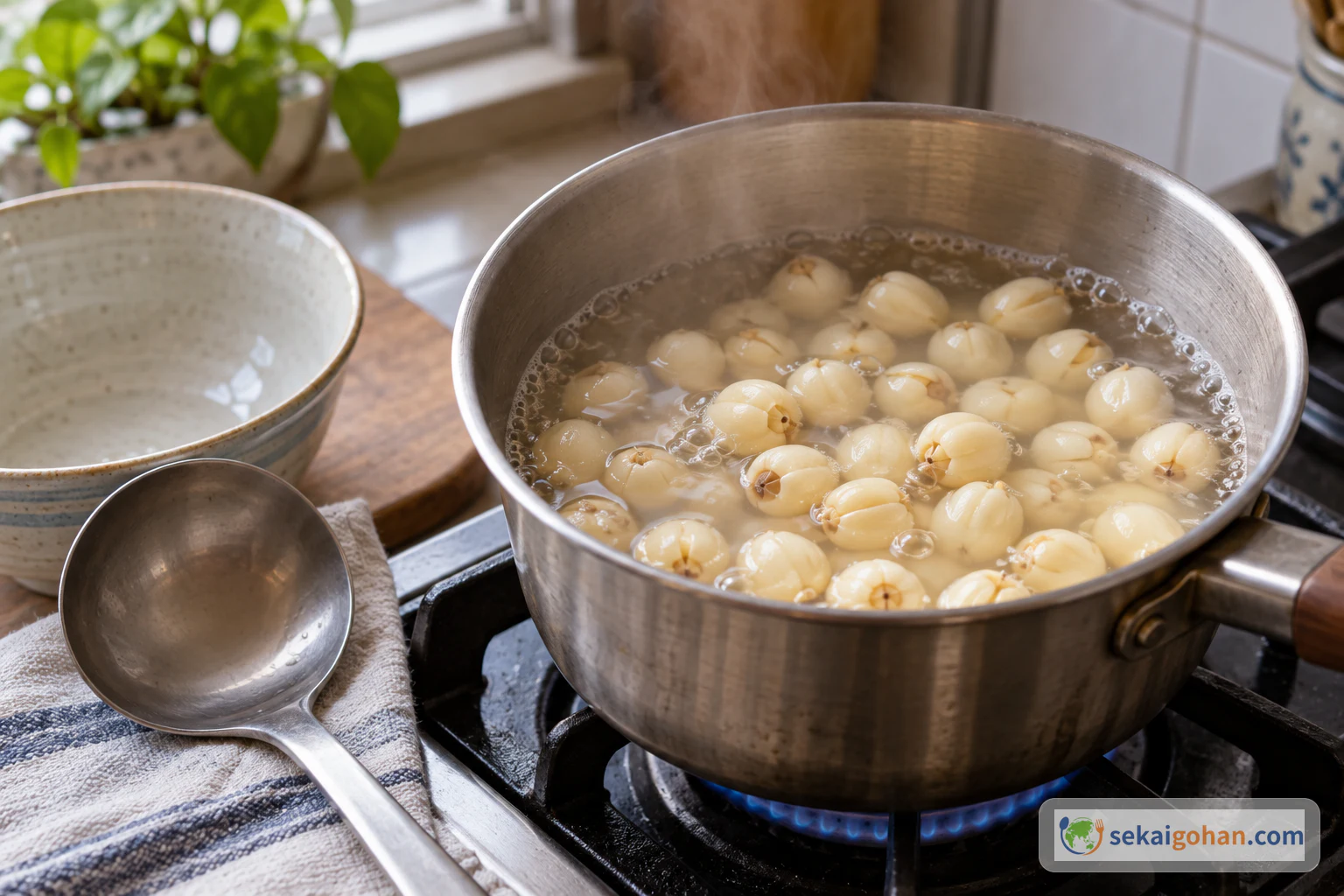
Stop when the seeds are soft but still hold their shape, and keep the cooking liquid 3Cook the lotus paste until it holds its shape
Purée the boiled seeds in about two batches, adding the reserved cooking liquid a little at a time until the purée is as smooth as hummus. You won't need all of the liquid.
Transfer the purée to a wide pan over medium-low heat and keep turning it constantly from the bottom. Add the oil in 3–4 additions, then the powdered sugar in 3–4 additions, and finally the maltose in 2 additions, mixing until each addition is fully absorbed before adding the next. Adding them gradually simply helps each one blend evenly into the paste. Plan on about 30 minutes, but judge by the paste, not the clock: how fast the moisture cooks off depends on your heat. Avoid heat so high that the bottom of the pan smokes or throws off heavy steam.
Stop when the paste comes together, soft but able to hold its shape. If it is still loose, it will be harder to wrap later. Let it cool completely, then refrigerate, ideally overnight.
4Prepare the salted egg yolks
This recipe uses cooked individual salted duck egg yolks. Bake them at 350°F (175°C) for 8 minutes, then let them cool completely. No spirit is needed for this route.
Other product types need different handling (see the variations below). Whichever you use, confirm whether the yolks are raw or cooked before you start.
5Make the dough and let it rest
Mix the 140 ml of syrup, 1/3 cup oil and 1 tsp lye water, then add the 1 3/4 cups flour. Fold with a rubber spatula just until no dry flour remains; don't overwork it. Cover tightly and refrigerate for 1 hour. Chilled dough is easier to shape.
6Weigh out the filling and dough
Divide the lotus paste into 12 portions of 2 oz (58g) and 6 portions of 2.5 oz (70g), and roll each into a ball. Make a hollow in each 2 oz (58g) ball, set one salted yolk inside, and close the paste around it. Divide the dough into 18 portions of 25g, plus a little extra for patching. Keep the yolk and no-yolk balls on separate trays so you can tell them apart, and keep any dough you aren't working with in the refrigerator.
7Wrap the filling and press the pattern
Flatten a portion of dough into a thin disc about 4 inches (10 cm) across and set a filling ball in the center. Ease the dough up and around the filling, spreading it evenly, press out any trapped air, and seal. If the skin tears, close the gap with a bit of the extra dough.
Dust the wrapped ball lightly with flour, and dust the patterned face of the 3.5 oz (100g) mold each time before pressing. Press, then release the cake carefully; don't rush this. If dough sticks in the edges or fine details of the mold, the pattern will come out incomplete, so clean the mold and dust it again before the next one. This is the same kind of careful wrapping found in other Chinese filled dishes such as xiaolongbao, though the dough and filling here are entirely different.
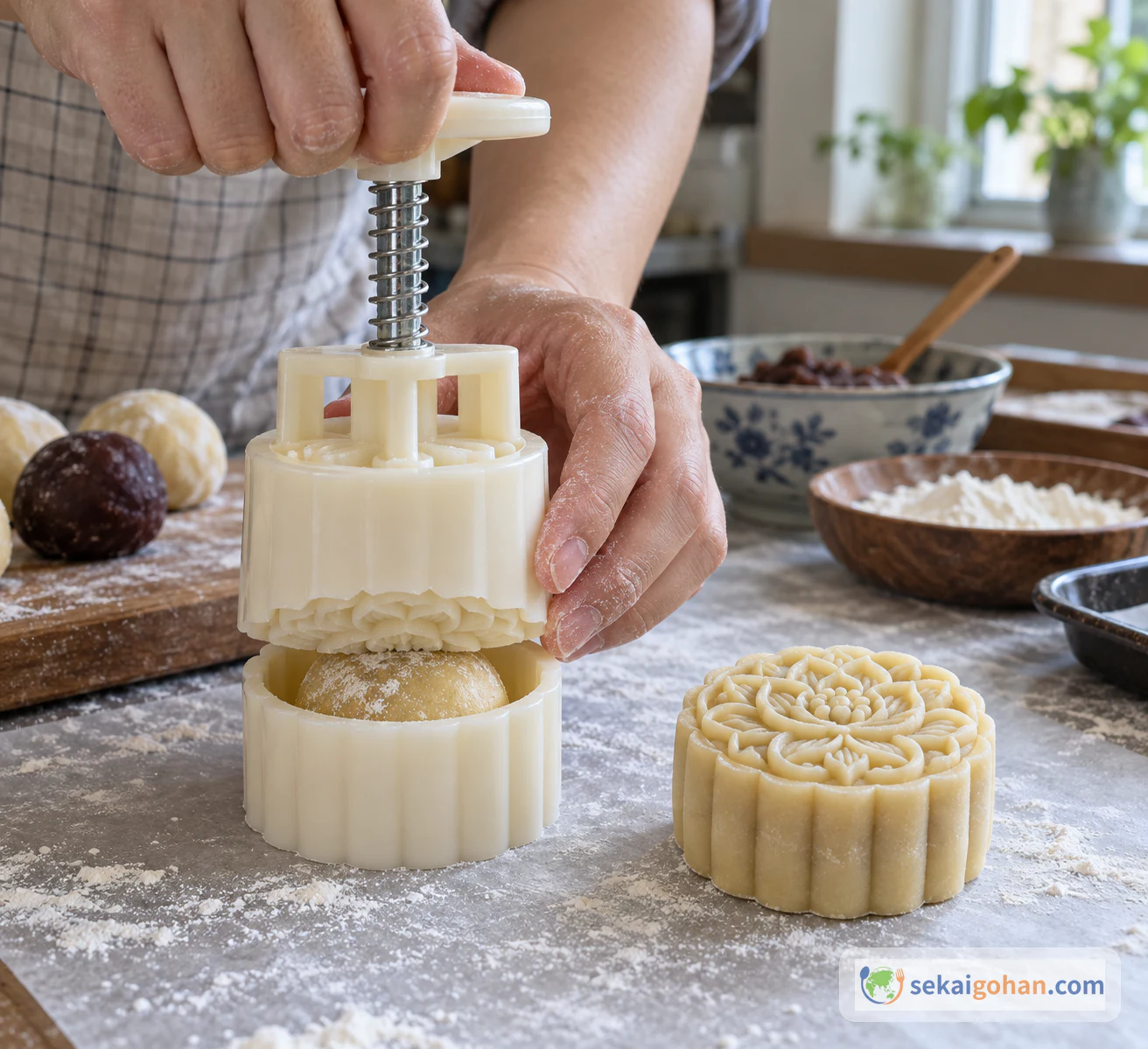
Dust the mold every time, and clean out any dough caught in the pattern 8Bake at 325°F (160°C), then finish at 300°F (150°C)
Preheat the oven to 325°F (160°C). Lightly mist the surface of the cakes with water, or flick on a few drops with your fingertips, to keep the surface from cracking during baking. Bake at 325°F (160°C) for 5 minutes.
Take the tray out, minding the hot pan, and lower the oven to 300°F (150°C). Mix the egg yolk with the 3 tbsp water and brush a single thin coat over the cakes, keeping the wash from pooling in the grooves of the pattern. Bake for another 15 minutes, and take them out once the cakes are baked with their pattern intact. Don't judge doneness by color alone.
Fresh from the oven the crust looks dry. That is normal.
9Cool, then rest in an airtight container
Let the mooncakes cool completely, then refrigerate them in an airtight container. The crust regains its sheen after a 1–2-day rest. Keep them refrigerated throughout, since they contain egg yolk.
Because these contain egg yolk, store leftovers in the refrigerator for up to 10 days; that is not a safety guarantee for every home kitchen. No safe room-temperature period or reheating method is suggested here.