Ingredients and steps on one page. Print it, or choose “Save as PDF” in the print dialog.
Sekai Gohan
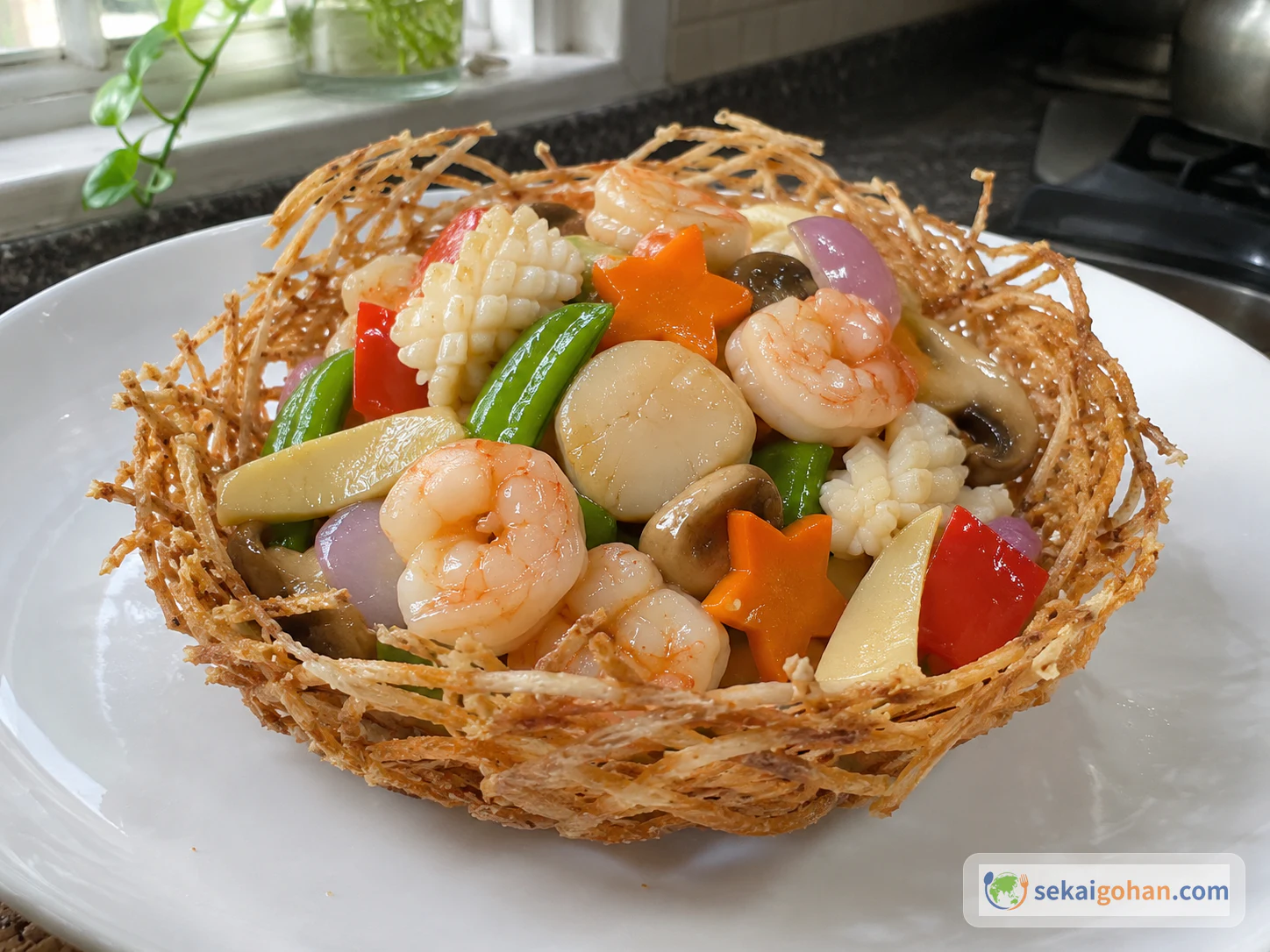
Seafood Bird's Nest: Cantonese Seafood Stir-Fry in a Fried Taro Basket
Ingredients
| Ingredient | Amount | Role |
|---|---|---|
| Taro (芋頭), cut into thin matchsticks | 4 cups | The nest; its own starch binds the strands |
| Canola oil, for deep-frying | 6 cups | Fries the nest at 325°F (163°C) |
| Large shrimp (16–20 count), peeled and deveined | 6, about 6 oz (170 g) | Sweet, firm bite; a lucky food |
| Large sea scallops | 6, about 6 oz (170 g) | Soft, rich bite; a lucky food |
| Whole squid, cleaned | 6 oz (170 g) | Curls into scored pieces that hold sauce |
| Water, for blanching | 6 cups | Par-cooks the seafood |
| Canola oil, for stir-frying | 3 tbsp, divided | 2 tbsp go into the wok first for the aromatics |
| Ginger, sliced ⅛ inch (3 mm) thick | 8 slices | First aroma in the oil |
| Scallions, white parts only, cut on the diagonal into 1½-inch (4 cm) pieces | 2 | Mild onion aroma |
| Garlic, sliced | 2 cloves | Savory backbone |
| Carrot, cut into ⅛-inch (3 mm) stars | ½ | Color and sweetness |
| Bamboo shoots, rinsed and drained | ½ cup | Crisp, clean crunch |
| Red bell pepper, cut into 1-inch pieces | ¼ | Color and sweetness |
| Straw mushrooms (草菇), fresh or canned | ½ cup | Slippery, meaty bite |
| Sugar snap peas, ends trimmed | 1 cup | Green snap |
| Red onion, cut into 1-inch pieces | 1 small | Sweetness and color |
| Shaoxing wine (紹興酒) | 2 tsp | Warm, rounded aroma on the seafood |
| Chicken stock, hot | 1 cup, adjusted to taste | Body of the sauce |
| Salt | 1 tsp | Seasoning |
| Sugar | ¼ tsp | Rounds the salt |
| Ground white pepper | ⅛ tsp | Gentle heat |
| Sesame oil | ½ tsp | Finishing aroma |
| Cornstarch (optional) | 1½ tbsp | Thickens the sauce |
| Warm water (optional) | 1½ tbsp | Mixed with the cornstarch into a slurry |
Steps
1Cut the taro and weave the nest
Cut the taro into thin matchsticks until you have 4 cups. Lay the strands across a large mesh strainer in a crisscross pattern, layer over layer, letting the ends hang over the rim. Do not rinse or dry them; the taro's natural starch is what binds them. Press the second strainer of the same size on top to sandwich the strands. The nest is ready to fry when the strands sit in an even, tightly overlapping lattice with no open holes at the bottom.
2Heat the oil and lower the nest
Pour 6 cups of canola oil into the wok and heat it, watching the thermometer, until it reads 325°F (163°C). Holding both strainer handles together, lower the sandwiched nest into the oil very slowly. The oil bubbles up hard as the moisture leaves the taro, so let it settle a little before lowering further. Move on when the whole nest is submerged and the oil is bubbling steadily around the strands.
3Fry the nest golden and set it on the platter
Keep the oil as close to 325°F (163°C) as you can, adjusting the heat as the taro cools it. Tilt the strainers back and forth so every part of the nest, including the overhanging rim, spends time under the oil. Fry until the nest is golden all over. Lift the strainers out together, let the oil drain back into the wok, then turn the nest out onto a serving platter. It is done when it is evenly golden.
4Cut and score the squid
Separate the squid tentacles and leave them whole. Cut the body into flat pieces about 2 by 3 inches. Score the inside of each piece in a fine crosshatch, cutting partway through without cutting all the way. Put 6 cups of water on to boil for blanching. The squid is ready when every flat piece carries an even grid across its surface.
5Blanch the seafood
Drop the shrimp and scallops into the boiling water for about 20 seconds, until they are about 70% cooked, then lift them out with a spider. Add the squid next for about 10 seconds, until the pieces curl and the scored grid opens, and lift it out. Set all the seafood aside together.
6Bloom the aromatics
Set a clean wok over medium-high heat. Swirl 2 tbsp of the stir-frying oil around the sides so it coats the wok. Add the ginger and fry for about 10 seconds. Add the scallions and garlic and fry for about 10 seconds more. Move on to the vegetables once the aromatics have had those times.
7Stir-fry the vegetables
Add the carrot, bamboo shoots and bell pepper, turn the heat to high and stir-fry for 30 seconds. Add the straw mushrooms, snap peas and red onion and toss them through the oil. Keep everything moving so nothing sits on the hot metal. The vegetables are ready when they are bright, glossy and still crisp.
8Return the seafood and add the wine
Put the blanched shrimp, scallops and squid back into the wok. Pour the Shaoxing wine around the edge so it hits the hot metal. Stir-fry for about 1 minute. The seafood finishes cooking here, so work quickly. Move on when the shrimp and scallops are opaque all the way through and the wine has cooked off into a warm aroma.
9Add the stock and season the sauce
Pour in the hot chicken stock. As it comes to a boil, add the salt, sugar, white pepper and sesame oil. Taste and adjust quickly so the seafood does not overcook. If you want a thicker sauce, stir the cornstarch into the warm water and add the slurry a little at a time, stirring, until the sauce is glossy and thick enough to coat the seafood.
10Fill the nest and serve
Right before serving, spoon the stir-fry into the taro nest on its platter. Pour in the sauce with the filling. Carry it straight to the table. Serve while steam is still rising and the nest still holds its crisp, rigid shape.