Ingredients and steps on one page. Print it, or choose “Save as PDF” in the print dialog.
Sekai Gohan
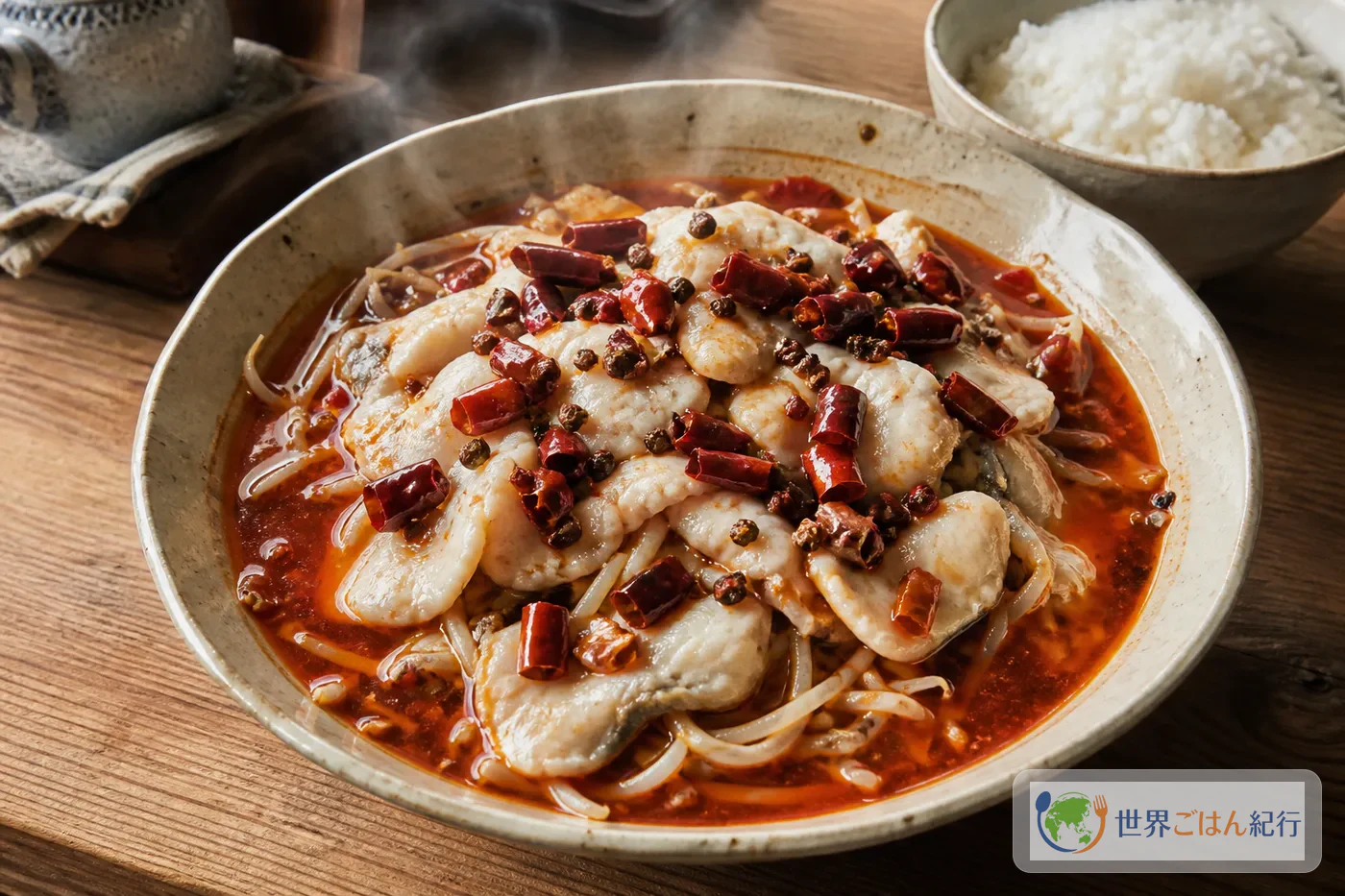
Shuizhu Yu: Sichuan Boiled Fish Finished with Sizzling Oil
Ingredients
Fish and marinade
| Ingredient | Amount | Substitutes & how to choose |
|---|---|---|
| White fish fillets (skinless, boneless) | 1.25 lb (600 g) | Basa, sea bass, red sea bream. Pat cod dry before using |
| Salt | 4 g | About 0.7% of the fish's weight. Keep it modest because of the doubanjiang's salt |
| White pepper | 1 g | Ground. Optional |
| Shaoxing wine | 1 tbsp (15 ml) | A mild cooking wine also works |
| Egg white | From 1 egg (about 1 oz / 30 g) | Starch alone makes the coating heavy |
| Potato starch | 25 g | Cornstarch also works |
| Oil for the marinade | 2 tsp (10 ml) | A neutral oil such as rice bran oil |
Broth and vegetables
| Ingredient | Amount | Role & substitutes |
|---|---|---|
| Soybean sprouts | 9 oz (250 g) | Or 9 oz (250 g) napa cabbage, 6.5 oz (180 g) celery, 7 oz (200 g) enoki |
| Pixian doubanjiang | 1.75 oz (50 g) | Heat and the savory depth of fermented beans. With regular doubanjiang, start at 1.5 oz (45 g) |
| Chicken stock or water | 2¾ cups (650 ml) | Prefer unsalted stock. If using granules, reduce the salt |
| Garlic | 4 cloves (about 25 g) | Half for the broth, half for finishing |
| Ginger | 20 g | Peel thinly; cut half into thin strips |
| Japanese long onion (negi) | 1 (about 3.5 oz / 100 g) | White part for the broth, green part for finishing. A thick leek or several scallions can stand in |
| Soy sauce | 2 tsp (10 ml) | Color and salt. Too much hides the doubanjiang aroma |
| Sugar | 1 tsp (4 g) | Softens the edge of the heat. Not meant to make it sweet |
| Black vinegar (Chinkiang) | 2 tsp (10 ml) | For finishing. If using rice vinegar, start at 1 tsp |
| Oil | 2 tbsp (30 ml) | For frying the doubanjiang. Rice bran oil, canola oil, etc. |
Finishing
| Ingredient | Amount | How to use |
|---|---|---|
| Dried chiles | 12–18 (about 12 g) | To lower the heat, remove half the seeds and use fewer |
| Sichuan peppercorns (whole) | 5–7 g | Keep them whole for aroma; use 3 g for less numbness |
| Finishing oil | ¼ cup (80 ml) | Aim for 170–180°C; stop before it smokes |
| Cilantro or scallion greens | 20 g | If you don't like cilantro, use scallions only |
Steps
1Slice the fish on the diagonal and coat with egg white and starch
20 min (including resting in the fridge)
Holding the knife at a 45-degree angle to the grain, slice 1.25 lb (600 g) white fish into pieces 8–10 mm thick and 5–6 cm long. Toss with 4 g salt, the white pepper and 1 tbsp (15 ml) Shaoxing wine, add 1 oz (30 g) egg white and mix until the surface turns slick. Add 25 g potato starch in 2 additions, and once no dry powder remains, drizzle 2 tsp (10 ml) oil over the surface. Rest in the fridge for 15 minutes; the fish is ready when its surface has a thin sheen.
If you cut it thick, the coating comes off before the center cooks; too thin and it falls apart in the pot. If the fillets are very wet, press them with paper towels before salting. Don't leave the fish at room temperature for long, and return the marinated bowl to the fridge.
2Line the bowl with vegetables and make the doubanjiang broth
10 min
Medium to medium-high heat. Blanch 9 oz (250 g) soybean sprouts in boiling water for 40 seconds, drain and spread them over the bottom of the deep heatproof bowl. Thinly slice the white part of the long onion, 10 g ginger and 2 cloves garlic. Heat 2 tbsp (30 ml) oil in the wok over medium heat and stir-fry the onion, ginger and garlic for 40 seconds. When fragrant, add 1.75 oz (50 g) Pixian doubanjiang and fry for 1 minute 30 seconds, scraping the bottom of the wok with a wooden spatula. When the oil turns red and the raw smell of the doubanjiang is gone, pour in 2¾ cups (650 ml) chicken stock or water.
Add 2 tsp (10 ml) soy sauce and 4 g sugar and bring to a boil over medium-high heat. When it boils, lower to medium-low and simmer for 5 minutes to draw the ginger and doubanjiang aroma into the liquid. It's enough when red oil floats on the surface and a thin color remains on the back of a spoon. Burnt doubanjiang leaves a bitterness you can't undo, so add the stock before black bits stick to the bottom of the wok.
3Add the fish piece by piece and cook at a gentle simmer
4–6 min
Medium-low heat, aiming for a broth temperature of 85–90°C (185–194°F). Bring the broth back to a gentle bubble and slide the fish in one piece at a time without overlapping. Dropping it all in at once makes the coating stick together, so add 10–15 pieces at a time, with pauses in between. After all the fish is in, lower the heat, don't stir the pot broadly, and gently spoon broth over the surface with the slotted ladle.
For pieces 8–10 mm thick, 2 minutes 30 seconds to 3 minutes is the guide. Check that the flesh has turned from translucent to white, feels springy when pressed with chopsticks, and is heated through to the center. As a food-safety standard, the thickest part of the fish should reach 63°C (145°F). Even without a thermometer, don't plate fish whose center is still translucent. If you keep the broth at a hard boil, the starch film breaks and the fish splits.
4Transfer the fish and broth to the heatproof bowl and layer the spices
3 min
Work quickly after turning off the heat. Once the fish is cooked, use the slotted ladle to move it onto the soybean sprouts first. Taste the remaining broth; if it needs salt, add 1 g at a time, and if you want acidity, add 2 tsp (10 ml) black vinegar. Pour the broth over the fish and scatter 10 g of the green part of the long onion, 10 g of ginger cut into thin strips, the remaining 2 cloves garlic, 12–18 dried chiles and 5–7 g Sichuan peppercorns over the surface.
Don't heap the chiles and peppercorns in the center; spread them thinly over all the fish. If the oil hits only one spot, that spot burns and the other spices don't release their aroma. Always use a heatproof bowl warmed with boiling water, and never pour hot oil into thin glass or a cold ceramic bowl.
5Pour over 170–180°C oil and eat right away
3 min
Heat the finishing oil over medium heat. Put 80 ml finishing oil in a small pan and heat over medium to 170–180°C (338–356°F). Without a thermometer, dip a dry wooden chopstick into the oil: fine bubbles should stream steadily around the tip, with no smoke. If the oil is smoking, turn off the heat, wait 30 seconds and check again.
Pour the oil in a thin stream from the center of the bowl outward. Success is when the peppercorns and chiles immediately crackle softly and the edges of the garlic turn lightly golden. Finish with 20 g chopped cilantro or scallion on top. If you smell burning, don't force the rest of the oil in; make a new batch at a lower temperature. The oil will spatter, so keep your face away from the bowl, wear long sleeves, keep a dry cloth ready, and turn off the stove when you've finished pouring.
Serve the finished shuizhu yu with white rice before the oil cools. Using one spoon for the broth and a slotted ladle that won't break the fish keeps the coating from coming off in the bowl.