Ingredients and steps on one page. Print it, or choose “Save as PDF” in the print dialog.
Sekai Gohan
Tanghulu: Northern Chinese Candied Hawthorn Skewers in Glassy Sugar
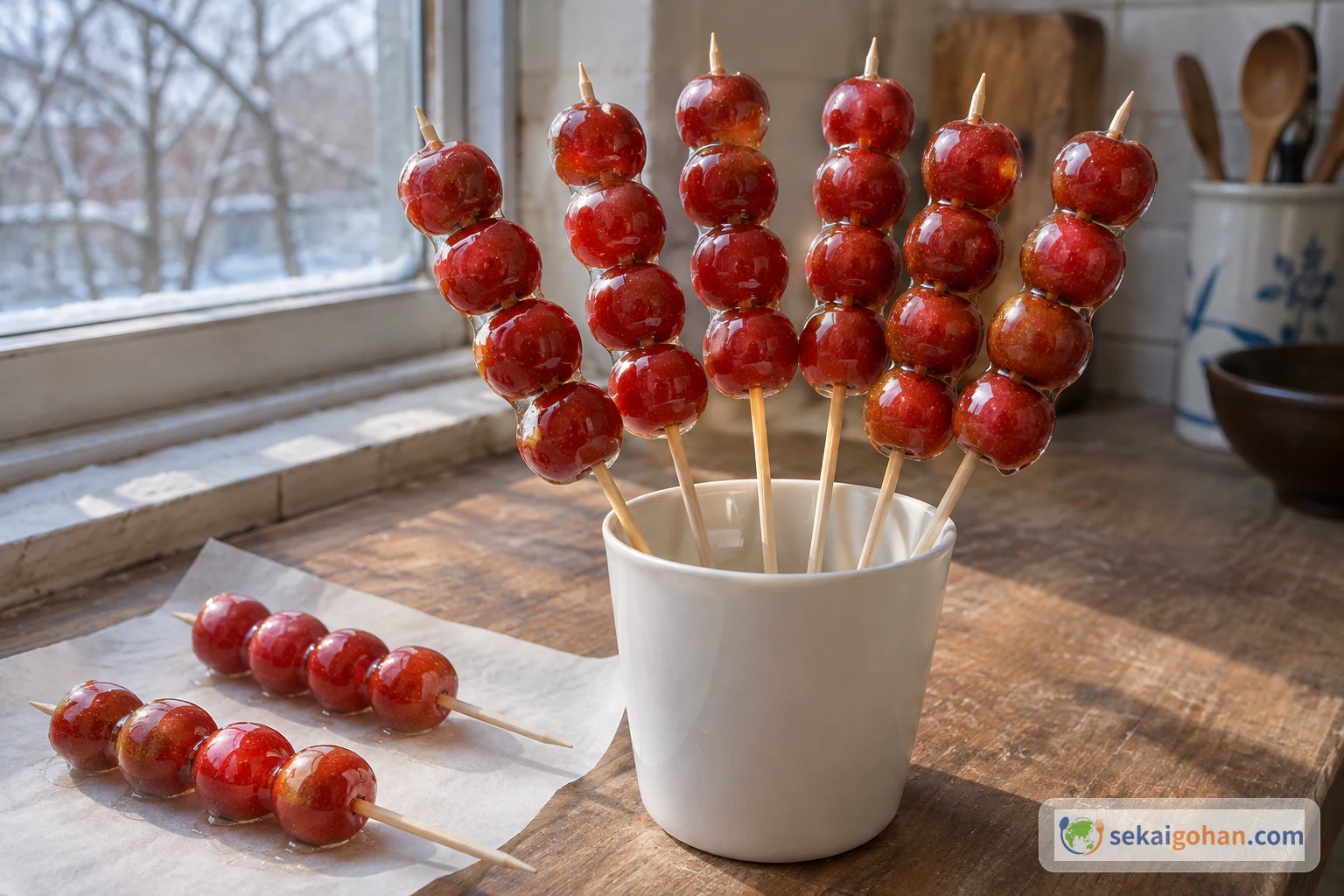
Ingredients
| Ingredient | Amount | Role |
|---|---|---|
| Fresh hawthorn berries (山楂, shānzhā) | 24 | The sour centre of each bite; pitted, 4 per skewer |
| Granulated white sugar (白糖) | 7 oz (200 g) | Cooks down into the glassy shell |
| Water (清水) | 3½ oz (100 g / 100 ml) | Dissolves the sugar before it boils off |
Steps
1Wash, pit and dry the fruit
Wash the hawthorn and drain it well. Push each pit out with the thick end of a skewer or a small pitter, or halve the berry lengthwise with a paring knife and lift the pit out. The pits must go, because they are a choking hazard. Spread the berries in a single layer on a dry towel and leave them to air-dry for about 30 minutes, or pat each one with paper towels if you are short of time. Move on when the skins look matte and no bead of water sits in the pit cavity.
2Thread the skewers
Thread 4 berries onto each skewer, leaving a gap of about ⅛ inch (3 mm) between them so syrup can wrap each one. Keep a bare length at the end as a handle. Once a berry is on, do not twist or reposition it, or it loosens and spins in the syrup. Lay the six skewers in a row near the stove. They are ready when each berry sits snug and turns with the skewer.
3Start the syrup
Put the sugar and water in the shallow saucepan. Stir once or twice, just enough to wet all the sugar, and set the pan over medium heat. You can stir gently until the sugar dissolves, then put the spoon away for good. The syrup is ready to boil when the liquid runs clear with no grains on the bottom.
4Boil without stirring
Let the syrup boil and swirl the pan now and then instead of stirring. If sugar crystals form on the inside wall, brush them down with a pastry brush dipped in water. The bubbles start large and clear, then turn small, dense and even while the syrup thickens and goes faintly yellow. On a strong burner this takes 10 to 15 minutes, and on gentler heat it can stretch to 20 to 30, so watch the bubbles, not the clock.
Stir only before the boilStirring a boiling sugar syrup knocks it back into crystals and turns the shell white and sandy. Once it boils, your only moves are swirling the pan and brushing down the walls.
5Test for hard crack
With a thermometer, cook to 300°F (150°C). Without one, dip the tip of a clean skewer or a fork into the syrup and plunge it straight into the iced water. Wait a few seconds and bend the sugar: if it snaps hard and clean, the syrup is ready. If it bends or feels tacky, boil one more minute and test again, then turn the heat to low to keep the syrup fluid.
6Coat each skewer in one thin pass
Tilt the pan so the syrup pools deep on one side. Lay a skewer against the surface and roll it through once, so the syrup wraps the berries in a thin, even layer. Keep the fruit from sinking into the syrup, because it heats through and starts to weep juice. Lift it, let the excess run back for a moment, and never go in for a second coat. A good pass leaves a glossy shell with the red of the fruit showing clearly through.
One pass, on the surfaceA second dip or a full plunge builds a thick, lumpy shell and cooks the fruit underneath. If the syrup starts to stiffen between skewers, warm it briefly over low heat before the next one.
7Cool until the shell sets
Lay each skewer on the silicone mat or parchment with space between them, so the shells do not fuse. Leave them for 2 to 3 minutes. For a quicker set, dip a freshly coated skewer straight into the iced water instead, then shake it off and lay it down. The shells are set when they look glassy and feel hard.
8Eat, and deal with the leftover syrup
Wait until the shells are completely cool, then eat. Tanghulu is at its best within an hour or two, and it should be eaten the same day. Pour any leftover syrup onto parchment and break it into shards once hard, or melt it again over low heat for a few more skewers. If the syrup has gone grainy and white, start a fresh batch instead. The first bite should shatter cleanly with no pull on your teeth.