Ingredients and steps on one page. Print it, or choose “Save as PDF” in the print dialog.
Sekai Gohan
Wu Gok: Cantonese Deep-Fried Taro Dumplings with a Honeycomb Crust
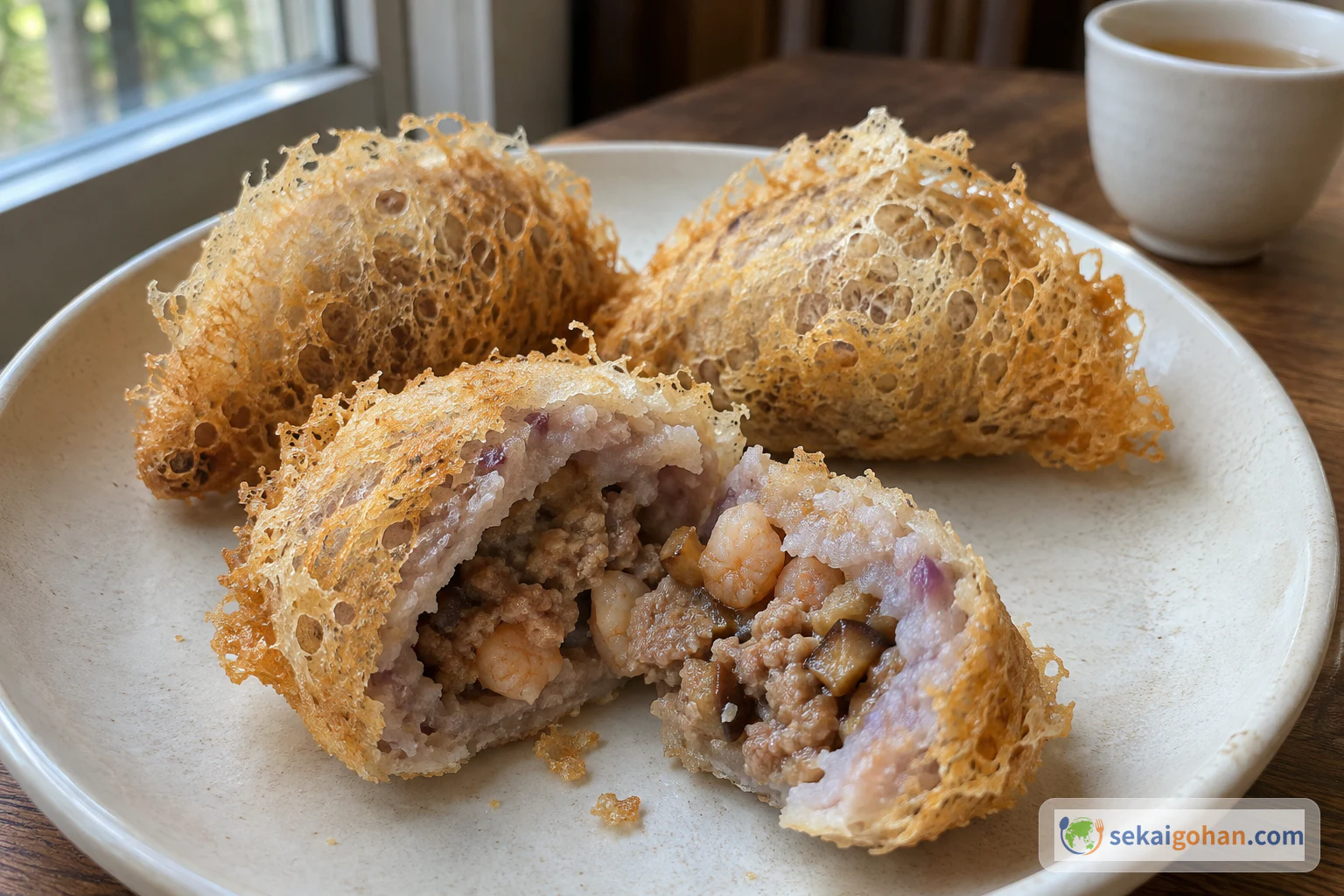
Ingredients
| Ingredient | Amount | Role |
|---|---|---|
| Filling | ||
| Vegetable oil | 1 tbsp | For stir-frying the filling |
| Raw shrimp, peeled | scant 1 oz (25 g) | Sweetness and bite |
| Pork shoulder, minced | 3½ oz (100 g) | The body of the filling |
| Dried shrimp | scant ¼ oz (5 g) | Deep savory flavor and salt |
| Dried shiitake mushrooms | 2 | Aroma and chew |
| Oyster sauce | 2 tbsp | Savoriness, gloss, color |
| Ground white pepper | ¼ tsp | Gentle heat |
| Dark soy sauce (老抽) | 2 tsp | Color and depth |
| Sugar | 1 tsp | Rounds the seasoning |
| Salt | ½ tsp | Seasoning |
| Water | ¼ cup (about 60 ml) | Simmers the filling into a sauce |
| Cornstarch | 2 tsp | Thickens the filling |
| Sesame oil | 1 tsp | Finishing aroma |
| Wrapper | ||
| Wheat starch (澄粉) | 4¼ oz (120 g) | The structure that puffs into lace |
| Boiling water | ⅔ cup (150 ml) | Cooks the starch |
| Salt | 1 tsp | Seasons the shell |
| Chinese five-spice powder | 1 tsp | Fragrance in the shell |
| Ground white pepper | ½ tsp | Warmth |
| Taro, weighed after peeling | 10½ oz (300 g) | The body of the shell |
| Butter, room temperature | 1 oz (30 g) | Richness and a soft mouthfeel |
| Lard | 1½ oz (40 g) | Richness and the layered crust |
| Baking soda | ½ tsp | Helps color and puff |
| For frying | ||
| Neutral oil (vegetable, rice bran or canola) | as needed, deep enough to submerge a dumpling | Frying |
Steps
1Prepare and stir-fry the filling
Soak the dried shiitake in water until soft, squeeze them out and dice them small. Chop the dried shrimp coarsely and cut the raw shrimp into small pieces. Heat 1 tbsp vegetable oil in a wok over medium heat and stir-fry the minced pork, breaking it up as it cooks. Add the dried shrimp, raw shrimp and shiitake and keep stirring until the pork and shrimp are cooked through.
2Season and thicken the filling
Add the oyster sauce, white pepper, dark soy, sugar and salt, and stir until every piece is coated a deep brown. Pour in ¼ cup water and bring it to a boil. Mix the 2 tsp cornstarch with a little water, stir it into the wok and cook until the sauce goes glossy and tight. Drizzle in the sesame oil and turn off the heat. The filling is ready when it is thick and fairly dry, with no liquid running across the wok.
3Chill the filling
Spread the filling in a bowl and let the steam escape until it is barely warm. Cover tightly and refrigerate for 3 hours. Cold filling is firm and easy to spoon into the dough. It is ready when it is cold, firm and easy to spoon.
4Steam the taro
Put on gloves, peel the taro and cut it into slices about 1 inch (2.5 cm) wide and ½ inch (1.2 cm) thick. Lay the slices in a steamer set over boiling water. Steam over high heat for 30 minutes, adding boiling water to the pot if it runs low. The taro is done when a fork slides in with no resistance.
5Mash the taro while hot
Tip the hot taro into a wide bowl. Mash it at once with a masher, or push it through a sieve, until no lumps remain. Hot taro mashes smooth, but cold taro turns gluey and lumpy, and every lump becomes a weak spot where the shell can split in the oil. Stop when the mash is smooth, thick and slightly sticky.
6Cook the wheat starch with boiling water
Bring the water to a full rolling boil. Put the wheat starch in a heatproof bowl, pour all ⅔ cup of boiling water over it in one go, and stir hard with chopsticks. The powder clumps, then pulls together into a sticky mass. Keep stirring until it turns translucent and no dry powder is left. This cooked starch is what expands in the oil and forms the honeycomb.
7Mix the dough and chill it
Add the mashed taro to the starch and mix until the color is even. Season with the five-spice, salt and white pepper. Add the baking soda, lard and room-temperature butter and work everything together with your hands until the fats disappear. Cover with plastic wrap and refrigerate for 2 hours. The dough is ready when it is cool and firm and a fingertip sinks in slowly.
8Portion, fill and seal
Divide the dough into 1½ oz (40 g) pieces on the scale. Flatten one piece into a disc in your palm and press a hollow into the center. Spoon in ½ oz (15 g) of cold filling, fold the dough over into a half-moon and pinch the edge firmly shut all the way along. Set each one on a lined tray. Check every seam: no gaps or thin spots, because oil that gets inside makes the dumpling burst.
9Heat the oil
Pour oil into a deep pot or wok, deep enough to submerge a dumpling, and clip on a thermometer. Heat it over medium heat to 340°F (170°C). To check without a thermometer, drop in a pinch of dough: it should stay whole and float within a few seconds. Lower the heat a little once you reach temperature so the oil does not keep climbing.
10Fry until the lace forms
Set one dumpling on the spider and lower it gently into the oil until it is fully under. Fry one at a time, or a few at most, so the temperature holds. After 2 to 3 minutes the surface puffs into a fine net and turns golden. Lift it onto a wire rack to drain and serve right away, when the outside is crisp and the inside creamy. Let the thermometer climb back to 340°F (170°C) before each new dumpling goes in.