Ingredients and steps on one page. Print it, or choose “Save as PDF” in the print dialog.
Sekai Gohan
Korokke: Japanese Beef and Potato Croquettes (コロッケ)
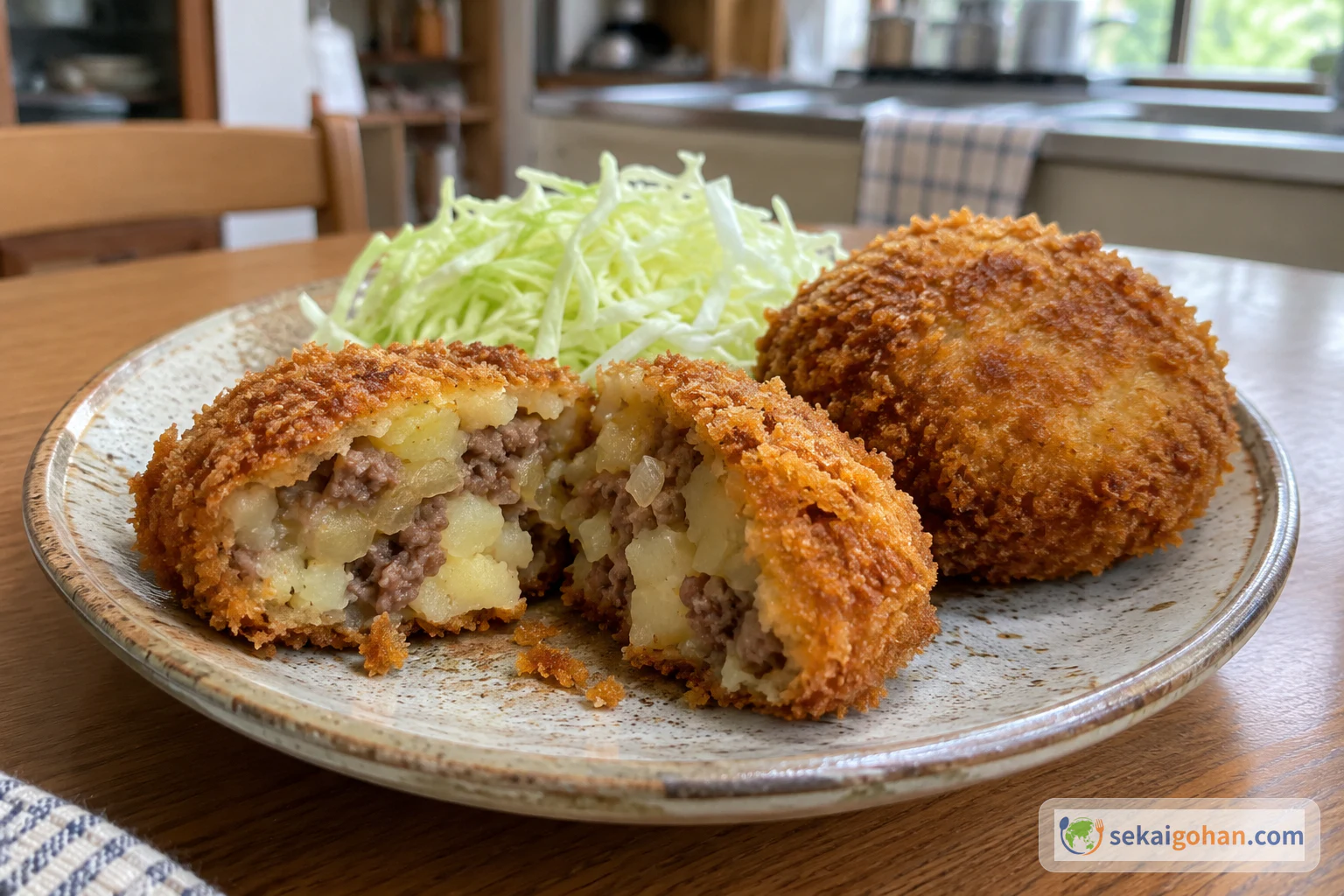
Ingredients
| Ingredient | Amount | Role |
|---|---|---|
| Russet potatoes | 2 lb (about 4) | The body of the filling. Go by weight rather than count |
| Water | as needed | For boiling the potatoes, starting cold |
| Yellow onion | 1 (272 g) | Finely chopped and cooked until soft and sweet |
| Neutral oil | 1 Tbsp | For cooking the onion; separate from the frying oil |
| Ground beef, 85% lean | 1 lb | Cooked with the onion for savory depth |
| Diamond Crystal kosher salt | 1/2 tsp for the meat + 1/2 tsp for the potatoes | Seasoning, added in two separate portions |
| Black pepper | 1/4 tsp for the meat + 1/4 tsp for the potatoes | Seasoning, added in two separate portions |
| Unsalted butter | 1 Tbsp | Mixed into the hot mashed potatoes |
| Plain (all-purpose) flour | 1/2 cup | First layer of the coating |
| Large eggs | 3 (50 g each without shell) | Beaten; second layer of the coating |
| Panko | 2 cups | Final layer, for a light, crisp crust |
| Neutral oil for frying | 4 cups, or enough for at least 2 inches (5 cm) depth | For deep-frying; this is the depth in the pot, not the amount absorbed |
| Tonkatsu sauce | to taste | For serving, at the table |
| Shredded cabbage | as needed | Optional side for serving |
Steps
1Boil the potatoes from cold
Wash, peel and remove any eyes from the potatoes, then cut each into quarters. Put them in a pot, cover with cold water and bring to a boil over medium heat; this takes about 15 minutes. Then keep the water at a gentle boil for about 15–20 minutes more, until a skewer slides easily into the largest piece.
2Cook the onion, then the beef
While the potatoes cook, finely chop the onion. Heat 1 Tbsp oil in a skillet over medium heat and cook the onion for 12–15 minutes, until translucent and soft. Add the ground beef with 1/2 tsp salt and 1/4 tsp black pepper, breaking it up as it cooks, until no pink remains. Check with a food thermometer that the center of the beef reaches 160°F (71°C); color alone is not a reliable check. Cook off the excess moisture, then drain away any liquid left in the pan.
3Dry and mash the potatoes, then combine
Drain the potatoes and return them to the pot. Over low heat, shake the pot for 1–2 minutes to drive off the surface moisture. While they are still hot, mash them, leaving some small chunks, then mix in the butter, 1/2 tsp salt and 1/4 tsp black pepper. Add the drained beef and onion and fold everything together gently.
4Shape 16 ovals and chill them
When the mixture is warm but no longer hot, divide it into 16 portions. Shape each into an oval about 3 inches (7.5 cm) long, pressing it firmly between your palms so no air pockets remain inside. Spread the patties out on one or more shallow trays so they cool quickly, then cover and refrigerate for 15–30 minutes. Get them into the refrigerator promptly rather than letting them stand at room temperature.
5Coat in flour, egg and panko
Put the flour, the beaten eggs and the panko in three separate shallow containers. Take the patties from the refrigerator and coat each one in flour, shaking off the excess, then dip it in egg, then roll it in panko. Press the panko on lightly so it sticks, and make sure every surface is covered.
6Fry two or three at a time
Heat the frying oil in a heavy pot to 340–350°F (170–180°C), checking with a thermometer. Lower in 2–3 croquettes at a time so the pot isn't crowded. Leave them undisturbed until golden, turning them gently so both sides color, for about 2–3 minutes. Let the oil come back to temperature before the next batch.
7Drain on a rack
Lift the croquettes out and set them on a wire rack over a tray to drain. Keeping them on a rack rather than stacked lets the bottoms stay crisp.
8Serve with tonkatsu sauce
Plate the korokke and add tonkatsu sauce to taste, with shredded cabbage on the side if you like. Pour the sauce over at the table rather than mixing it into the filling.