Ingredients and steps on one page. Print it, or choose “Save as PDF” in the print dialog.
Sekai Gohan
Mabo Nasu: Japanese Home-Style Eggplant with Spicy Ground Pork Sauce (麻婆茄子)
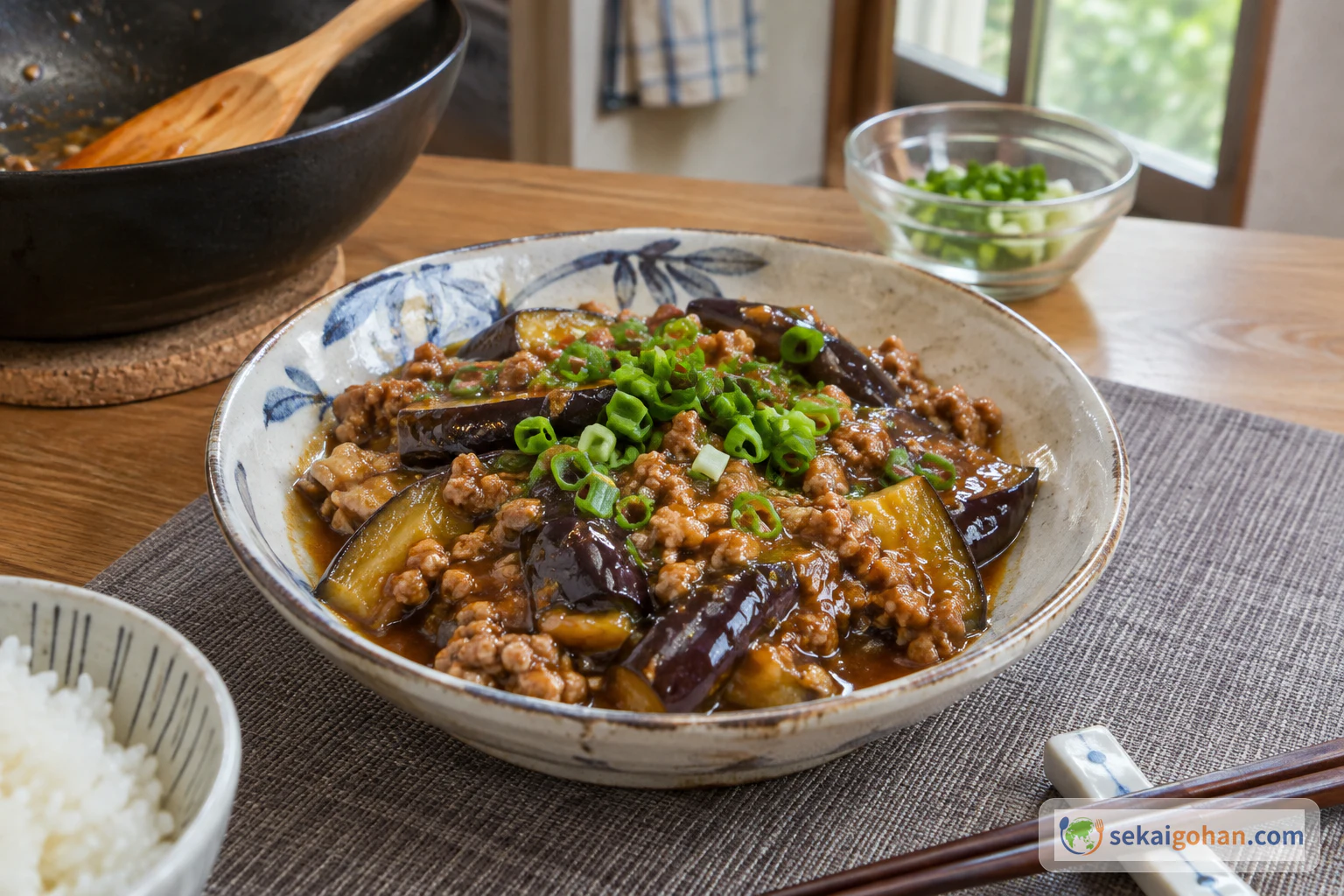
Ingredients
| Ingredient | Amount | Role |
|---|---|---|
| Eggplant (nasu) | 3–4 (300g) | Main ingredient. Remove the calyx, halve lengthwise, cut diagonally 1–1.5 cm wide |
| Salt, for the eggplant | a little | Sprinkled over the eggplant in the pan |
| Ground pork | 150g | The body of the sauce |
| Garlic, minced | 2 tsp | Group A |
| Ginger, minced | 1 tbsp | Group A |
| Doubanjiang (豆板醤) | 1 tsp | Group A. Fermented chili-bean paste |
| Tianmianjiang (甜麺醤) | 2 tsp | Stir-fried into the pork |
| Soy sauce | 1 tbsp | Group B |
| Sake | 1 tbsp | Group B |
| Chicken stock powder (gara soup no moto) | 1/2 tsp | Group B |
| Hot water | 1/2–2/3 cup | Group B |
| Salt, for the seasoning liquid | a little | Group B |
| Pepper | a little | Group B |
| Potato starch (katakuriko) | 1 tsp | Group C, for thickening |
| Water | 2 tsp | Group C, for thickening |
| Sesame oil, for the eggplant | 2 tbsp | Coats the eggplant before steaming |
| Sesame oil, for the aromatics | 1/2 tbsp | Fries group A and the pork |
| Sesame oil, to finish | 1 tsp | Added at the end |
| Vinegar | 1 tsp | Added at the end |
| Green onions (banno negi) | 3 | Sliced into small rounds and added at the end |
Steps
1Cut and soak the eggplant
Cut the calyx off each eggplant, then halve each one lengthwise. Slice the halves diagonally into pieces 0.5 inches (1–1.5 cm) wide and put them in a bowl of water. Lift the eggplant into a colander to drain, then wipe the water off the surface with paper towels. The eggplant is still fresh and raw, just dry on the outside.
2Prepare the aromatics and green onions
Finely mince enough fresh garlic to make 2 tsp, and enough fresh ginger to make 1 tbsp. Wash the 3 green onions well under running water, then slice them into small rounds. Set the green onions aside in a separate bowl for the finish.
3Mix the slurry, seasoning liquid and groups
Stir 1 tsp potato starch into 2 tsp water until smooth; this is group C. Combine 1 tbsp soy sauce, 1 tbsp sake, 1/2 tsp chicken stock powder, 1/2–2/3 cup hot water, and a little salt and pepper; this is group B. Put the garlic, ginger and 1 tsp doubanjiang together in a small dish as group A, and keep 2 tsp tianmianjiang in its own small bowl.
4Cook the eggplant until soft
Heat 2 tbsp sesame oil in a frying pan, add the eggplant, and sprinkle a little salt over it. Turn the eggplant so the oil coats the pieces. Put the lid on and cook over low heat for about 2 minutes, then take the lid off and shake the pan so the eggplant turns over. Put the lid back on and cook over low heat for about 1 minute, until the eggplant has softened.
5Set the eggplant aside
Lift the softened eggplant out onto a plate and set it aside.
6Fry the aromatics
Pour 1/2 tbsp sesame oil into the same frying pan. Add the garlic, ginger and doubanjiang to the oil, and stir-fry group A over low heat until fragrant.
7Cook the pork
Add 5.5 oz (150g) ground pork to the pan. From here until you add the green onion, keep the tools and hands that touched raw pork away from the finishing garnish unless they have been washed. Break up the pork and stir-fry until its color changes. Heat ground pork to 167°F (75°C) at the center for at least 1 minute, or an equivalent. Without a thermometer, stir well and keep heating until no raw or red meat remains.
8Coat the pork with tianmianjiang
Add 2 tsp tianmianjiang to the pork. Stir-fry until the tianmianjiang coats the meat.
9Simmer with the eggplant
Add the seasoning liquid (group B) to the pan, then put the set-aside eggplant back in. Simmer for 2–3 minutes, mixing the eggplant and sauce thoroughly, until the liquid has cooked away.
10Stir in the slurry
Turn off the burner. With the heat still off, stir the starch and water again until smooth. Pour group C into the pan, stirring the sauce the whole time you pour, and keep stirring until the slurry is evenly mixed through the sauce.
11Thicken the sauce
Turn the heat back on and stir until the sauce thickens. Let the thickened sauce simmer a little.
12Finish with green onions, vinegar and sesame oil
Add the sliced green onions, 1 tsp vinegar and 1 tsp sesame oil. Mix everything together.
13Serve
Spoon the mabo nasu into serving bowls. It needs no extra toppings or garnish. Serve it with a separate bowl of plain rice if you like; the rice is an optional side.