Ingredients and steps on one page. Print it, or choose “Save as PDF” in the print dialog.
Sekai Gohan
Okinawa Soba: Wheat Noodles with Braised Pork Belly in Pork and Bonito Broth
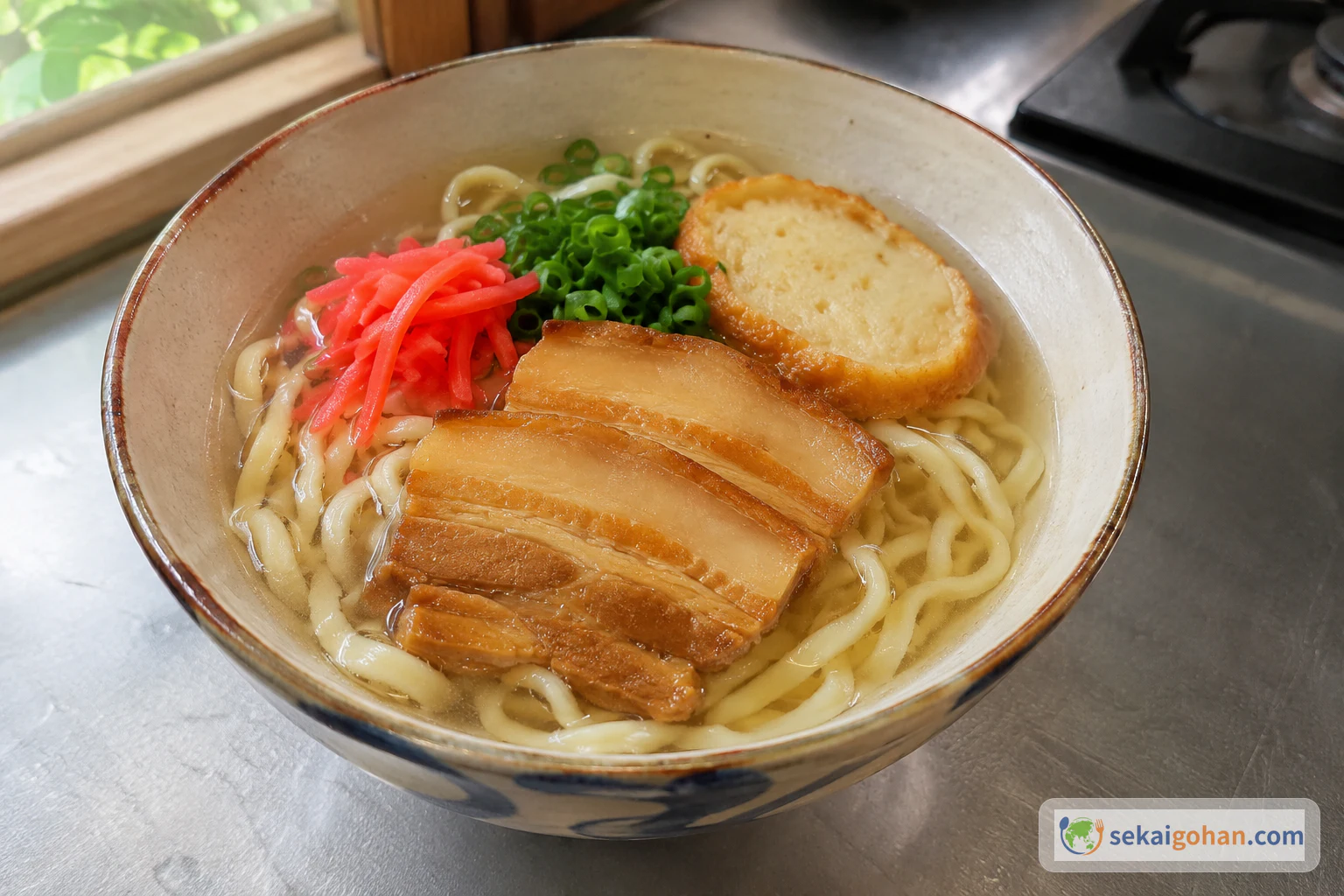
Ingredients
| Ingredient | Amount | Role |
|---|---|---|
| Cooked Okinawa soba noodles (ready-boiled, not dried) | 1kg | The wheat noodles of the bowl |
| Pork belly, one whole piece (sanmainiku), weighed before boiling | 400g | Boiled whole, then sliced and braised; also gives the pork stock |
| Water for boiling the pork | 4 cups, plus more as it boils down | Becomes the pork stock |
| Sugar | 45g | Braising the pork |
| Mirin | 1 2/3 tbsp | Braising the pork |
| Soy sauce, for the pork | 5 tbsp | Braising the pork |
| Awamori | 1 2/3 tbsp | Braising the pork |
| Thick-shaved bonito flakes | 24g | For the bonito stock |
| Water for the bonito stock | 4 cups, plus about 1 cup | The extra cup makes up for what the flakes absorb |
| Pork stock (the strained pork cooking liquid) | 3 3/4 cups | Half of the broth |
| Bonito stock | 3 3/4 cups | Half of the broth |
| Salt, for the broth | a little | Seasoning to taste |
| Soy sauce, for the broth | a little | Seasoning to taste |
| Fried round kamaboko (age-maru kamaboko) | 75g | Topping, sliced on the diagonal |
| Wakegi | 15g | Topping, washed and cut into small rings |
| Red pickled ginger (beni shoga) | 50g | Topping |
Steps
1Boil the pork belly whole
Put 4 cups of water and the whole 400g piece of pork belly in a deep pot without rinsing the meat. Check the water level and add a little more to allow for what will boil away. If the pork sticks out of the water, add enough to cover it. Bring to a boil and skim off the scum, then keep at a small, steady boil with the lid off for about 40 to 50 minutes. Check the thickest part with a thermometer: the center must reach at least 167°F (75°C) for at least 1 minute. If it hasn't, keep boiling.
Keep the knife, board and tongs that touched the raw pork away from the cooked pork and the serving tools.
2Strain the stock and slice the pork
Lift out the pork with clean tongs. Strain the cooking liquid, remove the fat and scum, and measure out 3 3/4 cups. If you are short, add water to reach that amount. Don't add any extra liquid to the broth. On a clean board, cut the boiled pork into pieces about 2 inches (5cm) wide and about 0.5 inches (1cm) thick.
3Braise the pork
Put the pork slices in a pan. Combine the sugar, mirin, 5 tbsp soy sauce and awamori, then pour them over the pork. Don't add water or stock. Simmer the slices in the sauce, turning them as needed, until they have taken on its flavor. Watch the pan so the sugar doesn't scorch.
4Make the bonito stock
Bring 4 cups of water plus about 1 cup to a boil. Add the 24g of bonito flakes, simmer over low heat for 2 to 3 minutes, and turn off the heat. Leave it to stand for a while, then strain through a cloth. Measure out 3 3/4 cups.
5Combine and season the broth
Pour the pork stock and the bonito stock into a pot and heat until they come to a boil. Add a little salt and a little soy sauce, stir and taste. Adjust to taste, then keep the broth hot.
6Prepare the toppings
Wash the wakegi well under running water, then cut it crosswise into small rings on a clean board. Cut the fried round kamaboko on the diagonal.
7Warm and drain the noodles
Pass the cooked noodles through boiling water. Lift the noodles out with a strainer and let the water drain off. Drain well before they go into the bowls, then divide the noodles among 5 bowls.
8Top the noodles
Using clean tongs, place the braised pork on the noodles. Add the sliced kamaboko, then spoon the wakegi into each bowl. Finish with the red pickled ginger in each bowl.
9Pour in the hot broth
With all the toppings in place, ladle plenty of hot broth into each bowl. Serve right away.