Ingredients and steps on one page. Print it, or choose “Save as PDF” in the print dialog.
Sekai Gohan
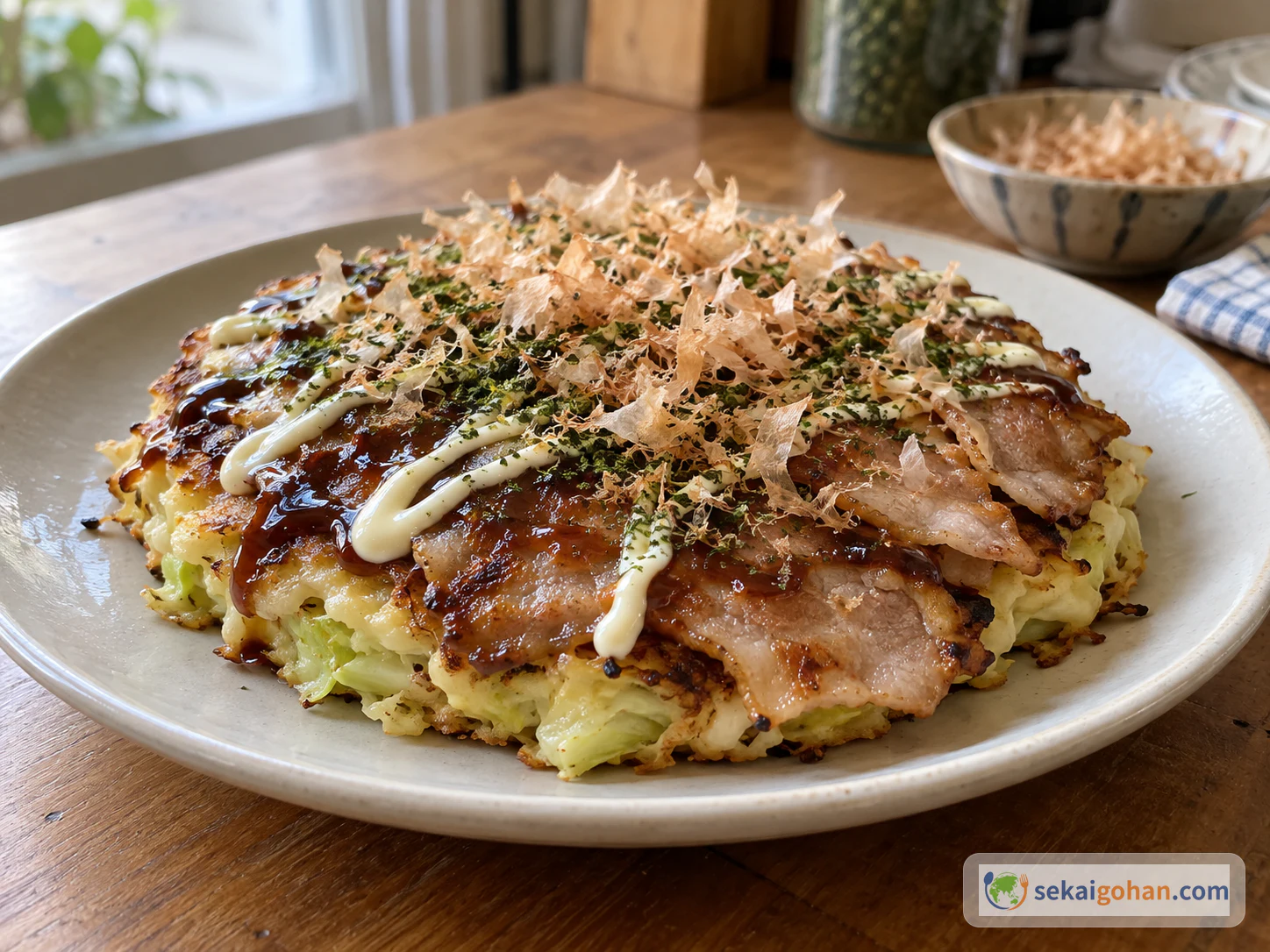
Okonomiyaki: Osaka-Style Savory Cabbage Pancakes (お好み焼き)
Ingredients
Batter
| Ingredient | Amount | Role and how to handle it |
|---|---|---|
| Cake flour (Japanese hakurikiko) | 3.5 oz (100g) | The structure of the batter |
| Dashi | ½ cup (100ml) | Loosens the flour and adds savory depth |
| Nagaimo, grated | 1.5 oz (40g) | Holds the batter together and keeps it soft |
| Salt | a pinch | Seasons the batter |
Fillings and pork
| Ingredient | Amount | Role and how to handle it |
|---|---|---|
| Cabbage, cut about 0.25 inch (5 mm) wide | 8.5 oz (240g) | The main filling. It releases water once mixed, so cook it right away |
| Eggs | 2 | One per pancake |
| Tenkasu (tempura crumbs) | 4 tbsp | Toasty flavor and richness. Split between the two pancakes |
| Green onion | 4 tbsp | Aroma. Split between the two pancakes |
| Pork belly, thinly sliced about 0.125 inch (3 mm) thick | 4 slices (about 5.5 oz / 160g) | This is the total for both pancakes. Use about half on each, and arrange it with the fat toward the outer edge |
| Beni shoga (red pickled ginger) | to taste | Optional. Split between the two pancakes |
For cooking and finishing
| Ingredient | Amount | Role and how to handle it |
|---|---|---|
| Vegetable oil | as needed | A thin coat on the cooking surface |
| Okonomiyaki sauce | as needed | Topping |
| Aonori (green laver flakes) | as needed | Topping |
| Katsuobushi (bonito flakes) | as needed | Topping |
| Mayonnaise | as needed | Optional topping |
Steps
1Make the batter
In a bowl, combine 3.5 oz (100g) cake flour, ½ cup (100ml) dashi, 1.5 oz (40g) grated nagaimo and a pinch of salt. Mix until no lumps of flour remain and the batter is smooth.
2Combine one pancake's fillings just before cooking
Put half the cabbage in a bowl. Top it with half the batter, 1 egg, 2 tbsp tenkasu, and half the green onion and beni shoga if using. Each pancake takes about 4 oz (120g) of batter. Divide the batter into two equal portions, and don't add water or flour to reach that number.
With a spoon, lift and turn the mixture from the bottom about 5–6 times. Stop as soon as the cabbage is coated with batter. Don't stir it hard or leave it sitting, because the cabbage releases water and the pancake turns heavy.
3Spread it into a round in the pan
Heat the frying pan over medium heat and coat it thinly with oil. If you use a hot plate, set it to 425°F (200–220°C). Put the mixture in the center and spread it out into a round 6.5 inches (15–16 cm) across. Make a slight dip in the middle, and don't press the pancake flat.
4Cook the underside, then lay the pork on top
Cook for about 3 minutes. Check that the underside has browned and set enough to turn. The top is still uncooked at this point.
Lay this pancake's share of pork, about 2.75 oz (80g) or 2 slices, across the uncooked top in three rows, cutting the slices if needed. Place the fat toward the outer edge.
5Flip, cover and cook on low
Turn the pancake over so the pork is underneath. Cover with the lid and cook on low heat for about 4 minutes. The lid traps steam so the thick center cooks through without the outside burning.
6Uncover, flip again and make sure it is cooked through
Remove the lid, turn the pancake over once more and cook for about 1 minute. Both the pork and the egg batter must be fully cooked in the center.
Don't rely on time or color alone. Heat the center to 167°F (75°C) for at least 1 minute. If it isn't done, keep cooking on a heat low enough not to scorch it.
7Add the toppings and serve
Move the pancake to a plate and top it with okonomiyaki sauce, aonori and katsuobushi. Add mayonnaise if you like. Serve it while it is hot, then mix and cook the second pancake from step 2 in the same way.