Ingredients and steps on one page. Print it, or choose “Save as PDF” in the print dialog.
Sekai Gohan
Takayama Ramen: Hida Clear Soy Broth with Thin Curly Noodles
Ingredients
| Ingredient | Amount | Role |
|---|---|---|
| Dark soy sauce (koikuchi shoyu) | ¼ cup (60 ml) | Tare: the main saltiness and the amber colour |
| Light-coloured soy sauce (usukuchi shoyu) | 2 tbsp (30 ml) | Tare: adds salt while holding the colour back |
| Mirin | 2 tsp (10 ml) | Tare: sweetness and gloss |
| Salt | 0.1 oz (2.7 g) | Tare: fine-tunes the saltiness; weigh it |
| Chicken carcasses (torigara) | 1¾ lb (800 g) | Broth: the base of the stock |
| Pork belly, in one block | 14 oz (400 g) | Broth and chashu: simmers in the stock, then sliced for the bowls |
| Thick-shaved bonito flakes (atsukezuri katsuobushi) | 1.4 oz (40 g) | Broth: smoky fish depth; anywhere from 0.7 oz (20 g) up suits a lighter fish note |
| Dried sardines (niboshi) | 0.7 oz (20 g) | Broth: savoury fish backbone |
| Kombu | ½ oz (15 g) | Broth: soaks in the first quart of water |
| Dried shiitake | 0.1 oz (3 g) | Broth: earthy depth |
| Onion, peeled | 1, whole | Broth: sweetness |
| Carrot | 3 oz (80 g), whole | Broth: sweetness and colour |
| Long onion (naganegi), green part | 1 stalk's worth | Broth: aroma |
| Ginger, thinly sliced | 4 slices | Broth: aroma |
| Garlic, peeled | 4 cloves | Broth: aroma |
| Vinegar | 1 tbsp | Broth: goes in just before straining |
| Sake | 3½ tbsp (50 ml) | Broth: goes in just before straining |
| Water, for soaking the kombu | 1 quart (1 L) | Broth |
| Water, added to the pot | 1 quart (1 L) | Broth |
| Salt-preserved bamboo shoots (shiozuke menma) | 3 oz (80 g) | Menma |
| Sesame oil | a little | Menma: for stir-frying |
| Mentsuyu | 1 tbsp | Menma: seasoning |
| Soy sauce | 1 tbsp | Menma: seasoning |
| Sake | 1 tsp | Menma: seasoning |
| Mirin | 1 tsp | Menma: seasoning |
| Water | enough to cover | Menma: simmering liquid |
| Sugar | a pinch | Menma: seasoning |
| Salt and pepper | a little | Menma: seasoning |
| Fresh thin curly ramen noodles, low-hydration | 4 portions, 3½–4 oz (100–110 g) each | The noodle that defines the bowl |
| Long onion (naganegi), white part, chopped | as needed | Topping |
| Vinegar and black pepper | as needed | On the table |
Steps
1Soak the kombu and blanch the bones
Put the kombu in a bowl with the first quart of water and leave it to soak while you deal with the bones. Bring a large pot of water to a rolling boil, drop in the chicken carcasses and boil them for 2–3 minutes. Tip them into a colander and rinse under running water, rubbing off blood and grey scum. Rinse the pork belly and pat it dry. The bones are ready when they look pale and clean, with no dark blood left in the crevices.
2Fill the stockpot and bring it up
Pour the kombu and its soaking water into the stockpot. Add the blanched bones, the pork belly in one piece and the second quart of water. Set the pot over medium heat and let it warm up slowly. Watch the edge of the pot: when small bubbles start to rise there and the first scum gathers on the surface, it is time to lower the heat.
3Skim and simmer slowly
Turn the heat down until only small bubbles break the surface. Skim off the grey-brown scum with the fine skimmer, and come back to it each time more rises. Let the pot simmer slowly and patiently, without stirring the bones. Carry on until the foam on top is fine and settled, the broth is still clear, and the meat is starting to fall away from the chicken bones.
4Add the aromatics
Add the onion, carrot, long onion greens, ginger, garlic and dried shiitake. Put the onion and carrot in whole so they can be lifted out in one piece later. Keep the heat low and let the vegetables simmer in the broth. Keep simmering until the onion is soft, then move on.
5Steep the bonito and sardines
Add the thick-shaved bonito flakes and the dried sardines. Keep the pot at a gentle simmer and stay close, because this stage is short. Fish left in too long turns the broth harsh and cloudy. Move on as soon as a strong bonito aroma rises from the pot.
6Add vinegar and sake, then strain
Pour in the vinegar and sake, let the pot return to a brief boil, then turn off the heat. Lift out the pork belly and set it on a plate to cool, and lift out the whole onion and carrot too: eat them as a pot-au-feu-style side, or discard them with the rest. Line a fine-mesh sieve with the straining cloth, set it over the second pot and pour the broth through. You are done when about 6¼ cups (1.5 L) of clear, glossy broth sits in the pot and the bones, kombu and fish stay behind in the cloth.
7Stir in the tare and simmer
Mix the dark soy sauce, light soy sauce, mirin and salt in a jug. Set the strained broth over low heat, pour in about four-fifths of the tare, stir slowly and taste. Add the rest only if the broth needs it; if it already tastes too salty, add a little hot water. Keep it on low so the soy and broth simmer together. It is ready when the broth has turned a deep, glossy amber and tastes balanced to you.
8Slice the chashu and cook the menma
Slice the cooled pork belly across the grain into neat slices; it goes into the bowls with only the flavour of the broth it cooked in. Desalt the menma as its pack directs, then taste a piece before seasoning. Warm a little sesame oil in a small frying pan and stir-fry the menma, then add the mentsuyu, soy sauce, sake, mirin, sugar, salt and pepper with enough water to cover. Simmer until the liquid has almost gone and the menma looks glossy.
9Cook the noodles one portion at a time
Fill the bowls with hot water to warm them, and keep the broth hot on low. Bring a large pot of water to a rolling boil. Cook one portion of noodles at a time for the time on the pack, loosening the strands with chopsticks as they go in. Thin low-hydration noodles soften fast, so drain them hard the moment the time is up, while they still spring back when bitten.
10Assemble the bowls
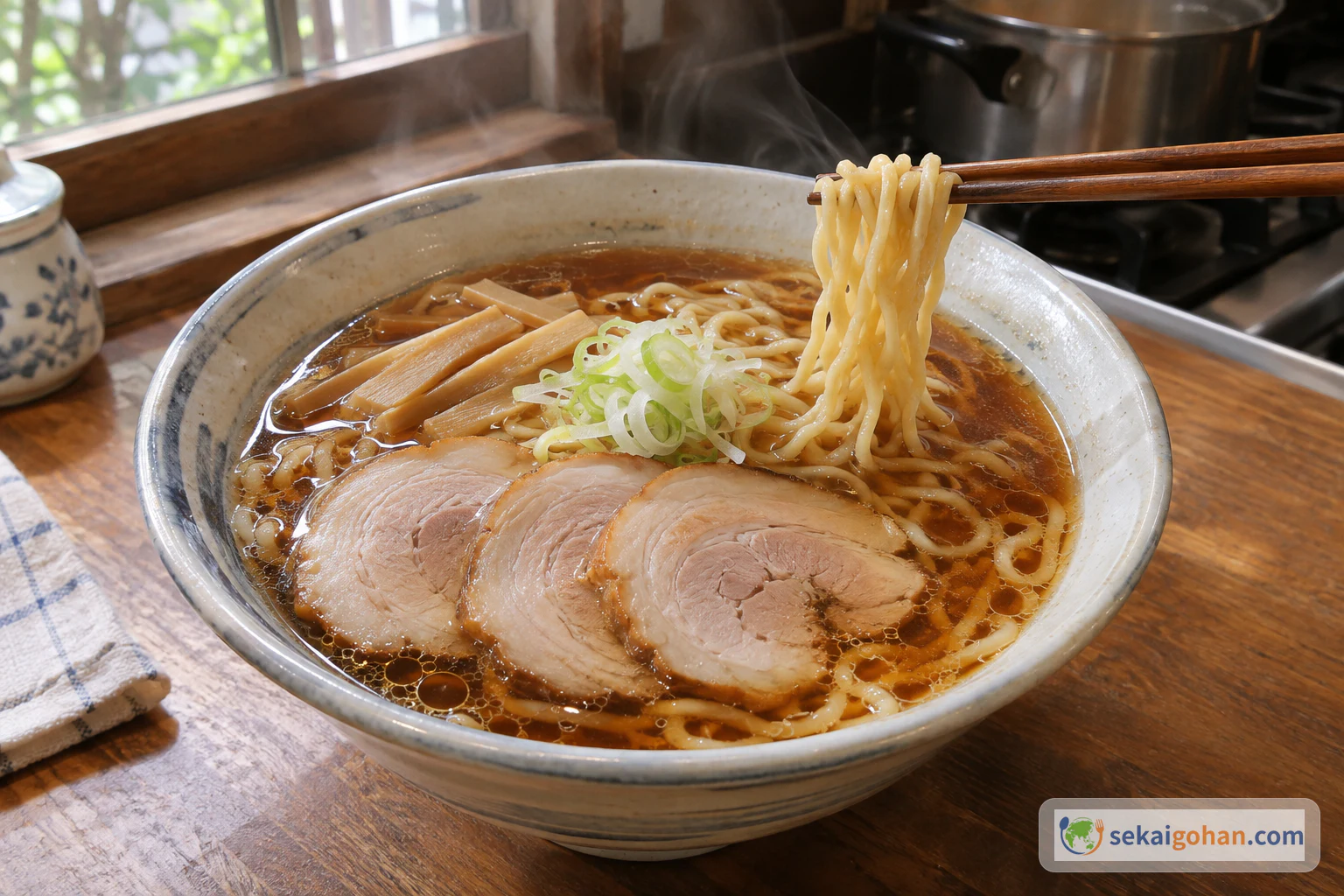
Tip the water out of a warmed bowl and ladle in about 1½ cups (375 ml) of hot broth. Slide in the drained noodles and fold them once so they lie in the broth. Lay the chashu, menma and chopped long onion on top. Serve the bowl while the steam is still rising, and drop the next portion of noodles into the water.