Ingredients and steps on one page. Print it, or choose “Save as PDF” in the print dialog.
Sekai Gohan
Takoyaki: Osaka-Style Octopus Balls with a Dashi Batter (たこ焼き)
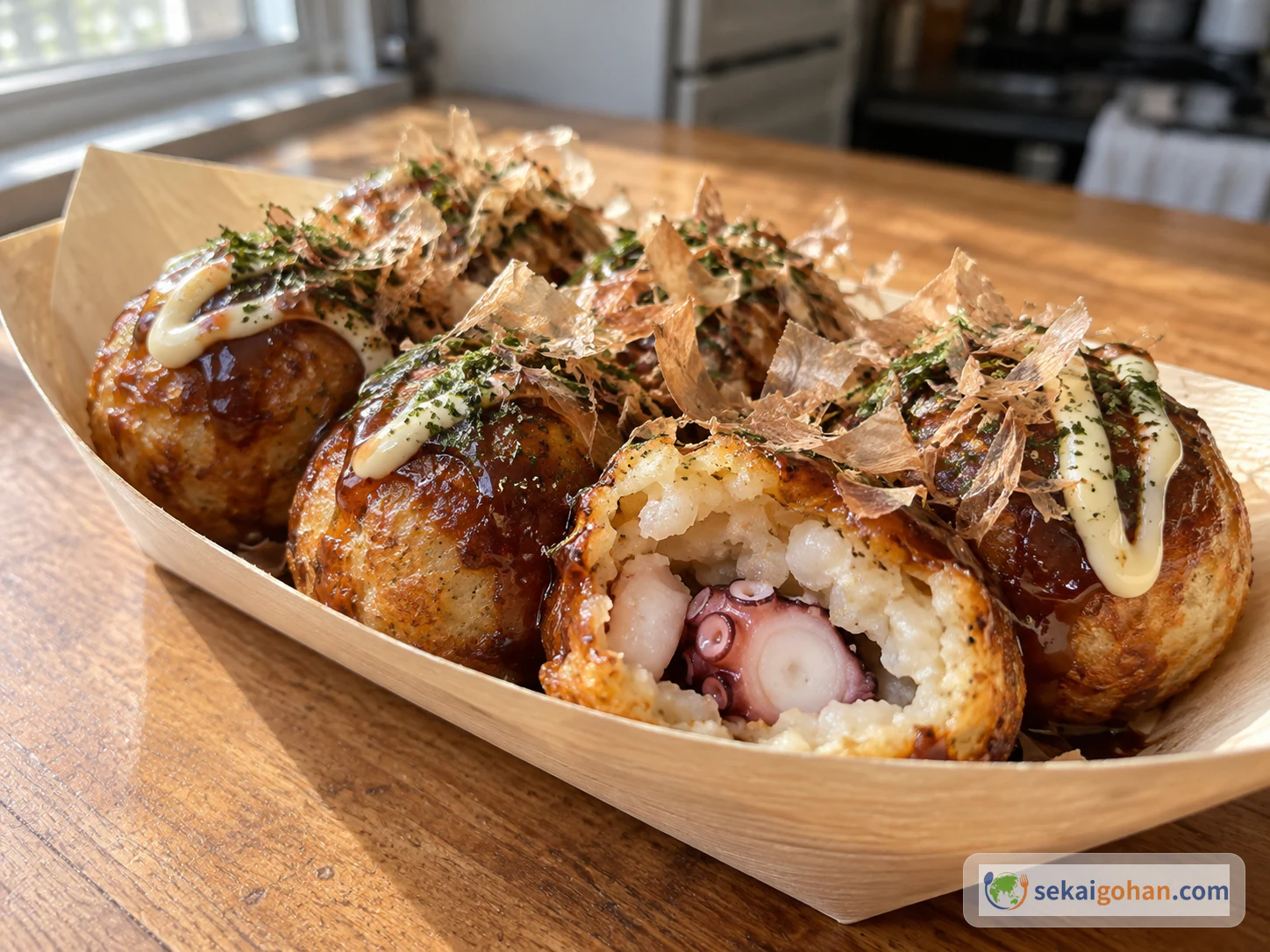
Ingredients
| Ingredient | Amount | Role |
|---|---|---|
| Cake flour (薄力粉, hakurikiko) | 10.5 oz (300 g) | Forms the tender batter |
| Dashi, prepared and cooled (だし) | 1.25 quarts (1,100 cc (1.1 L)) | Main liquid and savory aroma |
| Eggs (卵) | 3 | Bind and enrich the batter |
| Salt (食塩) | 2 g (range: 2–3 g) | Seasons the batter |
| Boiled octopus (ゆでだこ) | 7 oz (200 g) | The filling; cut into pieces of about 0.625 inch (15 mm) |
| Tenkasu, tempura bits (天かす / 揚げ玉) | 2 oz (60 g) | Small crisp, savory bits |
| Neutral oil (油) | As needed | Greases the wells and the surface of the balls |
| Rich takoyaki sauce (濃厚ソース) | To taste | Sweet-savory finish |
| Aonori, green laver flakes (青のり) | To taste | Sea aroma; optional |
| Shaved bonito (かつお節) | To taste | Umami; optional |
| Mayonnaise (マヨネーズ) | To taste | Creamy topping; optional |
Steps
1Cut the boiled octopus
Cut the boiled octopus tentacles crosswise into pieces of about 0.625 inch (15 mm). Pieces of a similar size are easier to drop into the wells one at a time. Don't mince the octopus; it should still have some bite.
2Mix the batter and let it rest
Beat the 3 eggs in a large bowl, then add the cooled dashi. Add the cake flour and the salt, adding the flour a little at a time, and whisk only until the flour is incorporated. Small lumps are fine. Let the batter rest for about 10 minutes, and the lumps will hydrate and settle.
Flour sinks to the bottom as the batter stands, so stir it again from the bottom every time you pour. The batter contains raw egg, so refrigerate the portion waiting for later rounds instead of leaving it at room temperature for long.
3Preheat the maker and oil the wells
Follow your appliance's manual. Preheat to 425°F (220 °C). Electric makers usually run at 200–220 °C, and gas models at medium-high heat. Use 425°F (220 °C) only if your maker supports it.
Brush a thin layer of oil into the wells and over the flat surface between them. To test the heat, drop in a little batter. A quick sizzle means the plate is ready. If the batter browns instantly or smokes, lower the setting. If it sits there quietly and stays pale, wait a bit longer.
4Pour past the wells and add the filling
Stir the batter from the bottom and pour enough to fill the wells and connect across the plate. Right away, place a piece of octopus in each well and scatter tenkasu over the surface. The 2 oz (60 g) of tenkasu is for the whole batch, so divide it across your rounds. If you fill only each well, the seams are weak and the sides come out flat; the extra batter on the plate is what you will tuck in later to make a full sphere.
5Cut the sheet and make the first 90-degree turn
When the edges turn white and begin to lift, after roughly 1–2 minutes depending on your maker, use a bamboo pick to cut the connected batter into portions along the wells. Tuck the loose batter around each well into it. Don't wait until the tops are dry: the batter should still be soft for the first turn. Lift each portion about 90 degrees so the soft batter flows down into the well.
6Keep turning to shape the balls
Complete the turn, then keep rotating each ball a little at a time to build a sphere. If you see a hole or a gap, fill it with a little batter from the plate. If a ball tears, wait briefly until its lower edge sets, then turn it again. Some wells cook faster than others, so swap balls between hotter and cooler wells to even out the browning.
7Check for color and steam, then lift them out
Keep turning until the outside is golden brown and steam rises. Brush a little oil over the surface for gloss and a light crispness. Every maker has its own hot spots, so expect some variation in crunch from ball to ball.
The center should be soft and moist, not raw or liquid. Color and steam alone do not prove the balls are cooked through, so if you're unsure, break one open. Check that the center reaches 167°F (75 °C) for at least 1 minute.
8Finish with sauce and toppings
Serve right away with rich sauce, and add aonori, shaved bonito and mayonnaise to taste. The center can be very hot, so let the balls cool enough to eat comfortably before biting in.