Ingredients and steps on one page. Print it, or choose “Save as PDF” in the print dialog.
Sekai Gohan
Tonkotsu Ramen: Kurume-Style Cloudy Pork Bone Broth at Home
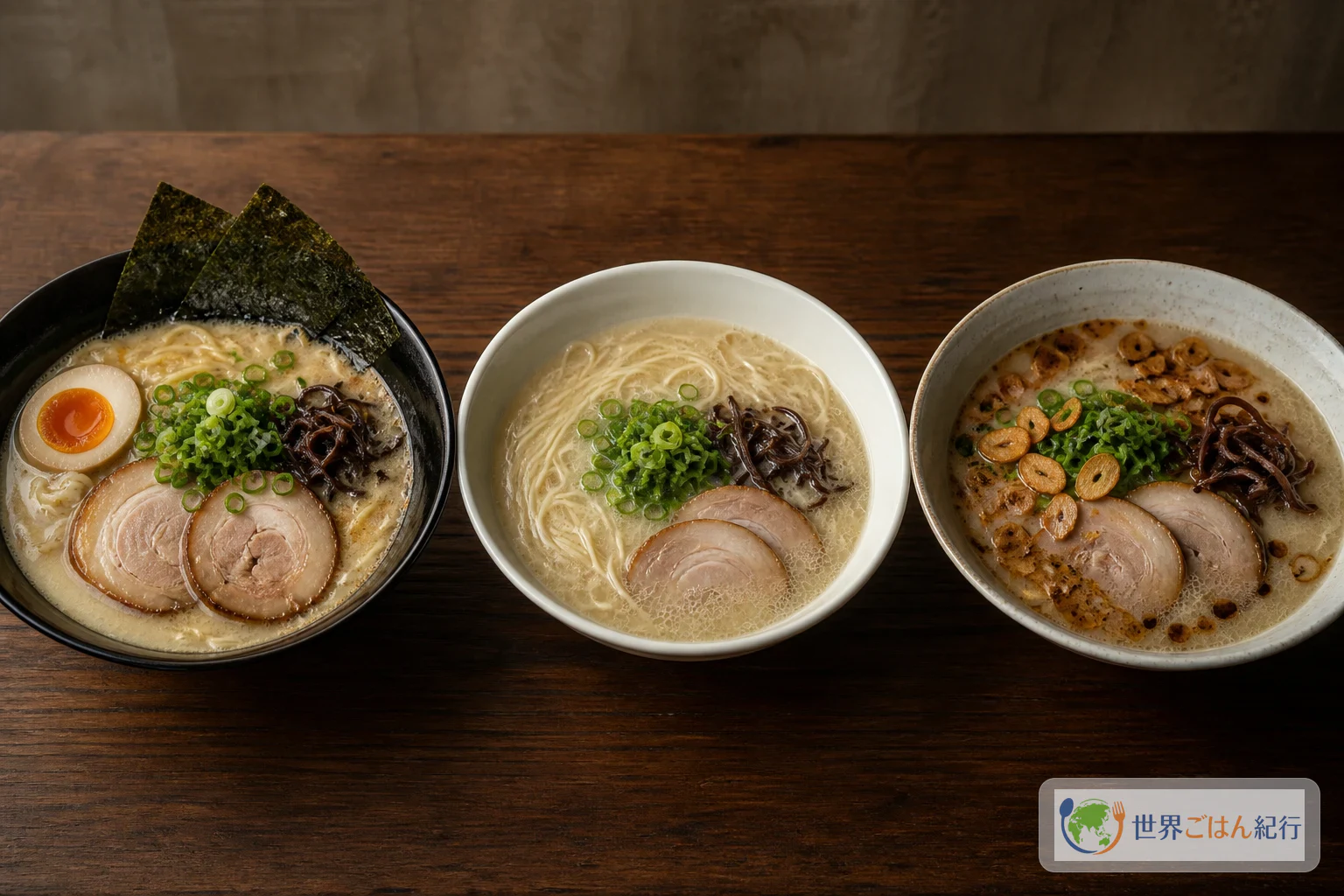
Ingredients
Tonkotsu broth
| Ingredient | Amount | Substitutes & notes |
|---|---|---|
| Pork knuckle bones (genkotsu) or pork backbone | 3.25 lb (1.5 kg) | Cut to 6–8 cm. Mixed types of bone are fine |
| Pork trotters | 1 lb (500 g) | Hooves removed. If unavailable, add 10.5 oz (300 g) more pork bones; the richness will be a little lighter |
| Water | 4.75 quarts (4.5 L) | Also have 1 quart (1 L) of boiling water ready to add during cooking |
| Onion | 1/2, about 4 oz (120 g) | Halved. Can be omitted if you don't want extra sweetness |
| Green part of a long scallion | 1 stalk | Cut into 2 inches (5 cm). Keep the white part for the finish |
| Ginger | 1.5 oz (40 g) | Sliced. Tempers the pork aroma |
| Garlic | 4 cloves, about 25 g | Crushed. Use it to strengthen a Kyushu-style aroma |
Tare and chashu
| Ingredient | Amount | Substitutes & notes |
|---|---|---|
| Pork belly, in a block | 1 lb (500 g) | Pork shoulder loin also works, with less fat |
| Dark soy sauce | ½ cup (100 ml) | For the tare. Salt content differs by product, so start with 1.5 tbsp (25 ml) per bowl |
| Sake | ¼ cup (80 ml) | Divided between the tare and the braised pork |
| Mirin | 3.5 tbsp (50 ml) | Reduce to 2 tbsp (30 ml) for less sweetness |
| Sugar | 15 g | For the chashu. Can be omitted |
| Salt | 12 g | For the tare. Not added to the broth itself |
| Kombu | 4 g | Only to soften the tare's edge. Remove before it boils |
| Ginger | 20 g | For the chashu. Sliced |
| Garlic | 1 clove | For the chashu. Crushed |
Noodles and finish
| Ingredient | Amount | Substitutes & notes |
|---|---|---|
| Fresh thin straight noodles | 1 lb (480 g) | 4 oz (120 g) per person. For dried noodles go by 2.75–3.25 oz (80–90 g) per person, following the package |
| Wood ear mushrooms (dried) | 15 g | Rehydrate and slice thin. About 2.75 oz (80 g) if fresh |
| Scallions (green) | 2 oz (60 g) | Thinly sliced. White scallion works too |
| Seasoned eggs | 4 | Store-bought or separately boiled eggs. Can be omitted |
| Red pickled ginger | 1.5 oz (40 g) | Served a little at a time at the table. Don't put it in the bowl from the start |
| Toasted sesame seeds | 2 tbsp | Optional, as a Nagahama-style table seasoning |
| Toasted nori | 2 sheets | Serve half a sheet each for a Kurume-leaning presentation |
Ingredients if making noodles yourself
| Ingredient | Amount | Substitutes & notes |
|---|---|---|
| Bread flour | 10.5 oz (300 g) | For 4 servings. Make a stiff, low-hydration dough |
| Water | 3.75 oz (105 g) | 35% hydration. Adjust by up to 5 g depending on how the flour absorbs |
| Powdered kansui | 3 g | Follow the product's stated amount. Mix directly into the flour |
| Salt | 3 g | To help the dough firm up |
| Potato starch for dusting | 20 g | Prevents noodles sticking. Shake off well before boiling |
Steps
1Blanch the bones, and wash the pot and the bones
25 min
Put the pork knuckle bones and trotters in a large pot, pour in water to cover and bring to a boil over medium heat. After boiling, keep gray foam coming for 20 minutes, then turn off the heat and drain in a colander. Wash the bones one at a time under running water, remove clots of red blood and surface foam with your fingers, and wash the inside of the pot with detergent too.
Wash raw meat in water with the sink emptied so splashes don't spread around. The signal to move on is that no red clots remain on the washed bones and the rinse water doesn't keep turning cloudy. Cutting bones at home makes knives slip, so use uncut bones as they are. The cloudiness will be a little weaker, but prioritize working safely.
2Build a hard boil in fresh water
60 min
Return the washed bones and trotters to a clean pot and pour in 4.75 quarts (4.5 L) water. Start over high heat, and even after it boils, leave the lid off and hold it for 10 minutes with the whole surface rolling. When the foam rises high, lower the heat a little and keep a strong boil within what won't overflow the pot. After about 30 minutes, add the onion, the green part of the scallion, the ginger and the garlic.
For the first 30 minutes only, skim off the gray foam that floats with a ladle. Skimming out even the beads of fat weakens the cloudiness, so leave the oil on the surface. If the water only rises and falls quietly, the heat is too low, and if bubbles aren't colliding around the bones the white is slow to come. After 60 minutes, if the broth is pale milky white and fine fat floats at the edge of the bones, move on to the long simmer.
3Grow the cloudiness while adding boiling water
4 h 30 min
Adjust from high to medium-high and keep a boil in which the bones move now and then. Check the water level every 40–50 minutes, and if the bones are about to rise above the surface, add 200–300 ml boiling water at a time. Don't pour in cold water; it stops the boil and tends to separate fat and water. Cook for 4.5–5 hours in total, until the area around the bones breaks down and the broth is white and opaque, with fine beads of fat floating continuously on the surface.
So that adding water doesn't make too much broth, reduce the amount you add in the final hour to about ½ cup (100 ml). If it drops until you can see the bottom of the pot, add 1¾ cups (400 ml) boiling water before the bones' essence reduces too far, and return to a strong boil. Conversely, if the water level is high and some transparency remains after 5 hours, boil with the lid off another 30–45 minutes. Check not only the white but that the liquid scooped in a ladle doesn't run thin and clear and leaves a thin film.
Leaving the pot at this stage leads to boilovers and dry-firing. If you need to turn off the heat, bring it back to high on restart and begin counting the time over. Don't just add up the simmering time; judge by the time it was actually boiling.
4Prepare the chashu and tare in a separate pot
90 min
Shape the pork belly into a block about 2 inches (5 cm) wide and tie it with kitchen twine in 2 places. In a small pot put 1¾ cups (400 ml) water, ¼ cup (80 ml) soy sauce, 3.5 tbsp (50 ml) sake, 2 tbsp (30 ml) mirin, 15 g sugar, ginger and garlic, and add the meat when it boils. Put a drop lid on, lower to low heat, and simmer 75–90 minutes, turning the meat over every 20 minutes. Confirm the center of the thickest part reaches 167°F (75 °C) or higher and no red remains on a cut face.
Take out the meat and rest it 20 minutes in the cooking liquid, then slice 4–5 mm thick once the heat has gone. For the tare, in another small pot warm ½ cup (100 ml) soy sauce, the remaining 2 tbsp (30 ml) sake, 1.5 tbsp (20 ml) mirin, 12 g salt, the kombu and 5 g sugar over low heat for 2 minutes, and take out the kombu before it boils. Don't settle on a strong flavor all at once; setting it so you can use 1.5 tbsp (25 ml) per bowl lets you adjust when kaedama thins things out.
Heating the center to 167°F (75 °C) for 1 minute or more kills many microorganisms, and thicker meat takes longer to reach it. Without a thermometer, heat until the red at the center is gone and the juices run clear. Adding a lot of the chashu cooking liquid straight into the broth makes it too salty and sweet, so make the tare separately.
5Strain the broth and finish the thin noodles one bowl at a time
15 min
Strain the tonkotsu broth through a fine strainer and remove the bones and aromatics. Aim for about 1.75 quarts (1.6 L), using 1¼ cups (300 ml) per bowl for 4 servings. If there is a lot, reduce it 10 minutes at a time over medium-low heat; if it is short, add a little separately warmed unsalted water, not boiling water straight from the pot. Rehydrate and thinly slice the wood ear mushrooms, and slice the scallions.
Warm the bowls with boiling water, put 1.5 tbsp (25 ml) tare and 1¼ cups (300 ml) hot broth in each bowl and mix. In a separate pot boil 2 quarts (2 L) or more of water hard, loosen fresh noodles one portion at a time and put them in, and boil 45–60 seconds if the package gives no instruction. Loosen the noodles with chopsticks, lift them out when a slight spring remains at the center, and shake the strainer up and down 3 times to drain. Drop the noodles into the broth before they absorb water, and top with chashu, wood ear mushrooms, scallions, seasoned egg and nori.
Mix the tare and broth until oil doesn't form only a big ring and the trail of the spoon smooths back. When fine beads of fat are scattered on the surface and the soy sauce color doesn't remain only at the bottom of the bowl, it is ready for the noodles.
Kaedama started in Nagahama. Thin noodles go soft in a large bowl, and fish market workers needed to eat quickly. Don't drink too much of the broth while eating the first noodles. Boil an extra 2.75–4 oz (80–120 g) of noodles in the same pot and put them into the bowl. Adding 1 tsp tare to the kaedama restores what the broth has thinned. Noodles boiled and left waiting in broth lose the texture of thin noodles, so serve and eat one person at a time.