Ingredients and steps on one page. Print it, or choose “Save as PDF” in the print dialog.
Sekai Gohan
Yakisoba-pan: Japanese Sauce-Fried Noodles in a Soft Bun
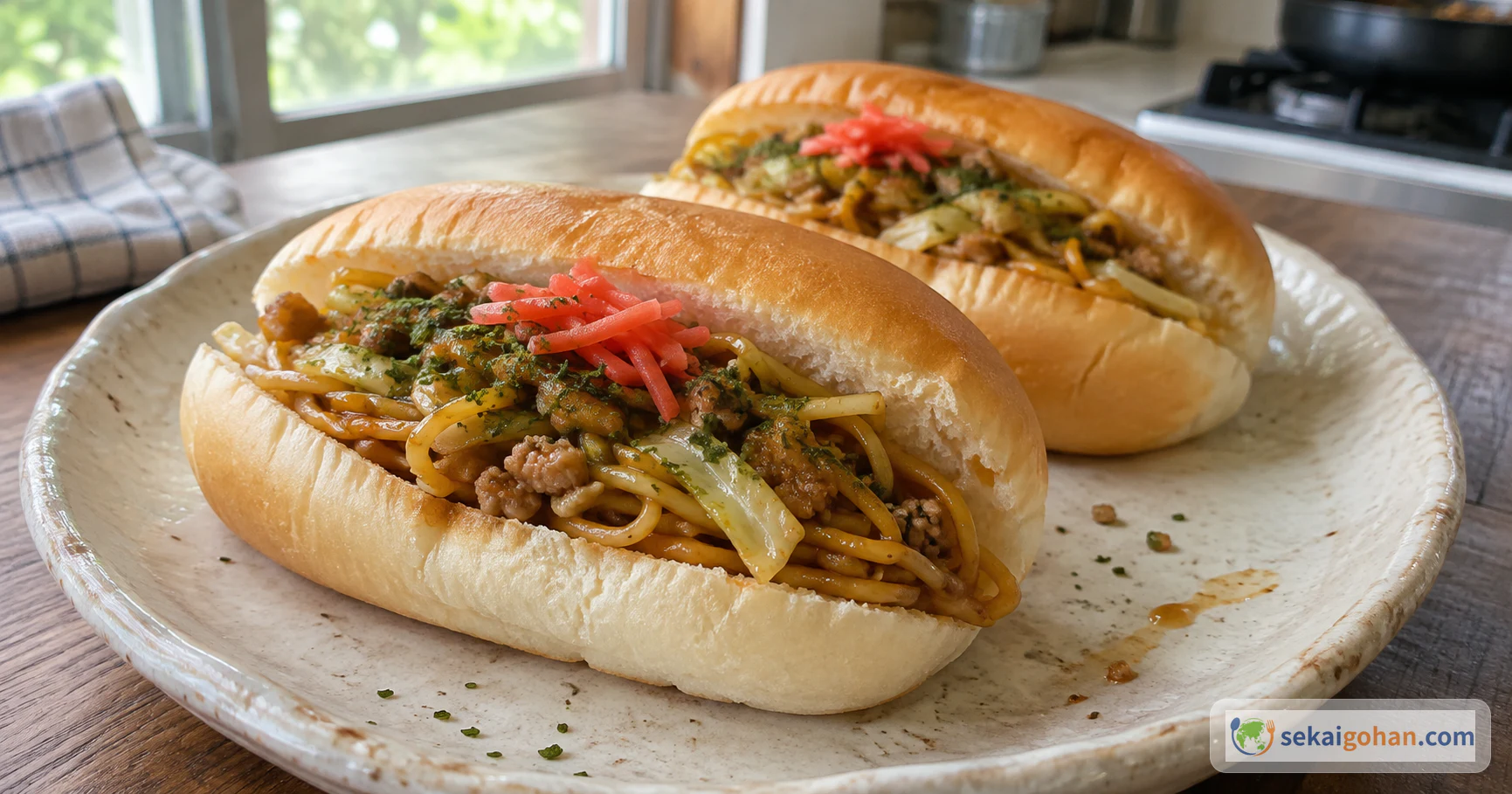
Ingredients
| Ingredient | Amount | Role |
|---|---|---|
| Koppepan (soft Japanese bread rolls) | 4 | The holder; split open to take the filling |
| Butter | as needed | Spread inside the cut to keep the bread from going soggy |
| Steamed yakisoba noodles (焼そば麺) | 1 portion | The filling; cut into quarters, one per bun |
| Minced pork | 1 oz (30 g) | Fat and savoury depth; small crumbs that cling to the bread |
| Cabbage, finely shredded | 1¾ oz (50 g) | Sweetness, moisture and volume |
| Salad oil | 1 tbsp | For frying |
| Water | 2 tbsp (30 ml) | Loosens and steams the noodles |
| Yakisoba sauce | 1 tbsp | The sweet-savoury backbone of the flavour |
| Red pickled ginger (beni shōga) | to taste | Sharp, sour contrast and colour |
| Aonori (green seaweed flakes) | to taste | Sea aroma |
Steps
1Split and butter the buns
Cut each koppepan down the middle lengthwise with a bread knife, stopping before you reach the bottom. The bun should open like a shallow boat, still joined along its base. Spread a thin layer of butter over both cut faces, right to the edges. The buns are ready when they open to show the white crumb inside and still hold together as one piece.
2Cut the noodles into quarters in the bag
Leave the noodles sealed in their bag and lay it on the cutting board. Press a knife straight down through the bag, then again at right angles, cutting the bundle into four. Each quarter is one bun's worth, short enough to sit inside the slit instead of trailing out the ends. Through the plastic you should see four separate blocks.
3Fry the pork
Heat the salad oil in the frying pan over medium heat. Add the minced pork and break it into small crumbs with the spatula as it cooks, so no clumps stay pink inside. Keep stirring until clear fat runs out into the pan. The pork is done when every crumb has changed colour and no pink remains.
Cook the pork throughCook minced pork until the centre reaches 167°F (75°C) for at least 1 minute. Without a thermometer, cook until the colour has fully changed and no pink is left anywhere. After handling raw meat, wash your hands, wash the knife and board and pour boiling water over them, and keep raw meat and its juices away from the cooked filling and the buns.
4Add the cabbage
Add the shredded cabbage to the cooked pork and stir-fry it in the pork fat. Putting the meat in first means the fat coats the cabbage, and the cabbage's water does not boil the pork. Keep turning everything so the pork crumbs mix through the shreds. Move on when the cabbage has wilted, shrunk down and turned glossy.
5Steam the noodles dry
Lay the four noodle blocks over the pork and cabbage and pour in the water. Let it hiss and steam without touching the noodles, because poking them straight after the water goes in tears them. Once most of the steam has gone, loosen the blocks with chopsticks and toss them through the pork and cabbage. The noodles are ready when they have separated into strands and no water shows on the bottom of the pan.
Wait, then loosenThe water is there to soften and separate the noodles, not to stay in the pan. Waiting for it to evaporate keeps the strands whole, and a dry pan is what keeps the bun from going soggy later. If the pan still looks wet, give it longer before the sauce.
6Coat with the sauce
Pour the yakisoba sauce over the noodles. Toss everything well with chopsticks so the sauce reaches every strand, the cabbage and the pork. The smell sharpens as the sauce hits the hot pan. It is ready when the noodles are an even, glossy brown with no pale strands left.
If it tastes weakBefore adding more sauce, check the pan. Leftover water thins the sauce, so cook it off first and taste again. When you have switched to a different sauce, adjust by tasting, since each brand is a different strength.
7Fill the buns
Take the pan off the heat. Hold a buttered bun open in one hand and use chopsticks to push a quarter of the noodles into the slit. Press the filling down gently so it settles into the bun rather than piling on top. Overfilling makes the noodles spill out and can tear the bun. Each bun is right when the filling shows just above the cut and the bun holds its shape when you lift it.
8Finish with pickled ginger and aonori
Scatter a pinch of pickled ginger along the top of each bun. Sprinkle aonori over the noodles. The ginger's sourness and the sea smell of the aonori lift the sweet, heavy sauce. For anyone who does not like ginger, set it in a small dish on the side instead. The buns are finished when the red and green are scattered across the brown noodles.