Ingredients and steps on one page. Print it, or choose “Save as PDF” in the print dialog.
Sekai Gohan
Zaru Soba: Japanese Chilled Buckwheat Noodles with Dipping Sauce
Ingredients
| Ingredient | Amount | Role |
|---|---|---|
| Dried soba noodles | 7 oz (200 g) | The noodles; weigh them from the package |
| Water | ¾ cup plus 1 tbsp (200 ml) | Base of the dipping sauce |
| Soy sauce (koikuchi, regular Japanese soy sauce) | scant ½ cup (100 ml) | Salt, color and depth in the sauce |
| Mirin | 2 tbsp (30 ml) | Sweetness and gloss |
| Sugar | ¾ oz (20 g) | Rounds the sauce toward gently sweet |
| Bonito flakes (katsuobushi) | ½ oz (15 g) | The dashi; smoky aroma |
| Green onion (aonegi) | 2-inch (5 cm) piece | Fresh, sharp condiment |
| Wasabi, fresh root or prepared paste | as needed | Clean heat for the noodles |
| Shredded nori (kizami nori) | a little | The topping that makes it zaru soba |
Steps
1Start the sauce base
Pour the water into a small saucepan and bring it to a boil over the heat. As soon as it boils, add the sugar, then the mirin, then the soy sauce. Adding them in this order to boiling water keeps the soy sauce from cooking on its own. The sauce settles for a moment as the cold liquids go in, then starts to bubble gently again.
2Add the bonito flakes
Once the sauce bubbles gently again, turn the heat down to medium-low. The moment it reaches a full boil, scatter in the bonito flakes. Let it come up to a boil once, then turn off the heat. Leave the pan to cool completely, with the flakes still in it; the bonito flavor settles into the sauce as it cools. The sauce is ready to strain when the pan is cool to the touch.
One boil, then offTurn off the heat as soon as the sauce boils up once with the flakes in. Keep it boiling and the bonito aroma cooks away.
3Strain the sauce
Set a fine-mesh strainer over a bowl and pour all the cooled sauce through. The bonito flakes have soaked up some of the liquid, so press them lightly with the back of a spoon to release it. You end up with about 1 cup plus 2 tbsp (280 ml) of dark, clear sauce with no flakes floating in it. Cover it and refrigerate it until you eat.
4Prepare the condiments
Slice the green onion into rings about ¼ inch (5 mm) wide. Soak them in a small bowl of water for about 5 minutes to take the edge off their sharpness, then drain well. For fresh wasabi, hold the cut stem end straight against the grater and grate slowly in small circles, which brings out its aroma; prepared paste works too. The onion rings should be crisp and mild, and the wasabi a soft pale green mound.
5Boil the noodles
Bring a large pot of water, at least 2 quarts (2 L), to a full boil, and leave the water unsalted. Drop in the noodles and spread them through the water with long chopsticks so the strands separate. Boil them for the time printed on the package. The surface flour clouds the water and makes it foam, so if it rises toward the rim, add a small splash of cold water without letting the boil stop. The noodles are done when they swim freely in the cloudy water and the package time is up.
6Rinse off the starch
Scoop the noodles into a colander, leaving the cooking water in the pot for later. Lower the colander into a bowl of cold water and rub the noodles gently between both hands to wash off the starch on the surface. Change the water whenever it turns warm. Rinsing cools the noodles and gives them a firm, clean bite. Stop when the strands feel smooth rather than slick and the water stays clear.
Rub, do not kneadUse the flats of both hands and a light touch. Rubbing hard or stirring roughly snaps the noodles into short pieces.
7Chill in ice water
Move the colander, noodles and all, into the bowl of ice water. Leave them for a few seconds, turning them by hand, and stop when they are as firm as you like; you will feel them tighten under your fingers. Chilling them hard is what gives soba its spring. Lift the colander and let it drain until the noodles look firm and separate and the water stops dripping.
8Plate on the bamboo tray
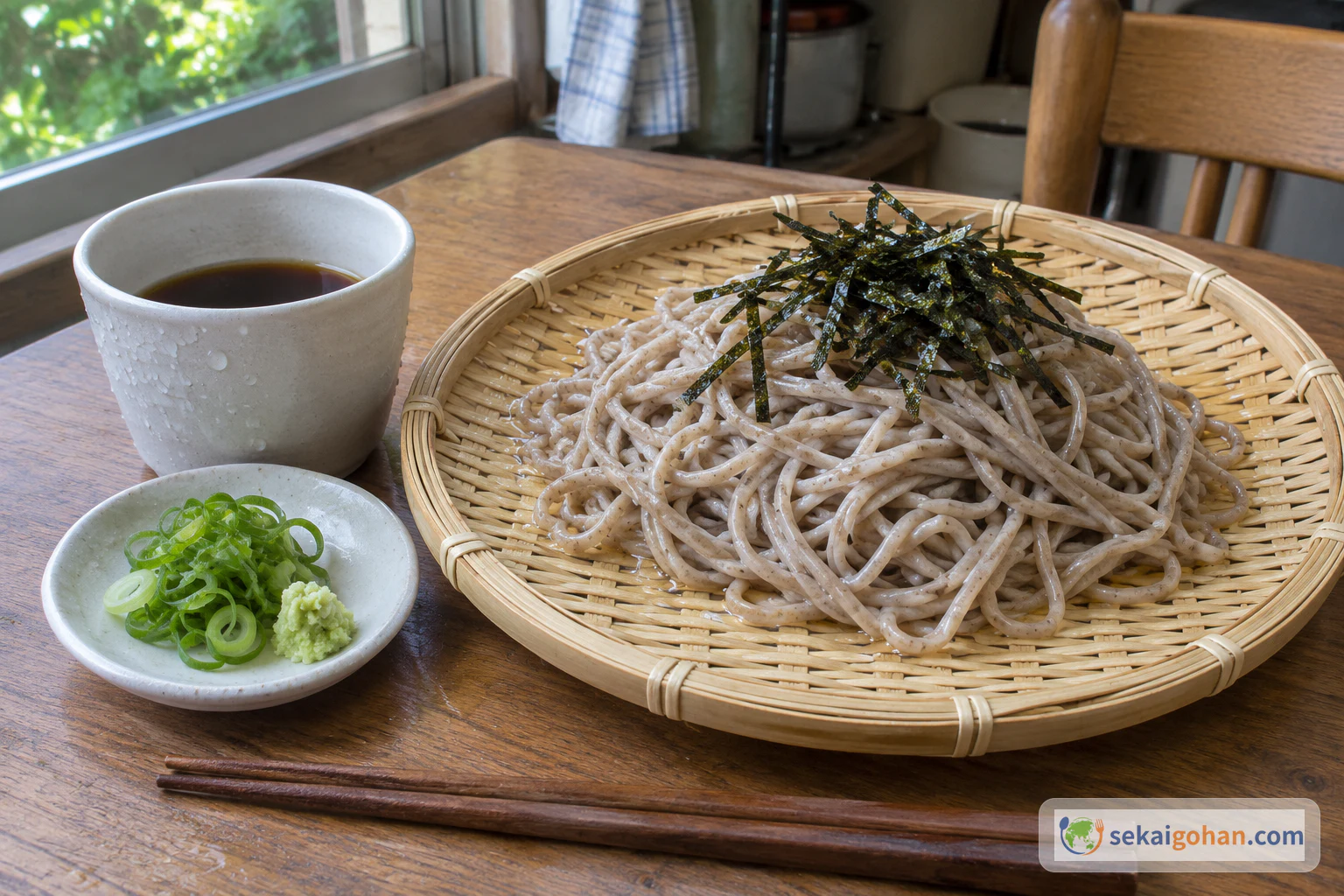
Pile the noodles loosely on the bamboo zaru. Shape and height are up to you. Scatter the shredded nori over the top. The noodles are ready when no water pools under them on the tray.
9Serve and dip lightly
Pour the sauce into soba cups and set the green onion and wasabi beside them. Add them to the sauce or put them right on the noodles as you eat. Dip only the lower part of each bundle: the sauce is strong, and a light dip lets the buckwheat flavor come through. Bring everything to the table as soon as it is plated, while the noodles still have their spring. When the noodles are gone, pour some of the hot cooking water, called soba-yu, into what is left of the sauce and drink it.