Ingredients and steps on one page. Print it, or choose “Save as PDF” in the print dialog.
Sekai Gohan
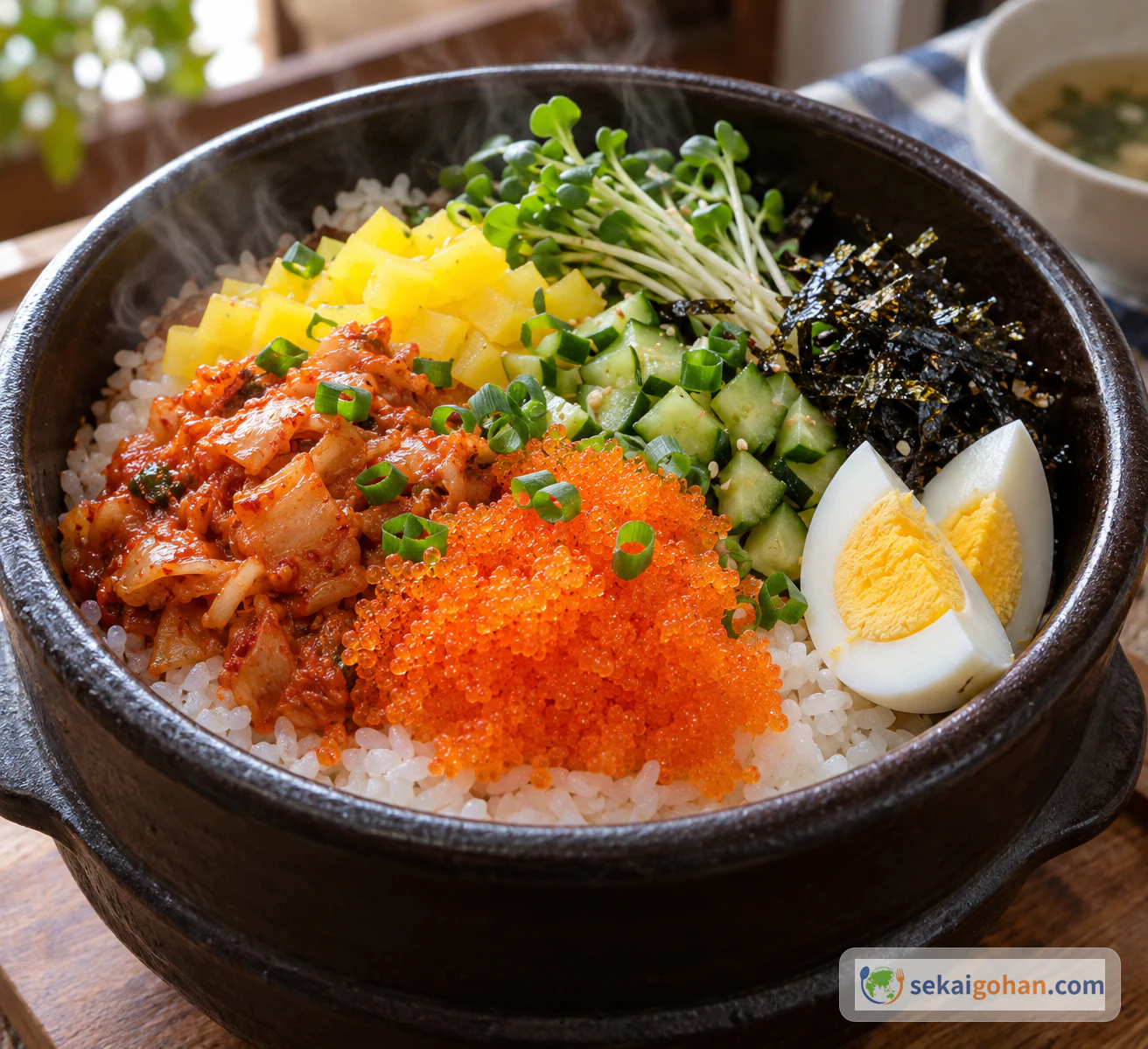
Albap: Korean Fish Roe Rice in a Hot Earthenware Pot (알밥)
Ingredients
| Ingredient | Amount | Role |
|---|---|---|
| Flying fish roe (날치알, tobiko) | 1/4 cup | The star: salty, popping beads. Choose a ready-to-eat product |
| Lemon juice | 1 tsp | Tossed with the drained roe to lighten its flavor |
| Cooked rice | 1 1/2 cups (range: 1 1/2–2 cups) | The hot base that crisps against the pot |
| Toasted sesame oil | 1 tbsp | Coats the pot and rice with aroma |
| Stir-fried kimchi (김치볶음, kimchi bokkeum) | 1/2 cup | Prepared in advance; warmed on top of the rice |
| Radish sprouts | 1/4 cup | Raw, fresh crunch added off the heat |
| Seedless cucumber, diced | 1/4 cup | Cool, crisp contrast |
| Yellow pickled radish (단무지, danmuji) | 1/4 cup | Sweet-sour crunch. Use this 1/4 cup once in total |
| Egg | 1 | Hard-boiled separately, peeled and quartered |
| Toasted seaweed (gim) | 1/2 sheet | Cut into thin strips; aroma to finish |
| Green onion, chopped | 1 tbsp | Fresh aroma to finish |
| Water (for boiling the egg only) | As needed | Used only to hard-boil the egg; not part of the bowl |
Steps
1Hard-boil the egg, then rinse and dress the roe
Put the egg in a small pot with water and boil it until it is hard-boiled with the yolk fully set. Cool it, peel it and cut it into quarters. Set it aside.
If your roe is frozen, follow the package's thawing instructions. Thaw it in the refrigerator or microwave, not at room temperature. Put the roe in a fine-mesh strainer and rinse it under cold running water, then press it gently with a wooden spoon to drain off excess water. If the package says not to rinse the roe, follow the package and skip the rinse. Transfer the roe to a small bowl and mix in 1 tsp lemon juice.
Keep the roe and its liquid away from other foods, wash your hands and tools after handling it, and don't leave it out at room temperature for long.
2Heat the pot and spread the rice
Heat the empty ttukbaegi over medium-high heat for 1 minute. Do this only if your pot's instructions say it can be heated empty on a direct flame. Some earthenware must not be heated dry; if yours is one of them, use a skillet instead.
Add 1 tbsp toasted sesame oil and the 1 1/2 cups cooked rice. Mix with a wooden spoon so the rice is coated, then press it into a flat, even layer.
3Add the kimchi, cover and listen for the crackle
Spread 1/2 cup stir-fried kimchi over the rice, cover with the lid, and heat for about 3 minutes, until you hear the pot crackling. Check the bottom and the smell too, since your pot, its size and your stove decide how fast heat builds. If you smell burning, take it off the heat. In a thin skillet, use a lower heat and watch closely.
4Arrange the egg, roe and cold vegetables
Remove the lid. Place the hard-boiled egg quarters in the center. Arrange the yellow pickled radish, cucumber and roe in separate sections around it. If you want some pickled radish on top for color at the end, hold a little back now, but use no more than the 1/4 cup in total.
5Take it off the heat and finish
Remove the pot from the heat. Top with the sprouts, the thin strips of seaweed and the chopped green onion (plus any pickled radish you held back).
6Mix and eat right away
Serve immediately. Mix everything together with a spoon right in the pot, so the roe, kimchi, vegetables and egg spread through the hot rice, and scrape up the browned rice from the bottom as you go. The crisp bottom and the hot-cold contrast fade as it sits, so this is not a dish to make ahead.