Ingredients and steps on one page. Print it, or choose “Save as PDF” in the print dialog.
Sekai Gohan
Gukbap Recipe (Dwaeji Gukbap): Busan Pork and Rice Soup at Home
Ingredients
Soup and meat
| Ingredient | Amount | Substitutes & notes |
|---|---|---|
| Pork neck bones or pork spareribs | 800 g | For the bone broth. Use spareribs if you can't find neck bones (about 1 3/4 lb) |
| Pork shoulder, in one piece | 450 g | Sliced thin for topping (about 1 lb) |
| Water (for soaking out blood) | 1.5 L | Soak the bones and meat |
| Water (for blanching) | 1.8 L | Removes scum and odor |
| Water (for simmering) | 2.2 L | The main simmering broth |
| Sake or rice wine | 60 ml | Softens the porky smell (about 1/4 cup) |
| Green tops of a long scallion (leek-type green onion) | 1 (about 40 g) | Aromatic |
| Onion | 1/2 (about 100 g) | Sweetness for the broth |
| Garlic | 6 cloves (about 30 g) | Aroma and depth |
| Ginger | 25 g | Rounds off the pork smell |
| Salt | 1 1/3 tsp | Base seasoning for the pot; more is added at the table |
| Black pepper | 1/3 tsp | For finishing |
For the table
| Ingredient | Amount | Substitutes & notes |
|---|---|---|
| Warm cooked rice | 1.25 lb (600 g) | 5.5 oz (150 g) per person. Slightly firm rice works best |
| Scallions | 4 (about 1.25 oz / 35 g) | Thinly sliced |
| Garlic chives | 1 bunch (about 3.25 oz / 90 g) | Cut into 1.5 inches (4 cm) lengths and dressed |
| Salted shrimp (saeujeot / 새우젓) | 1.5 oz (40 g) | Sets the saltiness in each bowl |
| Gochugaru | 1 1/2 tbsp | For the chives and the dadaegi |
| Grated garlic | 2 tsp | For the condiments |
| Sesame oil | 2 tsp | Aroma for the chives |
| Soy sauce | 1 tsp | Seasoning for the chives |
| Vinegar | 1 tsp | Cuts the heaviness of the chives |
| Kkakdugi (radish kimchi) or napa cabbage kimchi | 5.5 oz (160 g) | Palate refresher |
Steps
1Soak and blanch the bones and meat
30 min
Soak the 1.75 lb (800 g) neck bones or spareribs and 1 lb (450 g) pork shoulder in 1.5 quarts (1.5 L) water for 20 minutes, then discard the water. Bring the 2 quarts (1.8 L) blanching water to a full rolling boil over high heat, then add the bones and meat. Once it returns to a boil, cook for 3 minutes; when large gray foam rises and the surface of the meat turns white and firm, drain in a colander. Under running water, lightly rinse off only the blood clots in the cracks of the bones, without scrubbing the meat too hard.
2Simmer gently with the aromatics
90 min
In the washed pot, combine the blanched bones and meat, the 2.2 L simmering water, 60 ml sake, the scallion greens, the halved onion, the 6 garlic cloves lightly crushed with the flat of a knife, and the 25 g ginger, thinly sliced. Bring to a boil over medium-high heat, which takes about 10 minutes, skim off the white foam, then lower the heat. Keep it at about 90–95°C (194–203°F), with small bubbles rising steadily from the sides of the pot, and simmer with the lid slightly ajar for 80 minutes. When a bamboo skewer slides easily into the shoulder and the fat turns clear, move on.
3Rest the pork and slice it thin
12 min
Before taking it out, insert a thermometer into the thickest part of the meat and confirm 75°C (167°F) at the center for at least 1 minute. If it's not there yet, return it to the pot, cook longer, and measure again. Once confirmed, remove the shoulder, spoon 3 tbsp broth over it so it doesn't dry out, and let it rest for 10 minutes. When it has cooled a bit, slice it 4–5 mm (about 3/16 in) thick against the grain. If you try to slice it thin while it's hot, the juices run out and the slices fall apart, so wait until it's cool enough to touch.
4Strain the broth and adjust the volume and salt
35 min
Keep simmering the bones and aromatics left in the pot over low heat for 25 minutes. When the broth has reduced to about 1.75 quarts (1.6 L), fine beads of fat float on the surface and the bones have given up their flavor, turn off the heat, even if the broth isn't white. Strain through a fine-mesh sieve so no bone fragments remain, and return it to the pot. Measure the broth; if it's under 1.75 quarts (1.6 L), top it up with boiling water. Add salt a little at a time, using 1 1/3 tsp as the upper limit, and heat over medium-low for 5 minutes. Taste, and stop when it seems a little underseasoned on its own. If you season it strongly here, it will turn too salty once the saeujeot goes in.
5Make the seasoned chives and dadaegi
10 min
No heat needed. Cut the 3.25 oz (90 g) garlic chives into 1.5 inches (4 cm) lengths and thinly slice the 4 scallions. In a bowl, combine the chives, 1 tbsp gochugaru, 1 tsp soy sauce, 1 tsp vinegar, 2 tsp Korean sesame oil and 1 tsp grated garlic, and toss with chopsticks for 1 minute. You're aiming for the red flakes to coat the chives evenly, with no watery dressing pooling at the bottom. In a separate small dish, mix 1/2 tbsp gochugaru, 1 tsp grated garlic, 2 tbsp broth and 1 tsp saeujeot brine into a loose red dadaegi.
6Warm the bowls and add the rice
6 min
If you're using a dedicated vessel or a small pot, warm it according to its instructions and check whether heating it empty is prohibited. For ordinary bowls, pour in boiling water and leave for 2 minutes, then discard the water and wipe them dry. Put 5.5 oz (150 g) warm rice in each bowl and make a small hollow in the center with a rice paddle. Rice in a cold bowl drops the soup's temperature and the grains swell quickly. Warming the bowl all the way to the bottom keeps everything hot to the last spoonful.
7Combine the soup and pork
5 min
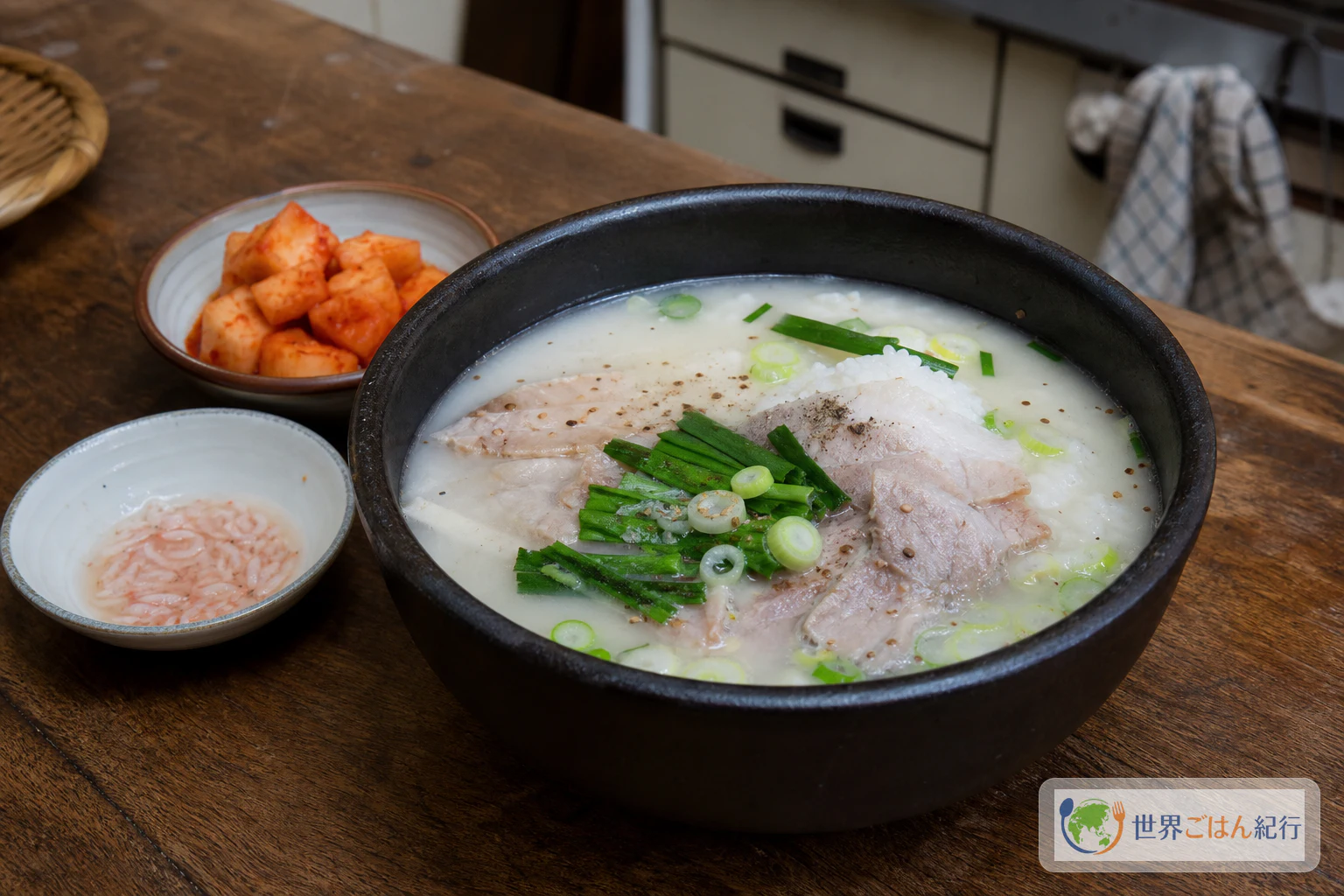
Heat the broth over medium-low to about 90°C (194°F); when small bubbles appear at the sides of the pot, turn the heat down. Pour 350 ml (about 1 1/2 cups) hot broth over the rice in each bowl and top with a quarter of the sliced pork. If you used spareribs, also divide the edible meat taken off the bones among the four bowls. If you're using a stone pot, warm it over low heat for just 1 minute and turn off the heat when fine bubbles appear around the rim. Boiling it hard breaks up the rice and toughens the pork, so stop before the bubbles get big.
8Add the toppings and season at the table
3 min
No heat needed. Top the center of each bowl with scallions, seasoned chives and black pepper, and divide the remaining salted shrimp into four small dishes to serve alongside. Take a first sip of the soup on its own, then dissolve a little salted shrimp and add more as needed, tasting for salt. Start with 1 tsp dadaegi to keep the soup from turning too red. Set kkakdugi or napa cabbage kimchi on the side and eat while hot.