Ingredients and steps on one page. Print it, or choose “Save as PDF” in the print dialog.
Sekai Gohan
Ganghoe: Korean Scallion-Tied Bundles with Naengi and Beef
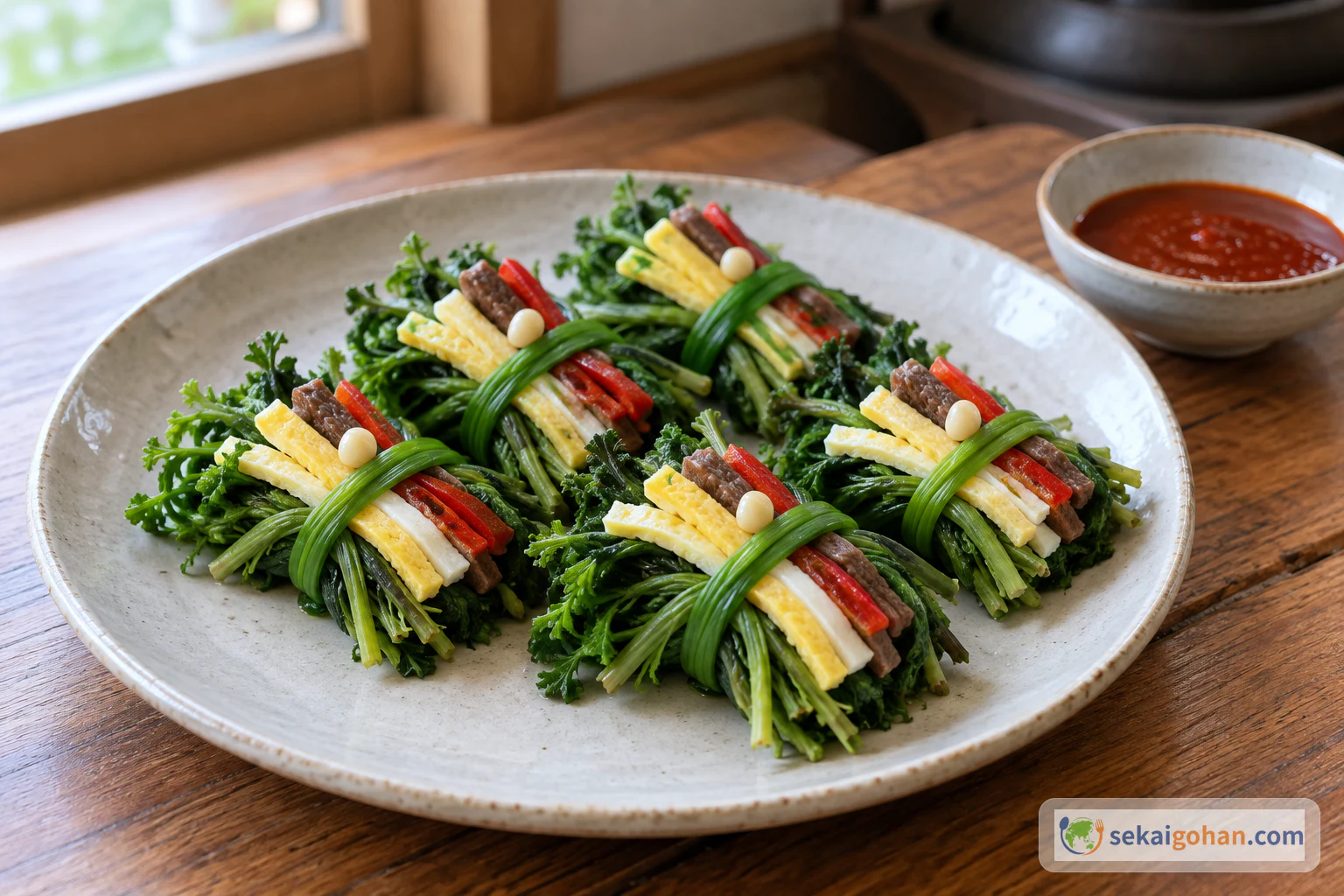
Ingredients
| Ingredient | Amount | Role |
|---|---|---|
| Naengi (냉이) | 3½ oz (100 g) | The green base, folded under the fillings |
| Slender scallions (실파, silpa) | 3½ oz (100 g) | Blanched whole and used to tie each bundle |
| Red chilis (붉은 고추) | 2 | Seeded strips for colour and a light heat |
| Egg (달걀) | 1 | Separated into white and yolk sheets |
| Pine nuts (잣) | 1 tbsp | Tips trimmed, tucked between the fillings |
| Cooking oil (식용유) | a little | For the egg sheets |
| Salt (소금) | a little | For the blanching water |
| Beef, buchaesal (쇠고기 부채살) | 3½ oz (100 g), one piece | Boiled, cooled and cut into thick strips |
| Water (물) | 14 oz (400 g) | For boiling the beef |
| Gochujang (고추장) | ¾ oz (20 g) | Base of the dipping sauce |
| Vinegar (식초) | ¾ oz (20 g) | Sourness in the sauce |
| Sugar (설탕) | ½ oz (15 g) | Sweetness in the sauce |
Steps
1Wash and trim the naengi and scallions
Trim the roots from the naengi and pull off any wilted leaves. Trim the scallions and pull away any wilted outer layers, but leave every stalk long and whole. Rinse both under cool running water in separate colanders, lifting the leaves so grit falls away. Keep the two greens apart from here on. Move on when the water runs clear and no soil clings to the bases.
2Blanch, chill and squeeze the greens
Bring a pot of water to a boil and add a little salt. Drop in the naengi, blanch it briefly, then lift it straight into cold water. Do the same with the scallions. Once they are cool, gather each green into a bundle and squeeze out the water firmly with your hands. The greens are ready when they feel soft and damp, not dripping.
3Soak and boil the beef
Put the beef in a bowl of cold water to draw out the blood. Bring the water for the beef to a boil in a pot. Lift the beef out of the soaking water, add it to the boiling water and boil for about 1 hour. Add nothing else to the pot. The beef is done when it is cooked through to the centre.
4Cool the beef and cut it into thick strips
Lift the beef out and let it cool completely before you cut it. Slice it into thick strips about ¼ × 1½ inch (0.5 × 4 cm). Line the strips up in a small pile so they are easy to grab during assembly. The beef is ready when the strips cut cleanly and keep their shape.
5Separate, strain and fry the egg sheets
Separate the egg and beat the white and yolk in two small bowls. Pass each one through a fine sieve. Wipe a lightly oiled pan, pour in the white and spread it thin, and cook until it is set through with no wet patches. Lift it onto a plate, then fry the yolk the same way. Both sheets are ready when they are even, flat and keep their colour, pale white and clear yellow.
6Cut the egg and chili to the same size
Cut the white and yellow sheets into strips about ¼ × 1½ inch (0.5 × 4 cm), and keep the two colours in separate piles. Rinse the red chilis under running water, split them lengthwise and scrape out the seeds. Cut the chili flesh into strips of the same size. Everything is ready when beef, egg and chili strips all match in length.
7Trim the pine nuts and mix the sauce
Pinch or cut off the small dark tip from each pine nut. Put the gochujang, vinegar and sugar in a small bowl and stir until the sugar dissolves. The sauce is ready when it is smooth, glossy and falls from the spoon in a thick ribbon.
8Fold the naengi, layer the fillings and tie with scallion
Fold a little blanched naengi into a pad about 1¼ inches (3 cm) long. Lay egg, beef and chili strips on top, setting the colours side by side. Wrap a blanched scallion around the middle, tuck the end under, and press a pine nut into the gap between the fillings. A bundle is right when you can lift it by the knot and nothing slides out.
9Arrange in a circle and serve
Set the bundles on a round plate in a circle, all facing the same way. Put the bowl of vinegar gochujang beside the plate or in the centre of the ring. Bring it to the table cool, with chopsticks for dipping. The plate is ready when each bundle shows its stripes of white, yellow, brown and red.