Ingredients and steps on one page. Print it, or choose “Save as PDF” in the print dialog.
Sekai Gohan
Gimbap: Korean Seaweed Rice Rolls with Sesame Oil Rice
Ingredients
Rice and seaweed
| Ingredient | Amount | Substitutes & notes |
|---|---|---|
| Warm cooked rice | 900 g | Just under 3 rice-cooker cups (about 540 ml) of raw rice. Cook slightly firm |
| Toasted nori or large Korean seaweed sheets | 4 sheets | Avoid small seasoned snack packs; they are hard to roll |
| Korean sesame oil | 1 1/2 tbsp | Untoasted light sesame oil has too little aroma. Toasted sesame oil works |
| Salt | 3/4 tsp | Reduce to 1/2 tsp if the Korean seaweed is salted |
| White toasted sesame seeds | 2 tsp | For finishing |
Fillings
| Ingredient | Amount | Substitutes & notes |
|---|---|---|
| Thinly sliced beef | 6.5 oz (180 g) | Beef scraps, ground beef, thin pork or ham also work |
| Eggs | 3 | Make a thickish thin omelet and cut into sticks |
| Carrot | 4 oz (120 g) | Matchsticks 1.5 inches (4 cm) long and 0.125 inch (3 mm) wide |
| Spinach | 6.5 oz (180 g) | If using komatsuna, boil the stems first for 20 seconds |
| Cucumber | 1 (3.5 oz/100 g) | If you don't want it to release water, salt it and squeeze |
| Pickled radish | 4 oz (120 g) | If you have danmuji, cut into 0.375-inch (8 mm) square sticks. Check the saltiness of Japanese-style takuan |
Seasoning for the beef
| Ingredient | Amount | Role |
|---|---|---|
| Soy sauce | 1 tbsp | Saltiness for the meat |
| Raw cane sugar | 2 tsp | Sweetness once cooled |
| Korean sesame oil | 1 tsp | Helps the meat separate |
| Grated garlic | 6 g | About 1/2 clove |
| Black pepper | 1/4 tsp | Tightens the aftertaste |
Table sauce for variation
| Ingredient | Amount | Role |
|---|---|---|
| Gochujang | 1 tbsp | Serve only to those who like heat |
| Mayonnaise | 1 tbsp | Children and those who dislike heat can skip it |
| Vinegar | 1 tsp | Cuts the heaviness |
| Water | 1 tsp | Makes it easy to mix |
Steps
1Season the rice
5 min
Put 2 lb (900 g) warm rice in a large bowl and drizzle on 1 1/2 tbsp Korean sesame oil and 3/4 tsp salt. Mix for 2 minutes in cutting strokes with a rice paddle until the grains are not crushed and only the surface is glossy. Spread on seaweed while steaming hard and the moisture tears it, so spread the rice out and cool it to a little hotter than body temperature.
2Cut and cook the fillings
18 min
Cut the carrot into 1.5-inch (4 cm) long, 0.125-inch (3 mm) wide matchsticks, and the cucumber and pickled radish into 0.375-inch (8 mm) square sticks. Boil the spinach in boiling water over medium heat for 40 seconds, move it to cold water, squeeze the water out hard and cut into 1.5-inch (4 cm) lengths. Mix a pinch of salt into 3 eggs and cook a thick thin omelet over low heat, then cut into 0.5-inch (1 cm) strips. Stir-fry the carrot in a skillet with 1 tsp oil over medium heat for 2 minutes, until slightly softened and darker in color. Work the seasoning into the beef and stir-fry in the same skillet over medium heat for 3 minutes, until the red is gone and almost no liquid remains.
3Spread the rice on the seaweed
4 min
Place one sheet of seaweed on the rolling mat with the long edge nearest you. With fingers lightly wet with water or sesame oil, spread about 8 oz (220 g) rice thinly from the near edge to the far edge. Leave 1 inch (2 cm) at the far edge as the seam, and keep the rice about 0.25 inch (5 mm) thick. If the center is thick, the fillings get pushed out when cut, so make it flat to all four corners.
4Line up the fillings in one row
4 min
Slightly nearer to you than the center of the rice, lay the beef, egg, carrot, spinach, cucumber and pickled radish in a single row across. Make each filling a bundle about 0.5 inch (1 cm) in diameter, don't stack too much, and keep the same thickness to the ends. The pickled radish acts as the core, so putting it toward the near side steadies the start of the roll. Fillings that are releasing water should rest once on paper towels before going on.
5Roll and let it rest
5 min
Lift the near edge of the mat, hold the fillings with your fingers, and in one motion bring the near seaweed over to the far side of the rice. Tighten lightly just once there, pressing out air, to make a cylinder about 1.5 inches (4 cm) across. Crush a few grains of rice on the far seaweed as paste and roll to the end. Pressing too hard makes the cross-section oval and too loose makes it fall apart when cut, so stop at the point where the whole roll through the mat has an even thickness. Rest it seam-side down for 3 minutes.
6Slice and serve
5 min
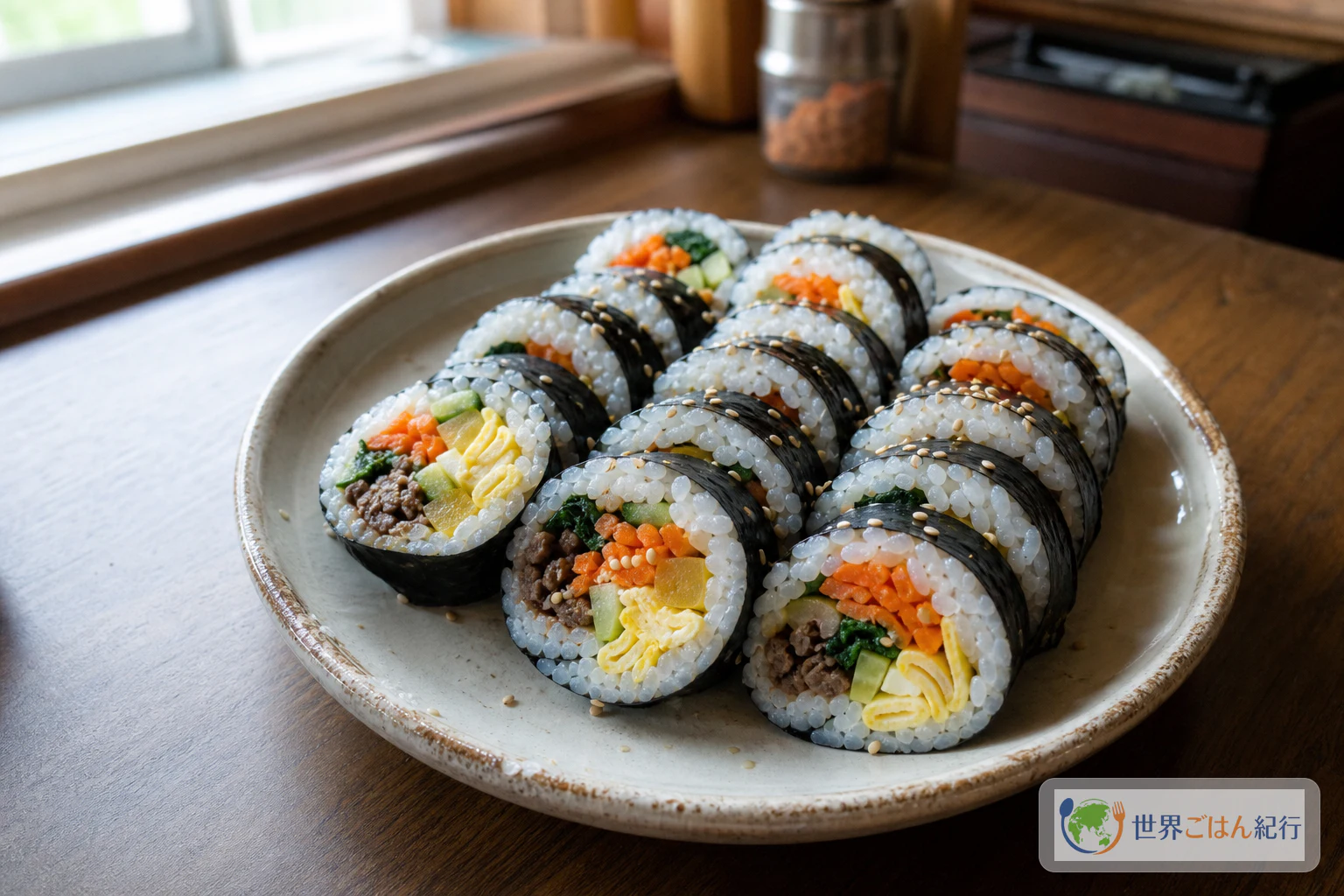
This is the plating step, with the heat off. Brush the knife lightly with sesame oil or wipe the blade with a damp cloth. Cut each roll into 8 slices about 1 inch (2 cm) wide. Don't press straight down; move the blade back and forth in long strokes, wiping the rice off the blade after each slice. It has worked when the rice is not crushed in the cross-section, the fillings stay in the center and the cut face doesn't collapse. Arrange on a plate, sprinkle on 2 tsp white toasted sesame, and serve the gochujang sauce on the side for people who want heat.