Ingredients and steps on one page. Print it, or choose “Save as PDF” in the print dialog.
Sekai Gohan
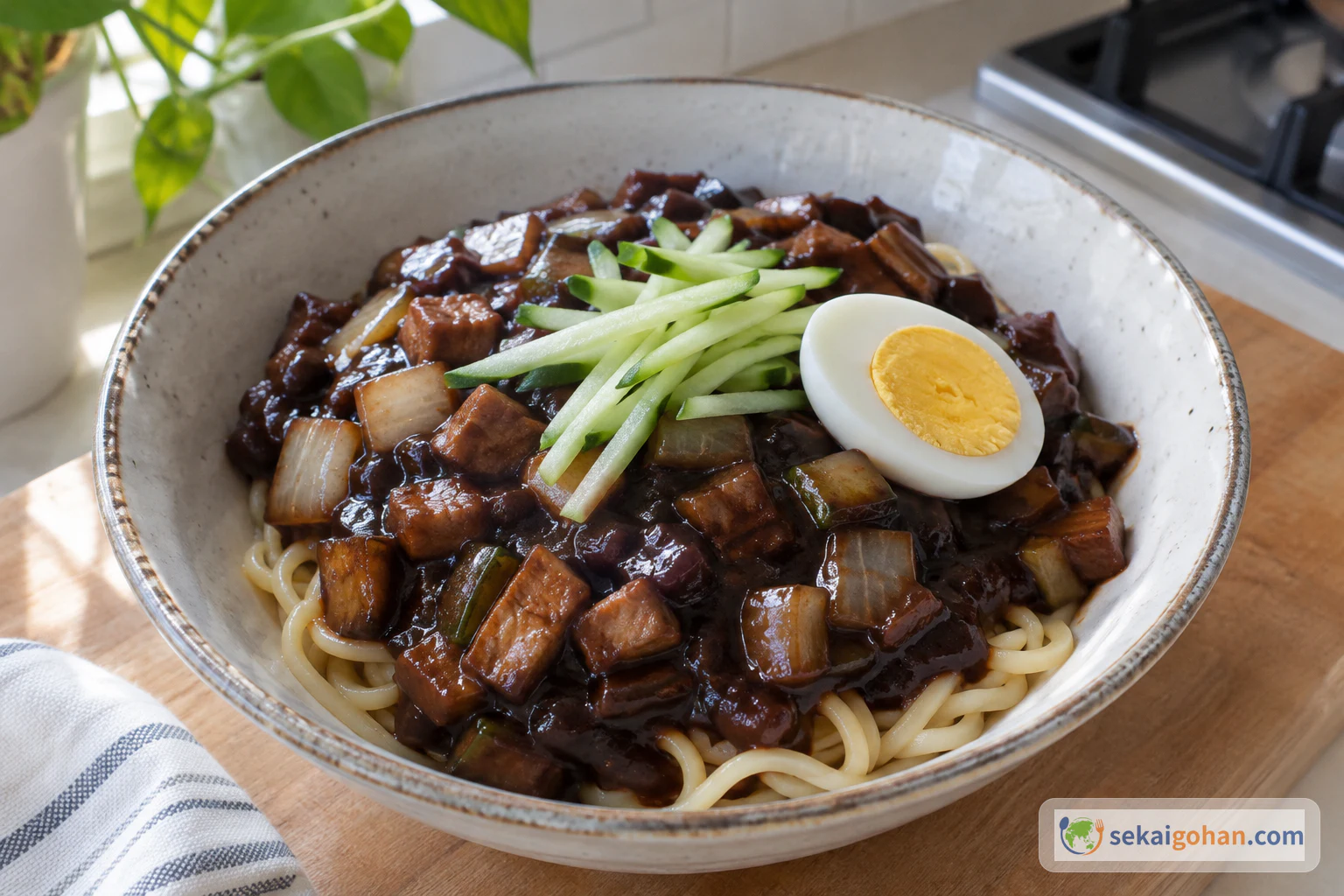
Jajangmyeon: Korean-Chinese Black-Sauce Noodles with Pork and Diced Vegetables (짜장면)
Ingredients
| Ingredient | Amount | Role |
|---|---|---|
| Chunjang (춘장) | 1/2 cup | Salty, savory backbone and dark color of the sauce |
| Oyster sauce | 1/4 cup | Savory depth in the sauce |
| Granulated sugar | 1 tbsp | Sweetness in the sauce |
| Light brown sugar | 1 tbsp | Sweetness in the sauce |
| Chicken broth | 3/4 cup | Liquid for the sauce; use broth you already have ready |
| Water, for the sauce | 1 cup | Whisked into the sauce mixture |
| Canola oil | 2 tbsp | For browning the pork and vegetables |
| Skinless pork belly | 12 oz | The meat of the sauce; cut into 1/2-inch cubes |
| Cabbage | 1/4 head (about 7 oz) | Cut into 1-inch pieces; cooked first, then returned at the end |
| Onion | 1 medium (about 7 oz) | Cut into 1/2-inch cubes |
| Zucchini | 1 medium (about 8 oz) | Cut into 1/2-inch cubes |
| Russet potato | 1 medium (about 7 oz) | Cut into 1/2-inch cubes |
| Mirin | 3 tbsp | Added with the pork to loosen the browned bits in the pot |
| Fresh wheat jjajang noodles | 1 3/4 lb (about 4 bundles) | The noodles |
| Water, for the noodles | 10 cups | Boiled in a separate large pot |
| Cornstarch | 1 tbsp | Thickens the sauce at the end |
| Water, for the slurry | 2 tbsp | Mixed with the cornstarch |
| English cucumber | 1/4 (about 3 oz) | Cut into thin strips; fresh topping |
| Hard-boiled eggs | 3 | Peeled and halved lengthwise; topping |
Steps
1Cut the pork and vegetables
On a board kept for raw meat, cut the skinless pork belly into 1/2-inch cubes. These should be compact cubes, not thin strips or large stewing chunks. Cut the cabbage into 1-inch pieces. Cut the onion, zucchini and russet potato into 1/2-inch cubes. Keep the cabbage apart from the other vegetables, because it goes into the pot on its own.
2Prepare the cucumber and eggs
Wash your hands after handling the pork. On a clean board, cut the English cucumber into thin strips for the topping. Peel the hard-boiled eggs and cut them in half lengthwise. Set both aside for serving; the cucumber is eaten raw, so keep it on the clean board.
3Whisk the sauce and boil the noodle water
In a large measuring cup, whisk together the chunjang, oyster sauce, granulated sugar, light brown sugar, chicken broth and 1 cup water until smooth. Set aside. Pour 10 cups water into a large pot and bring it to a boil. This pot is only for the noodles. The sauce is ready when no streaks remain, and the water is ready when it is at a rolling boil.
4Brown the pork
Heat the canola oil in a heavy pot over medium-high heat. Add the pork and cook, turning often, until browned on all sides, 3–4 minutes. Browned does not mean cooked through. The pork goes back into the pot and keeps cooking in the sauce. With a slotted spoon, move the pork to a plate, leaving the fat in the pot.
5Cook the cabbage
In the same pot, cook the cabbage until lightly charred and wilted, 30 seconds to 1 minute. With the slotted spoon, move the cabbage to its own plate, separate from the pork. The cabbage should show a little char and be just wilted.
6Brown the other vegetables
Add the onion, zucchini and potato to the pot. Cook, stirring often, until the surfaces are browned, about 2 minutes. Put the pork back into the pot with the vegetables and leave the cabbage on its plate. Pour in the mirin, then scrape up the browned bits stuck to the bottom of the pot with a wooden spoon until the bottom is clean.
7Simmer the sauce
Pour in the sauce mixture you whisked earlier and bring the pot to a boil. Cook for about 5 minutes, stirring often so the sauce doesn't scorch on the bottom. Test a potato cube with a fork or spoon, and keep cooking until the vegetables are tender, even if it takes more than 5 minutes.
8Hold the sauce
Turn off the heat under the sauce. Cover the pot and leave it while you cook the noodles. The sauce rests, covered, while the noodles cook in their own pot.
9Boil the noodles
Shake the fresh noodles to knock off any excess flour or starch, then lower them into the pot of boiling water. With tongs or long chopsticks, separate the noodles so they don't stick together. Cook for 6–8 minutes, until they are tender and springy with no floury taste. If your noodle pack gives a different time, follow the pack and check the texture.
10Rinse and portion the noodles
Pour the noodles into a colander. Rinse them under cold running water until they no longer feel slippery. Let them drain thoroughly, then divide the noodles among 4–6 bowls. The noodles should be slick-free and well drained, since excess water would thin the sauce.
11Thicken the sauce
Uncover the sauce and bring it back to a boil, then add the cabbage you set aside. In a small bowl, stir the cornstarch into 2 tbsp water until smooth. Pour the slurry into the sauce while stirring. Cook, stirring often, until the sauce is thickened and glossy, 2–3 minutes. Make sure the pork is cooked all the way through before serving. Its color in the pot does not tell you that it is done.
12Top and serve
Spoon the sauce generously over the noodles. Top each bowl with cucumber strips, then finish each bowl with half a hard-boiled egg. Serve right away, while the sauce is hot and glossy and the cucumber is still fresh.