Ingredients and steps on one page. Print it, or choose “Save as PDF” in the print dialog.
Sekai Gohan
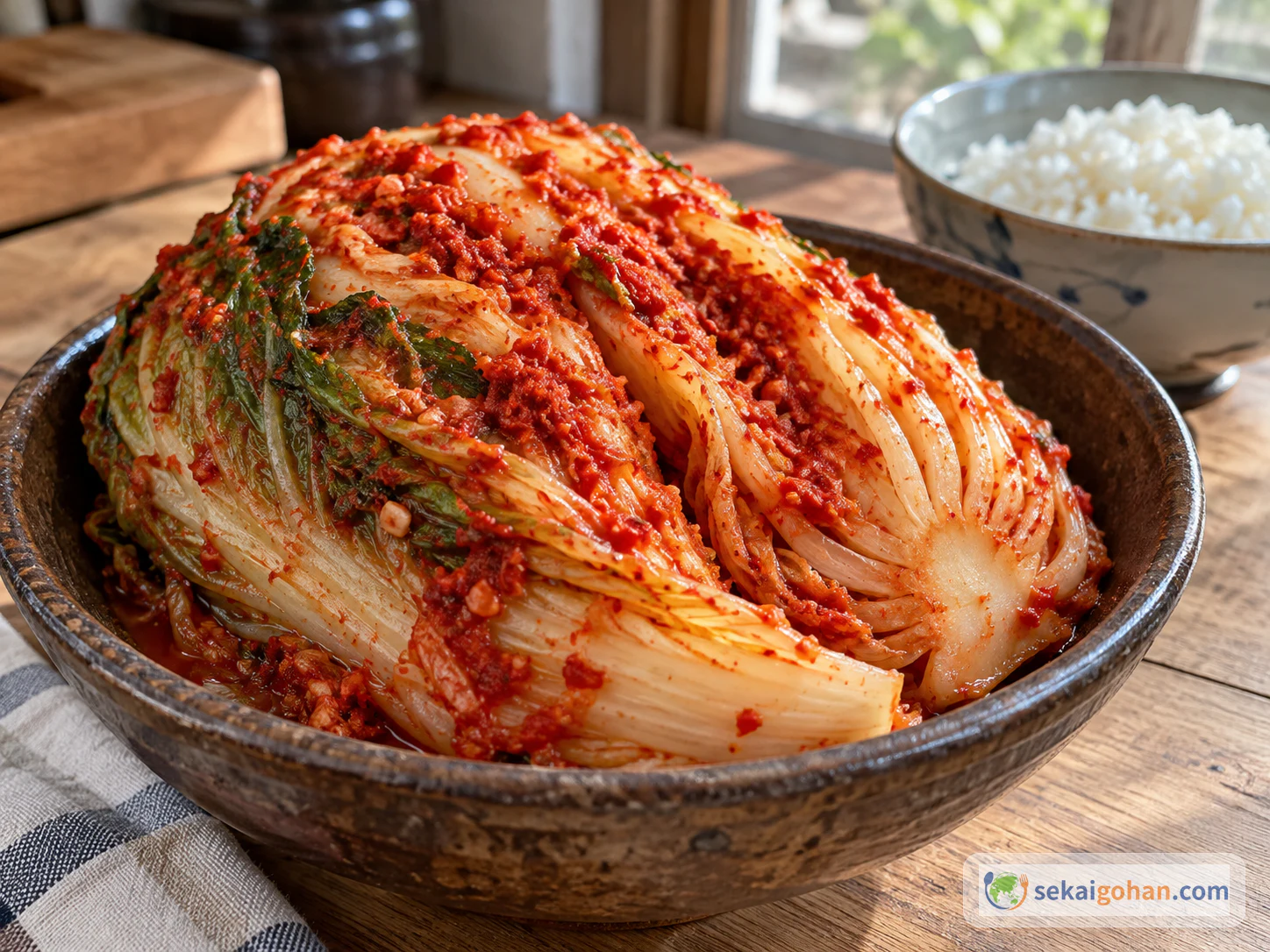
Korean Napa Cabbage Kimchi (Tongbaechu-kimchi): Seasoning Every Leaf of a Whole Cabbage
Ingredients
For salting the cabbage
| Ingredient | Amount | Notes |
|---|---|---|
| Napa cabbage (baechu) | 6 lb (about 2.7kg) | Go by weight, not by head count, since heads vary in size |
| Kosher salt | 1/2 cup (72g) | Rubbed between the leaves |
For the porridge
| Ingredient | Amount | Notes |
|---|---|---|
| Water | 2 cups | For cooking the porridge |
| Sweet rice flour (glutinous rice flour) | 2 tbsp | Thickens the porridge that carries the paste |
| Turbinado sugar | 2 tbsp | Brown or white sugar can be used instead |
Vegetables for the seasoning
| Ingredient | Amount | Notes |
|---|---|---|
| Korean radish | 2 cups, cut into matchsticks | Regular daikon can be used instead |
| Carrot | 1 cup, cut into matchsticks | Color and crunch |
| Green onions (scallions) | 7–8, chopped | |
| Asian chives (buchu) | 1 cup, chopped (optional) | 3 green onions can stand in for them |
| Water dropwort (minari) | 1 cup (optional) | Can be left out |
Seasoning paste
| Ingredient | Amount | Notes |
|---|---|---|
| Garlic | 1/2 cup (24 cloves), minced | |
| Ginger | 2 tsp, minced | |
| Onion | 1 medium, minced | |
| Fish sauce | 1/2 cup | Contains fish |
| Fermented salted shrimp (saeujeot) | 1/4 cup, chopped, including its brine | Contains shellfish (crustaceans) |
| Gochugaru (Korean chili flakes) | 2 cups | The color and heat of the paste |
Steps
1Split the cabbage, keeping the leaves attached
Don't cut too much off the core. Make a short, shallow cut at the root end, then pull the cabbage apart into halves with your hands. Next, make a shallow cut near the core of each half, so you will be able to split it again later while the leaves stay joined at the base. If the leaves come loose from one another, it becomes hard to spread paste between them one by one.
2Rub salt between the leaves
Wet the cabbage halves. Lift the leaves one at a time and rub the 1/2 cup (72g) kosher salt between them, using more on the thick white stems near the base. The thin green tips need less.
3Salt for 2 hours, turning every 30 minutes, then rinse and drain
Let the salted cabbage sit in the basin for 2 hours, turning the halves over every 30 minutes so they salt evenly. Liquid will come out and the leaves will start to relax. Stick to this timing.
After 2 hours, rinse the cabbage in cold water several times. Split each half into quarters along the cuts you made, remove the core, and set the quarters in a colander or draining basket to drain. There is no long soak in water here. If the cabbage isn't rinsed well, the kimchi comes out too salty. If it isn't drained well, the extra water thins the paste.
4Cook the porridge and let it cool completely
While the cabbage salts, combine the 2 cups water and 2 tbsp sweet rice flour in a small saucepan. Cook over medium heat for about 10 minutes, stirring along the bottom so it doesn't scorch, until it starts to bubble. Add the 2 tbsp sugar and stir for 1 minute, then turn off the heat. Let it cool completely. The seasonings go into cold porridge, not warm.
5Mix the seasoning paste
Add the garlic, ginger, onion, fish sauce, saeujeot and gochugaru to the cooled porridge and mix well. Then fold in the Korean radish, carrot and green onions, plus the Asian chives and minari if you are using them. Don't add extra salt after looking at or tasting the salted cabbage. The paste is meant to go on as mixed.
6Spread the paste over each leaf
Put on clean gloves. Take one quarter at a time, lift the leaves one by one, and spread a thin layer of paste over each one. Remember the small inner leaves near the core, and don't pile the paste up at the root end. A thin, even coat on every leaf works better than a thick layer in a few places.
7Wrap each quarter and pack it
Fold each coated quarter up in its outermost leaf so it holds together. Pack the quarters into clean containers. This batch makes about 8 lb (3.6kg), so splitting it among several containers is fine. Handle the paste carefully so it doesn't spill.
8Eat it right away, or let it ferment
You can eat the kimchi as soon as it is made, while it tastes fresh. You can also let it ferment. If you ferment it, how fast it goes depends on the conditions in your room. As a guide, after 1 to 2 days at room temperature the kimchi starts to smell and taste sour, and bubbles appear when you press down on the top. Once you see these signs that fermentation has begun, move the kimchi to the refrigerator, where the cold slows fermentation down.
Fermentation produces gas. If you seal the lid tightly, the gas can build up inside the container, so open it with care.