Ingredients and steps on one page. Print it, or choose “Save as PDF” in the print dialog.
Sekai Gohan
Ssambap: Korean Rice Wrapped in Fresh Lettuce and Perilla
Ingredients
| Ingredient | Amount | Role |
|---|---|---|
| Cooked short-grain white rice | 4 cups (960 ml) | The filling; seasoned while hot |
| Salt | ¼ tsp | Seasons the rice |
| Sesame oil (for the rice) | 1 tsp | Gloss and aroma; loosens the grains |
| Lettuce (sangchu, 상추) | about 20 leaves | The main wrapping leaf |
| Perilla leaves (kkaennip, 깻잎) | about 10 leaves | Second layer with a sharp, green aroma |
| Cabbage (yangbaechu, 양배추) | 4–6 large leaves | Steamed for soft, sweet wraps |
| Korean soybean paste (doenjang, 된장) | 4 tbsp | Salt and depth; the base of the ssamjang |
| Korean chili paste (gochujang, 고추장) | 2 tbsp | Heat and sweetness |
| Garlic, minced (다진 마늘) | 2 tsp | Raw bite in the sauce |
| Sugar | 1 tbsp | Rounds off the salt of the doenjang |
| Sesame oil (for the ssamjang) | 4 tsp | Loosens the paste and adds aroma |
| Toasted sesame seeds | 2 tsp | Nutty crunch |
| Water | 2 tbsp | Sets the consistency of the ssamjang |
| Canned tuna (optional, for tuna-mayo rolls) | 1 can, 5 oz (142 g) | Mild filling in place of ssamjang |
| Mayonnaise (optional) | 2 tbsp | Binds the tuna |
| Pickle relish (optional) | 2 tsp | Sharpness for the tuna |
| Salt and pepper (optional) | a little | Seasons the tuna |
Steps
1Wash the lettuce and perilla leaves
Wash your hands with soap. Put the lettuce and perilla leaves in a large bowl of water, leave them for 1 to 2 minutes, then swish them gently; change the water and repeat two or three times. Both leaves have fine hairs and deep creases, so work the stem ends and the wrinkled undersides more than you would other greens. Rinse each leaf under running water and lay it in a colander to drain. They are ready when water has run through the creases on the back and the leaves no longer drip, because drops left behind pool on the plate and loosen the wraps.
Raw leavesLettuce and perilla are eaten raw and never heated, so washing and keeping them clean is the only protection. Bag the leaves separately from raw meat and fish when you shop, and keep any meat or fish juices off the leaves and the board you use for them.
2Steam the cabbage and cool it in ice water
Bring the water in the steamer to a full boil before the cabbage goes in. Lay in the leaves and steam for 14 to 15 minutes. Lift them out as soon as the thickest part of the rib turns translucent, dip them in ice water for a few seconds, and drain in a colander. An overcooked leaf keeps softening from its own heat until it tears and turns dull, so judge by the rib, not the clock, with thin spring cabbage. The drained leaves should be pale green, soft enough to fold, with a faint bite left in the rib.
3Season the rice while it is hot
Turn the freshly cooked rice into a large bowl while it is still steaming. Scatter over the salt (¼ tsp) and sesame oil (1 tsp). Fold with a rice paddle in cutting strokes, lifting from the bottom without pressing the grains. Spread the rice out a little and let it cool until you can hold a handful comfortably. It is ready when the grains are whole and separate, evenly glossy, and no grains of salt remain.
Season straight from the potHot rice dissolves the salt and takes up the sesame oil evenly. Once rice cools, the salt stays in grains and the oil slicks the surface instead of coating each grain, and the shaped rice is more likely to crumble.
4Mix the ssamjang
Put the doenjang (4 tbsp) and gochujang (2 tbsp) in a small bowl and stir just these two together until smooth. Add the sugar, garlic, sesame seeds and sesame oil and mix again. Add the water a little at a time, stopping when the sauce falls from the spoon in a slow, thick ribbon. Nothing goes on the heat, so the garlic keeps its raw bite. It is done when the color is even with no streaks, and a dab sits on a leaf without sliding.
Blend the two pastes alone firstDoenjang is stiff and lumpy, gochujang is sticky. Working them together before anything else gets rid of the doenjang lumps. Sugar, oil and water added too early just slide around the lumps and leave streaks.
5Shape the rice into batons
Put on disposable gloves, or lay a sheet of plastic wrap over your palm. Divide the seasoned rice into 20 equal portions. Press each into a short baton about 2 by 1 inches (5 × 2.5 cm), or roll it into a ball, and line them up on a tray. Batons sit neatly along the length of a leaf and keep their shape in a lunchbox. Squeeze just enough that a piece holds together when picked up and still feels soft, not packed hard.
6Layer the leaves and wrap
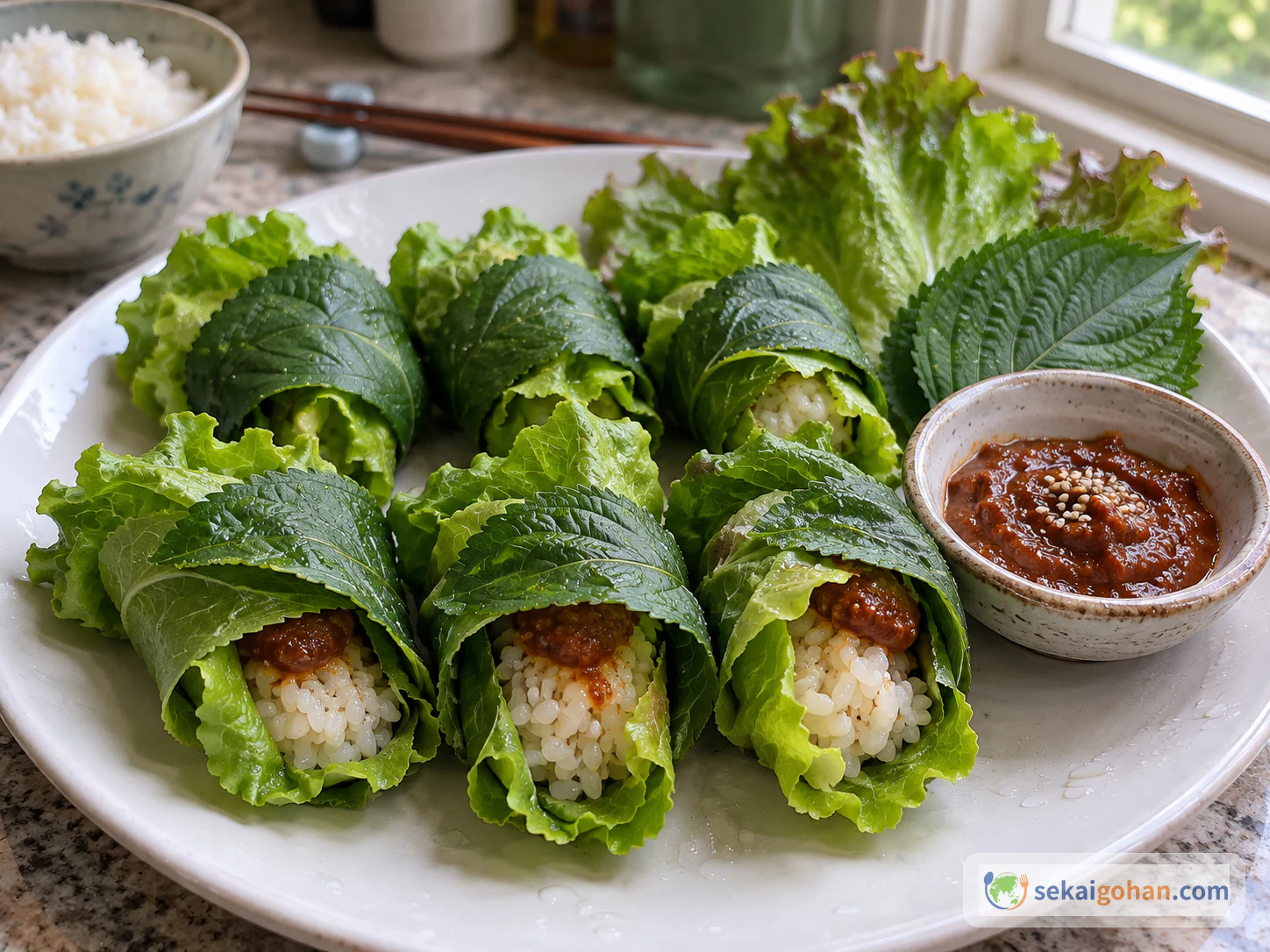
Spread a lettuce leaf on your palm and lay a perilla leaf over it. A slightly bitter leaf against a sweeter one is the pairing that works best. Set a rice baton in the middle and add about ½ tsp ssamjang on top. Fold in the left and right sides, then bring the near edge over and roll away from you. Make a few wraps in cabbage alone too. A finished wrap holds together when lifted and fits in one bite.
Smaller holds betterOverfilled wraps split and get too big to eat in one bite. One baton and a small dab of sauce per leaf is enough. The ssamjang can go on top of the rice inside the leaf or on the outside just before eating, and both work.
7Arrange the platter
Line a wide plate with a few loose leaves. Set the wraps in rows with a little space between them, mixing lettuce and cabbage wraps so everyone can choose. Put the bowl of ssamjang with a spoon in the center, and fan extra leaves at the edge for anyone who wants to roll their own. The leaves soften as they sit, so carry the plate to the table right away. Serve while the leaves still look crisp and glossy.