Ingredients and steps on one page. Print it, or choose “Save as PDF” in the print dialog.
Sekai Gohan
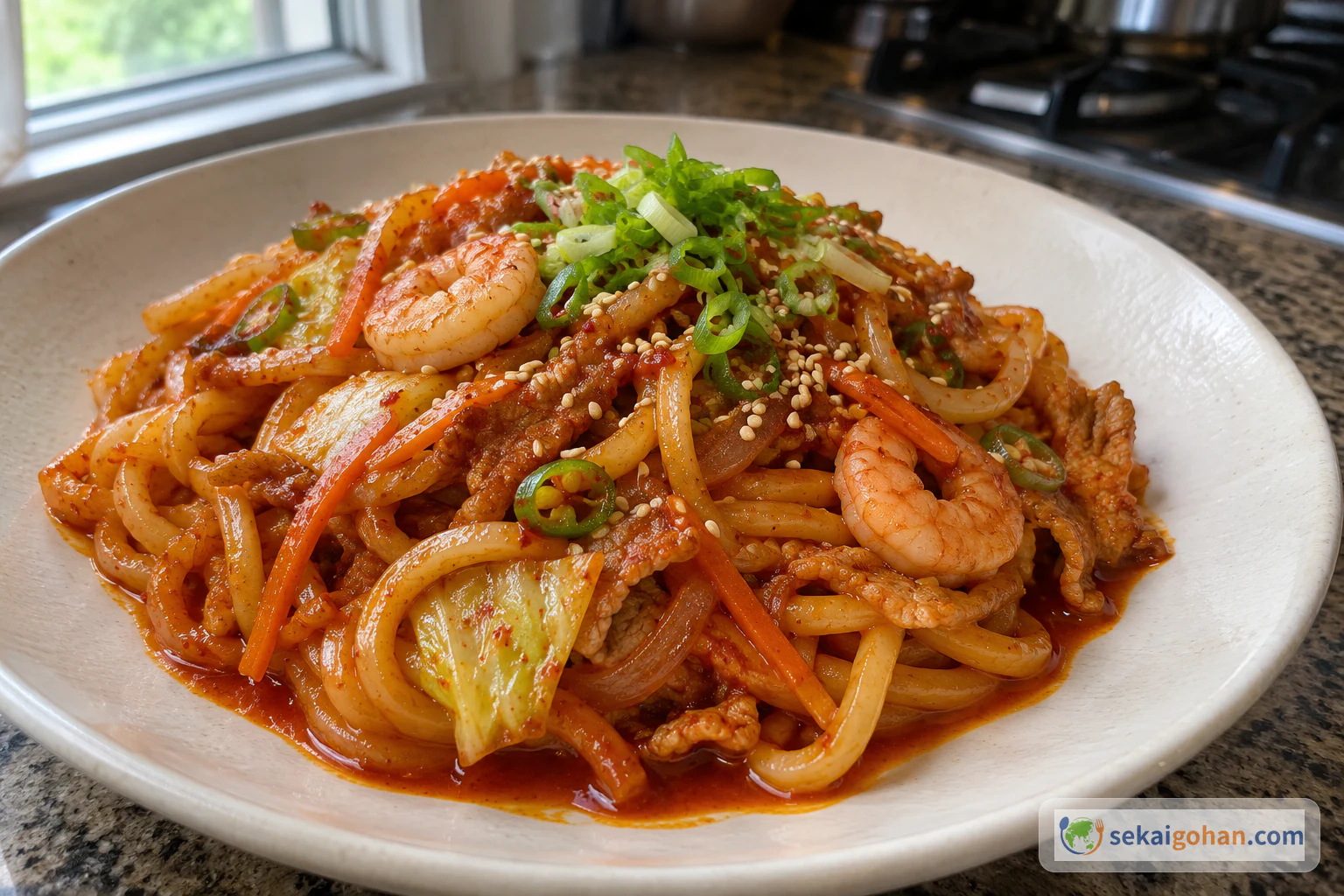
Yakki-udong: Daegu Spicy Stir-Fried Udon with Pork and Shrimp
Ingredients
| Ingredient | Amount | Role |
|---|---|---|
| Udon noodles (우동사리, udong sari) | 2 portions | Thick, soft, chewy body of the dish |
| Pork, any cut, thinly sliced (돼지고기, dwaeji-gogi) | 3½ oz (100 g) | Savory depth and fat |
| Shrimp, peeled, for cooking (새우, saeu) | 10 to 15 | Sweetness and snap |
| Cabbage (양배추, yangbaechu) | 3½ oz (100 g) | Sweetness and volume |
| Carrot (당근, danggeun) | ¼ | Color and sweetness |
| Onion (양파, yangpa) | ½ | Sweetness |
| Cheongyang or other hot green chilies (청양고추, cheongyang-gochu) | 2 | Sharp, fresh heat |
| Korean leek or thick scallion (대파, daepa) | ½ stalk | Scallion oil |
| Minced garlic (다진마늘, dajin maneul) | 1½ tbsp | Aroma and bite |
| Neutral cooking oil (식용유, sigyongyu) | 2 tbsp + 2 tbsp | Two rounds of frying |
| Mirin (미림, mirim) | 1 tbsp | Marinade |
| Salt and black pepper (소금·후추, sogeum, huchu) | a little each | Marinade |
| Brewed soy sauce (양조간장, yangjo ganjang) | 3½ tbsp | Sauce: salty backbone |
| Oligo syrup (올리고당, olligodang) | 2½ tbsp | Sauce: sweetness and shine |
| Vinegar (식초, sikcho) | ½ tbsp | Sauce: a sharp edge to the sweetness |
| Oyster sauce (굴소스, gul soseu) | 1 tbsp | Sauce: savory depth |
| Korean chili flakes (고춧가루, gochugaru) | 1½ tbsp | Sauce: heat and red color |
| Toasted sesame oil (참기름, chamgireum) | ½ tbsp | Finishing aroma |
| Chili oil (고추기름, gochu-gireum) | ½ tbsp | Finishing heat and aroma |
| Toasted sesame seeds (통깨, tongkkae) | as needed | Finish |
Steps
1Season the pork and shrimp
If the pork or shrimp are frozen, thaw them in the refrigerator or under running water. Pull out the dark vein along the back of any shrimp that still has one. Put the pork and shrimp in a bowl, sprinkle with a little salt and pepper, and pour the mirin over. Toss with your fingers until every slice and every shrimp looks evenly damp and flecked with pepper.
2Cut the vegetables
Cut the cabbage, carrot and onion into long, thin strips that are easy to eat with chopsticks. Mince the chilies very small and slice the leek or scallion on a sharp diagonal. Keep every vegetable in its own pile, since each goes into the pan at a different moment. The board is ready when five separate piles sit side by side and nothing is left whole.
3Mix the sauce
In a small bowl, combine the soy sauce, oligo syrup, vinegar, oyster sauce and gochugaru. Stir hard with a spoon, scraping the chili flakes down from the sides, until no dry red specks float on the surface. The sauce turns glossy and deep red-orange. Set it beside the stove.
Mix the sauce before the heat goes onAdding five seasonings one by one to a hot pan keeps the noodles on the fire far too long, and they turn soft while the chili scorches. With the sauce ready in one bowl, it goes in with a single pour.
4Boil the noodles for 2 minutes
Bring a pot of water to a boil, drop in the udon and cook for 2 minutes. Loosen the strands with long chopsticks as they soften. Before draining, scoop 2 to 3 spoonfuls of the cooking water into a small bowl and keep it by the stove. Drain the noodles in a colander once every strand has come free of the block.
The noodle water is your safety netThose few spoonfuls loosen noodles that turn dry and sticky in the pan. The water carries some salt from the noodles, so add it a spoonful at a time and taste, especially if the sauce already tastes strong.
5Fry the garlic, then the pork
Heat 2 tbsp of the oil in the skillet over low heat and add the garlic. Stir until it smells strong and sweet and only just begins to color; high heat scorches garlic and turns it bitter. Add the pork and stir-fry, spreading the slices out so they cook evenly. Move on when no pink remains on any slice.
6Cook the shrimp and set everything aside
Add the shrimp and keep stirring until they turn pink and opaque all the way through; cut the thickest one open to check the center. Slide the pork and shrimp onto a clean plate that has not held raw meat, leaving the oil behind in the pan. They wait there while the vegetables cook. The step is done when the pan holds only a little oil and the shrimp are pink and opaque all the way through.
7Make scallion oil and fry the vegetables
Add the remaining 2 tbsp oil and the leek or scallion, and let it sizzle gently over low heat until the oil smells of scallion. Add the carrot and stir-fry for 2 minutes, since it is the firmest vegetable. Add the onion and cabbage and keep tossing. Stop when the cabbage collapses, turns glossy and loses its stiffness.
8Combine over high heat
Turn the heat to high. Return the noodles, pork and shrimp to the pan, pour in the sauce and toss with chopsticks and spatula until every strand is red. If the noodles look dry and catch on the pan, add the reserved noodle water a spoonful at a time. Add the minced chili now, as much as you like for heat, tasting as you go. Stop when the sauce clings to the noodles and only a little loose sauce runs to the bottom of the pan.
Finish fast and hotThe vegetables keep releasing water, and a lukewarm pan turns that water into a thin, soupy pool. High heat and quick tossing evaporate the excess, give the noodles a light fire flavor and leave just the small pool of sauce a Daegu plate has.
9Finish with sesame oil and chili oil
Take the pan off the heat. Drizzle the sesame oil and chili oil around the noodles and scatter sesame seeds over the top. Give one last toss and pile onto plates while the steam is still rising. A thin pool of red sauce should gather at the bottom of each plate.