Ingredients and steps on one page. Print it, or choose “Save as PDF” in the print dialog.
Sekai Gohan
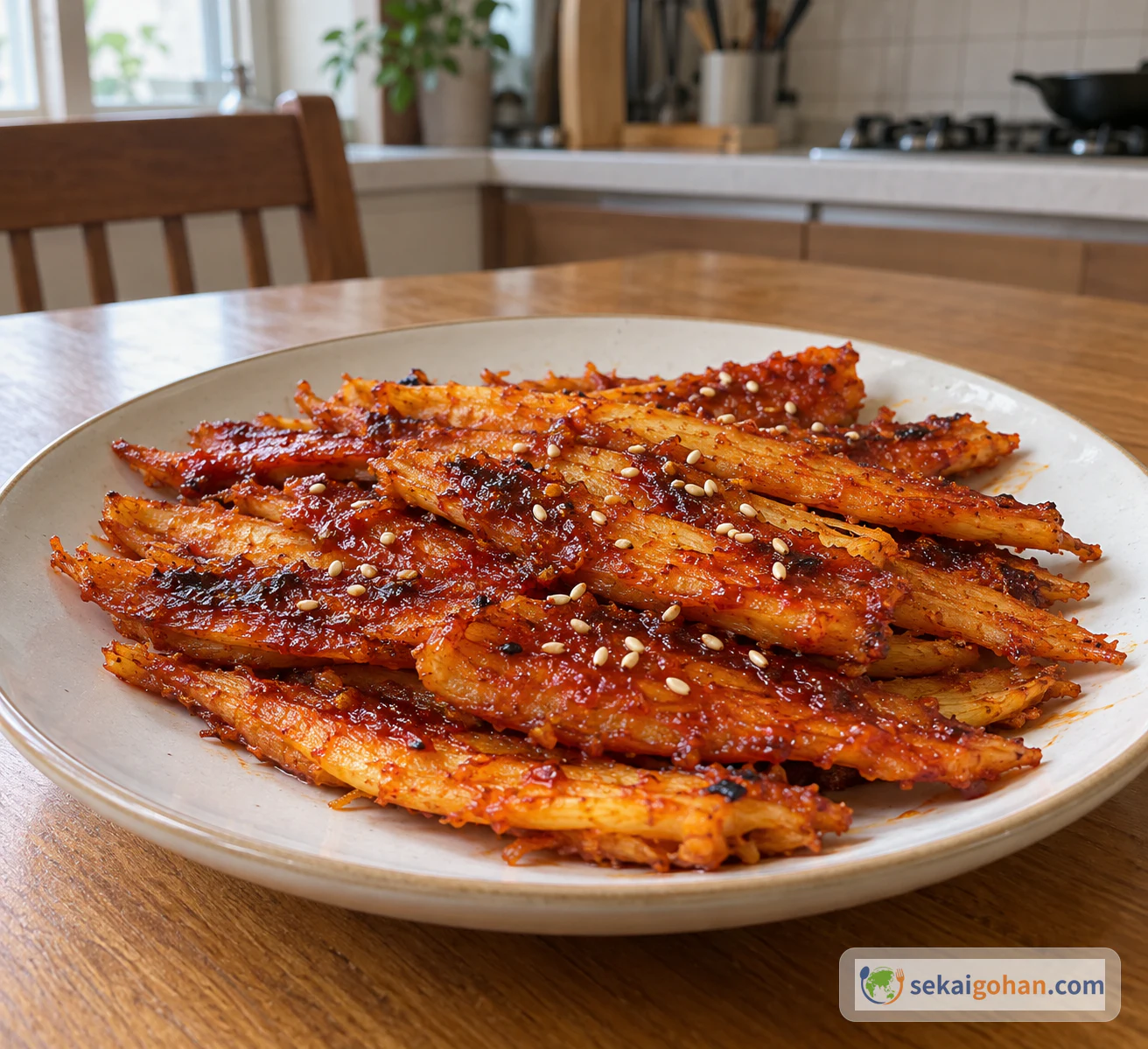
Deodeok Gui: Korean Pan-Roasted Deodeok Root with Gochujang Sauce (더덕구이)
Ingredients
| Ingredient | Amount | Role |
|---|---|---|
| Deodeok root (더덕), trimmed | 10.5 oz (300 g) | The main ingredient |
| Coarse salt (굵은소금) | 0.5 Tbsp | Dissolved in water for the soak |
| Water | as needed | For blanching, rinsing and the salt soak |
| Sesame oil (참기름) | 1.5 Tbsp | Yujang, the first coating |
| Perilla oil (들기름) | 0.5 Tbsp | Yujang |
| Jin-ganjang, Korean soy sauce (진간장) | 0.5 Tbsp | Yujang |
| Gochujang (고추장) | 2.5 Tbsp | Later sauce |
| Gochugaru, Korean chili powder (고춧가루) | 1 Tbsp | Later sauce |
| Jin-ganjang, Korean soy sauce (진간장) | 0.5 Tbsp | Later sauce; separate from the yujang portion |
| Mullyeot, Korean starch syrup (물엿) | 2 Tbsp | Later sauce |
| Sugar (설탕) | 0.5 Tbsp | Later sauce; can be reduced, down to none |
| Minced garlic (다진마늘) | 0.5 Tbsp | Later sauce |
| Minced daepa, Korean large green onion (다진 대파) | 1 Tbsp | Later sauce |
| Sesame oil (참기름) | 0.5 Tbsp | Later sauce; separate from the yujang portion |
| Whole sesame seeds (통깨) | a little | Sprinkled on at the end |
Steps
1Wash, blanch and peel the roots
Wash the soil off the deodeok roots under running water. Put the roots into plenty of boiling water and blanch them for only 10–15 seconds, then rinse them in cold water right away. Make a lengthwise slit along each root and, starting from the slit, peel off the skin. The skin pulls away cleanly and the roots look pale and smooth.
2Split and flatten the roots
Cut each peeled root in half lengthwise. Lay a plastic sheet on the cutting board and place the roots on it. Tap them gently with a rolling pin or plain rod until the fibers spread flat. Don't tear the roots; they should lie flat and stay in one piece.
3Soak in salt water
Stir 0.5 Tbsp coarse salt into a bowl of water until it dissolves. Put the flattened roots into the salt water and soak them for 15–20 minutes. The roots sit submerged in the clear salt water.
4Mix the yujang
While the roots soak, mix 1.5 Tbsp sesame oil, 0.5 Tbsp perilla oil and 0.5 Tbsp jin-ganjang to make the yujang. It has only the two oils and soy sauce, with no red sauce yet. Stir until the oils and soy sauce are evenly combined.
5Rinse, dry and coat with yujang
Lift the roots out of the salt water and rinse them lightly under running water. Pat them thoroughly dry with a kitchen towel. Spread the yujang over the top side, then turn the roots over and coat the other side as well. Both sides are evenly glossy with the yujang.
6Roast the first time
Heat the pan over medium-low and lay in the yujang-coated roots. Let the underside roast, then turn the roots and roast the other side, so that both sides together take 3–4 minutes. The roots are lightly roasted, with only the thin yujang coating on them.
7Mix the later sauce
While the roots roast, mix 2.5 Tbsp gochujang, 1 Tbsp gochugaru, 0.5 Tbsp jin-ganjang, 2 Tbsp mullyeot, 0.5 Tbsp sugar, 0.5 Tbsp minced garlic, 1 Tbsp minced daepa and 0.5 Tbsp sesame oil in a separate bowl. Keep it away from the roots. The sauce is smooth and evenly red.
8Sauce the roots off the heat
Transfer the roasted roots from the pan to a bowl and let them cool for about 1 minute. Spoon the later sauce over the roots. Turn the roots over in the bowl until the sauce coats every surface. Every root is covered in red sauce.
9Roast again and plate
Put the sauced roots back into the pan over medium-low. Roast them briefly, turning them, and stop once the sauce has set onto the roots and stays on their surface. Transfer the roots to a plate, sprinkle a little whole sesame over the top and serve.