Ingredients and steps on one page. Print it, or choose “Save as PDF” in the print dialog.
Sekai Gohan
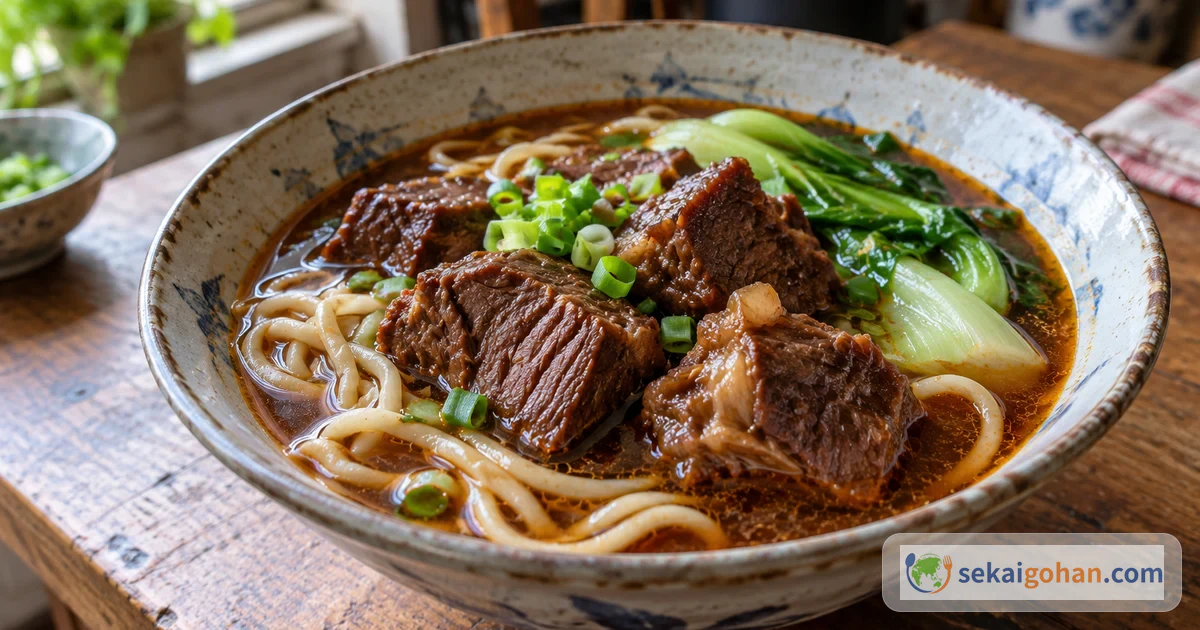
Taiwanese Beef Noodle Soup: Red-Braised with Doubanjiang and Star Anise
Ingredients
Parboiling the beef
| Ingredient | Amount | Substitutes & notes |
|---|---|---|
| Beef shank | 2.75 lb (1.3 kg) | Cut into 1.5 inches (4 cm) cubes. Chuck or short rib also work |
| Ginger (for parboiling) | 3 slices | Thinly sliced |
| Water (for parboiling) | 2.5 quarts (2.4 L) | Enough to cover the beef well |
Aromatic spices
| Ingredient | Amount | Substitutes & notes |
|---|---|---|
| Star anise | 2 pods | Put in a spice bag |
| Coriander seeds | 1 tsp | Put in a spice bag |
| Bay leaves | 2 | Go straight into the pot |
| Cinnamon stick | 1 | Cassia is the traditional form. Ceylon cinnamon also works |
Braising ingredients
| Ingredient | Amount | Substitutes & notes |
|---|---|---|
| Tomatoes | 2 large | Cut into 8 wedges |
| Onion | 1 | Cut into 1 inch (2.5 cm) squares |
| Garlic | 6 cloves | Crushed with the flat of a knife |
| Ginger | 3 slices | Thinly sliced |
| Scallions | 6 | Cut the white parts into 2 inches (5 cm) lengths, and slice the green parts thinly and set aside |
| Dried red chiles | 2 | Increase or decrease the heat to taste |
| Doubanjiang (chile bean paste) | 1 tbsp | An ordinary store-bought one works |
| Tomato paste | 1 tbsp | — |
| Rock sugar | 1 tbsp | Brown sugar or raw cane sugar also works |
| Shaoxing wine | ½ cup (120 ml) | Taiwanese cooking rice wine gives a lighter-colored broth |
| Soy sauce | ¼ cup (60 ml) | Regular (dark) soy sauce |
| Dark soy sauce (lao chou) | 3 tbsp | For color and body. Taste at the end and add more if needed |
| Water | 1.5 quarts (1.2–1.4 L) | To about 1 inch (2.5 cm) above the ingredients |
| Vegetable oil | 2 tbsp | — |
| Salt | A little | Adjust to taste at the end |
Finishing
| Ingredient | Amount | Substitutes & notes |
|---|---|---|
| Chinese wheat noodles | 4 portions | Thick fresh noodles suit it. If dried, enough for 4 servings |
| Bok choy | 1 lb (450 g) | Trim the base evenly |
| Green parts of scallions | The portion set aside | Thinly sliced |
| Chile oil | A little | Optional |
| Pickled mustard greens (takana-style) | 4 tbsp | Chopped. Stands in for Taiwanese suan cai. Optional |
Steps
1Parboil the beef
Put the beef shank cut into 1.5 inches (4 cm) cubes, 3 slices of ginger, and 2.5 quarts (2.4 L) of water in a large pot and set over high heat. Once it boils, boil hard for 5 minutes, and when a lot of gray scum has risen to the surface, drain in a colander. Wash the beef well under running water to remove the scum clinging to the surface. This parboiling makes a clear broth, so do not skip it even though it is a nuisance. Wash the pot as well.
2Dry-toast the spices
Set a heavy pot over medium heat and, without oil, toast the star anise, bay leaves, coriander seeds, and cinnamon stick for 1 to 2 minutes, shaking the pot. Take them out when the aroma rises and the star anise has deepened slightly in color. If they burn they turn bitter, so take the pot off the heat before smoke rises. Put the star anise and coriander seeds in a spice bag and tie it shut, and set the bay leaves and cinnamon aside.
3Sauté the aromatics and tomatoes
Turn the same pot to slightly above medium heat and add 2 tbsp vegetable oil. Add the tomatoes, onion, garlic, ginger, the white parts of the scallions, and the dried red chiles, sprinkle with a pinch of salt, and sauté for about 3 minutes. Move on when the corners of the tomatoes have rounded and the edges of the onion have turned a little translucent. You do not need to brown anything here.
4Add the doubanjiang and beef
Over medium heat, add 1 tbsp doubanjiang, 1 tbsp tomato paste, and 1 tbsp rock sugar, and mix all through, pressing against the bottom of the pot. When the oil has turned red and the toasty aroma of the doubanjiang rises, add the parboiled beef and stir together for about 2 minutes. It is enough when the seasonings evenly coat the surface of the beef. Doubanjiang scorches easily, so if the bottom of the pot starts to blacken, lower the heat a little.
5Braise for 2 hours
Add the spice bag, bay leaves, cinnamon stick, ½ cup (120 ml) Shaoxing wine, ¼ cup (60 ml) soy sauce, and 3 tbsp dark soy sauce, and pour in water to about 1 inch (2.5 cm) above the ingredients, about 1.5 quarts (1.2 to 1.4 L). Bring to a boil over high heat, skim the scum that rises, and then lower to low heat. Cover and braise for about 2 hours at a quiet heat where the surface only now and then trembles. If it keeps boiling hard, the meat tightens and turns tough, and the broth clouds. It is done when the beef splits easily when pressed with chopsticks.
6Adjust the broth
When the braise is done, turn the heat to low and take about 5 minutes to adjust the final seasoning. First take out the spice bag, cinnamon stick, and bay leaves. If a lot of fat floats on the surface, skim it lightly with a ladle. Take a small amount of broth and taste it; if it lacks salt, add salt, and if the color or sweetness is lacking, add dark soy sauce 1 tsp at a time. Poured over noodles it will taste diluted, so the right saltiness is when the broth tastes a little strong on its own.
7Boil the noodles and bok choy and assemble
Bring plenty of water to a boil in another pot, add the Chinese noodles and bok choy together, and boil for about 4 minutes, or as directed on the noodle package. When the noodles have loosened and the stems of the bok choy are bright green, drain well in a colander. Divide the noodles and bok choy among bowls and pour in plenty of beef and hot broth. Scatter the reserved scallion greens, and add chile oil to taste and pickled mustard greens chopped to about 0.25 inch (5 mm).