Ingredients and steps on one page. Print it, or choose “Save as PDF” in the print dialog.
Sekai Gohan
Ballokume: Elbasan's Spring Festival Cornmeal Cookies
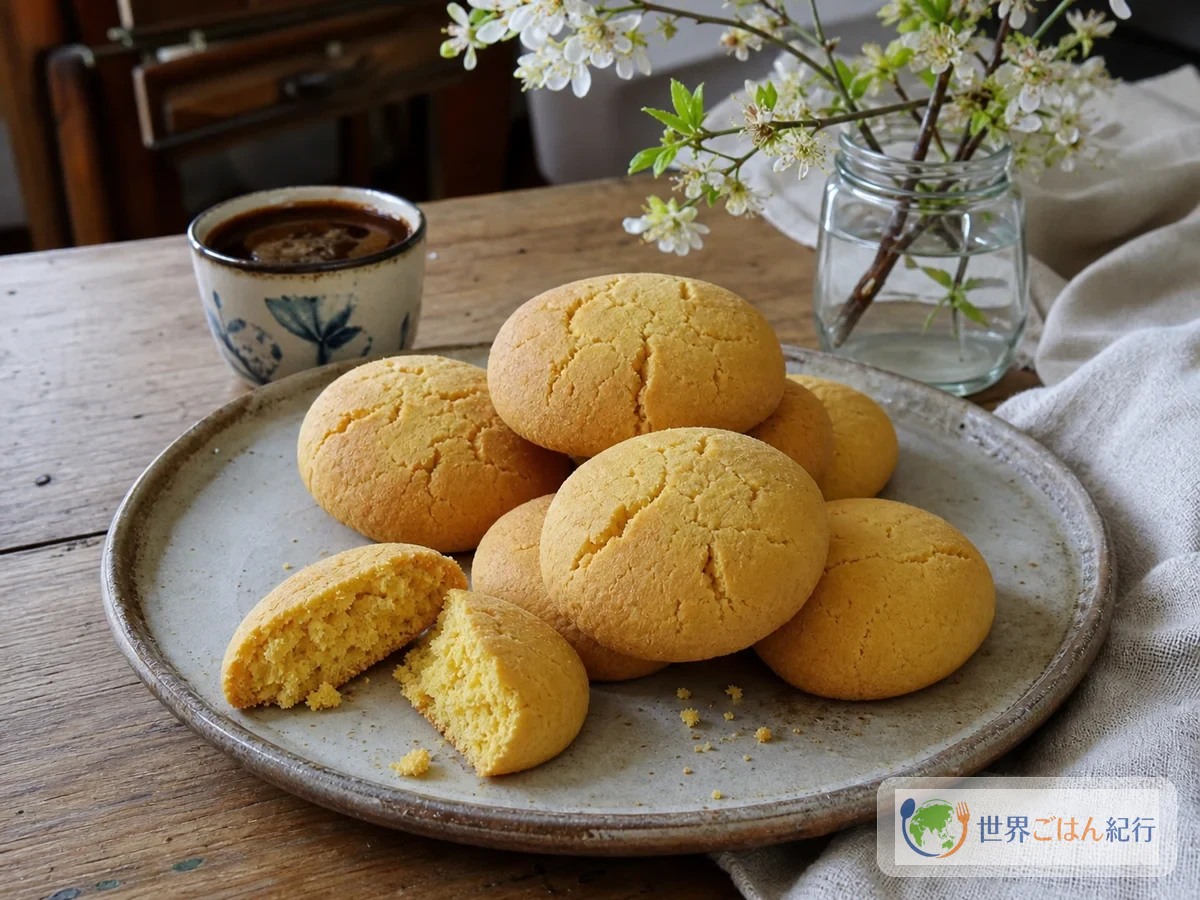
Ingredients
| Ingredient | Amount | Substitutes & buying |
|---|---|---|
| Corn flour | 15 oz (420 g) | Finely ground cornmeal. Coarse cornmeal alone turns gritty |
| Unsalted butter | 6.5 oz (180 g) | Soft enough for a finger to sink in at room temperature. Ordinary supermarket butter is fine |
| Granulated sugar | 8 oz (230 g) | Superfine sugar also works. Granulated is easier to handle in humid weather |
| Eggs | 4, about 8 oz (220 g) | Medium. Always bring to room temperature |
| Milk | 1 tbsp (15 ml) | A moisture aid in place of ash lye. Don't overdo it |
| Vanilla extract | 0.25 tsp (1 ml) | Optional. Don't make it too strong |
| Salt | 2 g | Tightens the sweetness. Only with unsalted butter |
| Corn flour for dusting | 20 g | A thin coat on the hands for shaping |
Steps
1Work the butter and sugar until pale
15 min
No heat. Bring 6.5 oz (180 g) butter to 20 to 23°C so it dents under a finger but hasn't melted. Put the butter, 8 oz (230 g) sugar, and 2 g salt in a bowl and work them by pressing against the side with a wooden spoon. Stop when the color goes from yellow to pale cream and a little of the sugar's grain remains. Melted butter makes the dough spread and turn greasy when cool.
2Mix in the eggs one at a time
12 min
No heat. Crack in room-temperature eggs one at a time and work for about 2 minutes each. At first it looks split, but pressing against the bottom of the bowl with the spoon brings it back to a glossy yellow cream. After the fourth egg, add 1 tbsp (15 ml) milk and 0.25 tsp (1 ml) vanilla extract. It should not be runny: lifting the spoon, it should fall in a thick ribbon.
3Fold in the cornmeal
8 min
No heat. Add 15 oz (420 g) corn flour in 3 portions. The first time, mix broadly with the wooden spoon; from the second, press it together against the side of the bowl. The guide: the dry look is gone, a scoop falls heavy, and in the bowl it forms a mass about 1 inches (3 cm) thick with spoon marks on the surface. If it is dry and cracks, add only 1 tsp (5 ml) milk; if sticky, add 10 g corn flour at a time.
4Rest the dough
25 min
No heat. Cover the bowl with plastic wrap or a cloth and rest 25 minutes at a room temperature of 20 to 23°C. Move on when the flour has absorbed the liquid and fat, and the dough spread into a disk about 7 inches (18 cm) across holds its edge without major breakage and the surface turns slightly matte. Refrigerating makes the butter too firm and the dough cracks when shaped. Only when the room is above 82°F (28°C), leave it 15 minutes at room temperature and then firm it 10 minutes in the refrigerator.
5Shape rounds and space them out
10 min
No heat. Coat your hands thinly with the dusting corn flour and divide the dough into 12. Shape each into a round mound about 2.75 oz (80 g), 5.5 to 6 cm across and 1 inches (2.5 cm) thick. You don't need to make the surface perfectly smooth; a few cracks are fine. Line a baking sheet with baking paper and set them at least 1.5 inches (4 cm) apart. If pressed thin, they bake toward a hard cookie.
6Bake at a low temperature
20–25 min
Preheat the oven to 350°F (170°C) and bake 20 minutes on the middle rack. The guide: the edges are a pale gold, fine cracks have formed on top, and pressed lightly in the center, it doesn't sink but slowly springs back. If the color is pale, add 3 minutes at a time. Baking quickly at 350°F (180°C) or above browns only the outside and leaves the center powdery. A smell of burnt butter means the temperature is too high.
7Cool on a rack, then break open
15 min
No heat. When they come out, leave them on the sheet 5 minutes, and once they hold together, move them to a rack. After 10 more minutes of cooling, the outside tightens lightly and the inside crumbles. Broken open hot, the center looks moist, but as they cool the flour and butter settle. Eaten warm before fully cool, the aroma is up; the next day they are a little more moist.