Ingredients and steps on one page. Print it, or choose “Save as PDF” in the print dialog.
Sekai Gohan
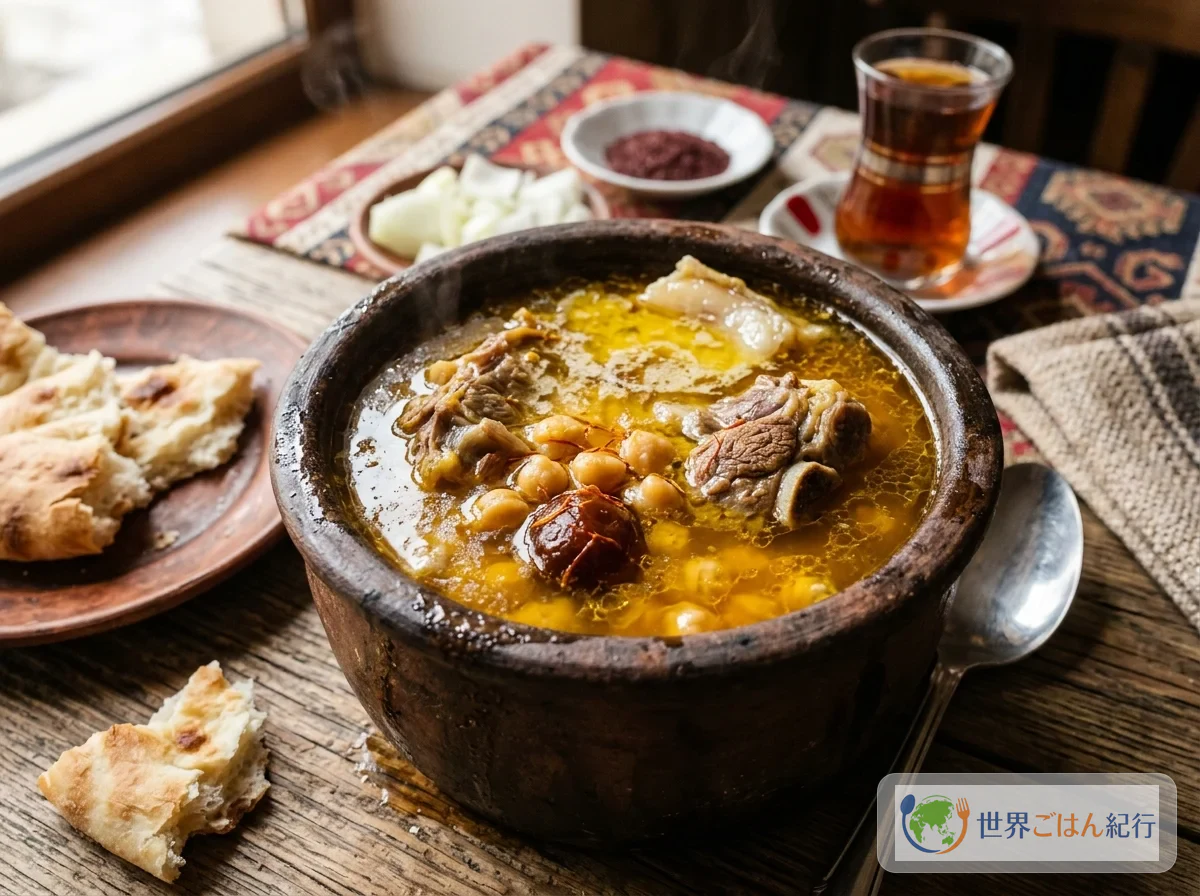
Piti: Sheki's Clay-Pot Lamb and Chickpea Stew, Eaten in Two Courses
Ingredients
For the stew
| Ingredient | Amount | Substitutes & notes |
|---|---|---|
| Lamb shoulder (in a block) | 1.5 lb (700 g) | 3–4 cm cubes. Leave a little fat on. Beef shank works at the same weight |
| Lamb tail fat or fatty trimmings | 2 oz (60 g) | If you can't find it, omit and leave the fat on the shoulder |
| Dried chickpeas | 6.5 oz (180 g) | Soak from the night before. If using canned, add 1 lb (480 g) drained weight in the second half |
| Onions | 2 | 1 simmered, 1 thinly sliced for serving |
| Potatoes | 4 small (about 14 oz / 400 g) | Quarter 1 each. A variety that holds its shape is easiest |
| Dried alycha or sour dried plums | 2 oz (60 g) | If hard to find, reduce to 6 dried prunes (about 1.5 oz / 45 g) |
| Saffron (threads) | 0.1 g | Steep in ½ cup (100 ml) hot water. Powder or turmeric alone changes the aroma |
| Water | 1.25 quarts (1.1 L) | 1 quart (1 L) for stewing and ½ cup (100 ml) for the saffron. Keep a little hot water aside to add partway |
| Salt | 8 g | Added in the second half when the other ingredients go in. Check at the end |
| Black pepper | 1/2 tsp | Can be light if you prefer the local dried mint |
| Dried mint | 1 tsp | Half in the stew, half for serving. Optional |
To serve alongside
| Ingredient | Amount | Substitutes & notes |
|---|---|---|
| Bread such as lavash, naan or pita | For 4 | Easiest to use if thin and tearable, since it gets dunked in the broth |
| Sumac | 2 tsp | Sour finish. If you have none, a little lemon at the table |
| Onion | 1 | Peeled and cut into wedges. Soak briefly in water if too pungent |
| Fresh herbs | As needed | Mint, basil, tarragon and so on. The dish works without them |
Steps
1Soak the chickpeas and steep the saffron
8–12 hours soaking the night before + 15 min on the day
Soak the chickpeas in plenty of water, and the next day, when they've swelled to about double, drain and rinse them. If the skins are tight and the centers are still hard when pressed with a finger, extend the soak by a few hours. Cut the lamb shoulder into 3–4 cm cubes and trim only the thick fatty parts to about 0.5 inches (1 cm).
For the 0.1 g of saffron, loosen the dry threads lightly with your fingers, pour on ½ cup (100 ml) hot water and cover. Let stand 20–30 minutes; it's ready when the water is a deep yellow and the threads release their aroma. They don't need to dissolve completely like powder. If using canned beans, rinse and drain them and do not add them in this step.
2Pack the pots with meat and beans and add the stewing water
15 min
Prepare four ovenproof containers of 600–700 ml, or one heavy 2.5–3 L pot. If you use clay pots, be sure to choose ones marked oven-safe that can be heated from cold. Don't pour boiling water into a pot chilled in the refrigerator, and don't pour cold water into a hot vessel.
Divide among the containers 6 oz (175 g) lamb, 15 g tail fat, the soaked chickpeas and wedges of onion. Sprinkle with black pepper and half the dried mint, and pour in the 1 quart (1 L) stewing water, 1 cup (250 ml) per container. The water doesn't need to cover the ingredients; stop when it comes halfway to two-thirds up the meat. Cover tightly with a lid or aluminum foil, and keep the potatoes and dried plums, which are added later, separate.
The finished state before heating is meat and beans that haven't fallen apart at the bottom of the container, with the water level at half to two-thirds of the ingredients. Don't start heating at this stage; keep the containers at room temperature until just before they go into a 150°C (300°F) oven.
3Cook the beans and meat first in a 300°F (150°C) oven
90 min
Preheat the oven to 150°C (300°F), put in the covered containers and heat for 90 minutes. The guide is a broth that trembles quietly at the edge of the container; there's no need to remove the lid and boil hard. If the water drops too low partway, add boiling water 50 ml at a time. Adding cold water disturbs the simmer and strains the clay pot.
Traditional versions simmer over low heat for 6–7 hours. This home version at 300°F (150°C), with soaked beans and 3–4 cm cubes of meat, adapts that method to a home oven. After 90 minutes, split a bean; if the center is chalky and hard, simmer another 30 minutes before adding the next ingredients.
4Add the potatoes, dried plums and saffron, and finish
90 min
Take the containers out once and add the quartered potatoes and dried alycha or prunes to each. Pour 1.5 tbsp (25 ml) of the saffron water over each, and divide 8 g salt and the remaining dried mint among them. If the potatoes stick well out of the broth, add just a little boiling water.
Put the lids back and heat another 90 minutes at 150°C (300°F). When you open them toward the end, check that the meat gives way and shreds when pressed with a fork, the chickpeas are soft enough to crush with a finger and the center of the potato offers no resistance. If you have a thermometer, check that the center of the thickest meat reaches 75°C (167°F) and holds for at least 1 minute. If it's still firm, extend by 20–30 minutes at a time and add boiling water if the liquid runs low.
If using canned beans, don't put them in for the first 90 minutes; add them in this step with the potatoes. If the canned beans are already soft, shorten the extra heating to 60 minutes and move on before the skins all peel off.
5Separate the broth from the solids and eat in two stages
10 min
Right after taking them off the heat, move the containers onto trivets and rest them, covered, for 10 minutes. Supporting the container with oven mitts, ladle only the broth into deep bowls. Rather than pressing the ingredients to squeeze out the liquid, scoop gently from the side so the meat and beans stay in the pot.
First, tear the bread and dunk it in the broth to taste the fat, saffron and aroma of beans. When the broth is finished, coarsely mash the meat, chickpeas and potatoes left in the pot with a fork. Stop when the meat fibers remain and the beans and potatoes are about half paste, then set it on bread with sumac and onion alongside. Not pushing it through a sieve completely keeps the texture of the second plate.