Ingredients and steps on one page. Print it, or choose “Save as PDF” in the print dialog.
Sekai Gohan
Qutab Recipe: Thin Stuffed Flatbreads from Azerbaijan
Ingredients
Dough
| Ingredient | Amount | Substitutes & notes |
|---|---|---|
| All-purpose flour (low-protein) | 7 oz (200 g) | If you have medium-strength flour, use 10.5 oz (300 g) of it instead of combining the two flours |
| Bread flour | 3.5 oz (100 g) | If the dough turns too chewy, replace it with all-purpose flour |
| Salt | 2/3 tsp (4 g) | For the dough. Don't cut it too far even if the cheese is salty |
| Lukewarm water | ¾ cup (170 ml) | About 95°F (35°C). Adjust by about 1 tbsp depending on how much the flour absorbs |
| Olive oil | 1 tbsp | Vegetable oil also works. Makes the dough less likely to tear |
Herb and white cheese filling
| Ingredient | Amount | Substitutes & notes |
|---|---|---|
| Spinach | 5.5 oz (150 g) | If using komatsuna (Japanese mustard spinach), chop the stems fine. Squeeze frozen spinach very dry |
| Dill | 20 g | If you have none, use more parsley. Dill is the closest to the local flavor |
| Cilantro | 20 g | If you dislike it, use 20 g Italian parsley |
| Italian parsley | 20 g | Regular parsley also works |
| Green onions | 3 (about 1.5 oz (45 g)) | Sliced thin. A little garlic chive can be mixed in |
| Feta cheese | 4 oz (120 g) | Cottage cheese, ricotta, or strained yogurt with salt added also work |
| Black pepper | 1/4 tsp | Coarsely ground |
| Sumac | 1 tsp | A little in the filling, more to finish. A little lemon zest plus lemon juice can stand in |
| Lemon juice | 2 tsp | Softens the raw green taste of the herbs |
Finishing and sides
| Ingredient | Amount | Substitutes & notes |
|---|---|---|
| Butter | 20 g | Melt it and brush on after cooking. Olive oil also works |
| Sumac | 2 tsp | For finishing. Adds sourness and red color |
| Plain yogurt | 5.5 oz (150 g) | Strained yogurt is richer. Mix in a pinch of salt |
| Cucumber | 1 | For the simple side salad |
| Tomato | 2 | For the simple side salad |
| Salt | 1/3 tsp | Divide between the salad and the yogurt |
Steps
1Knead the dough and let it rest
Combine 7 oz (200 g) all-purpose flour, 3.5 oz (100 g) bread flour, and 4 g salt in a bowl, then add ¾ cup (170 ml) lukewarm water at about 95°F (35°C) and 1 tbsp olive oil. When no dry flour remains, turn it out onto the counter and knead with the heel of your hand for 7 minutes. When the surface is smooth and the dough is slightly firmer than an earlobe, shape it into a round about 4.5 inches (12 cm) across, cover the bowl with a cloth right up to the rim so it doesn't dry out, and rest it for 30 minutes. If it is sticky, add flour 1 tbsp at a time; if it is stiff, add water 1 tsp at a time.
2Keep the herb filling from getting watery
Cut 5.5 oz (150 g) spinach into 0.25 inch (5 mm) strips, coarsely chop 20 g each of dill, cilantro, and parsley to about 0.125 inch (3 mm), and slice 3 green onions. Sprinkle with a pinch of salt, leave for 5 minutes, and lightly squeeze out the liquid by hand. Mix in 4 oz (120 g) feta, 1/4 tsp black pepper, 1 tsp sumac, and 2 tsp lemon juice until the filling holds together moistly but no water pools at the bottom of the bowl.
3Roll the dough into thin rounds
Divide the rested dough into 8 pieces and roll each into a ball of about 2 oz (60 g). Cover the rest with a cloth so they don't dry out, and roll them one at a time into rounds about 8.5 inches (22 cm) across and about 0 inch (1 mm) thick. Dust the counter and rolling pin lightly with flour and roll for about 3 minutes, pushing from the center outward. The edge should be slightly translucent. If the dough looks about to tear, stop at 8 inches (20 cm).
4Fill and fold into a half-moon
Spread about 1.75 oz (50 g) of filling over one half of the dough in a semicircle, leaving 0.5 inches (1 cm) at the edge. Fold the other half over, press the air out from the center outward with your palm, and pinch the edge closed. Allow about 1.5 minutes per piece. Overfilling releases liquid as it cooks, so keep the filling to 0.375 inch (8 mm) thick or less. If an edge lifts, brush a little water along it and press again.
5Cook on a dry pan
Preheat a heavy skillet over medium-high heat for 2 minutes, and lay one qutab in it with no oil. Keep the heat at medium to medium-high, so the surface doesn't scorch hard, and cook about 2 to 2 1/2 minutes on the first side. When small bubbles rise on the surface and brown spots appear, flip it. Cook the other side about 2 minutes; if the edge is still white and floury, give it 30 seconds more. For the meat version, drop to medium heat and cook at least 3 minutes per side so the center cooks through.
6Finish with butter and sumac
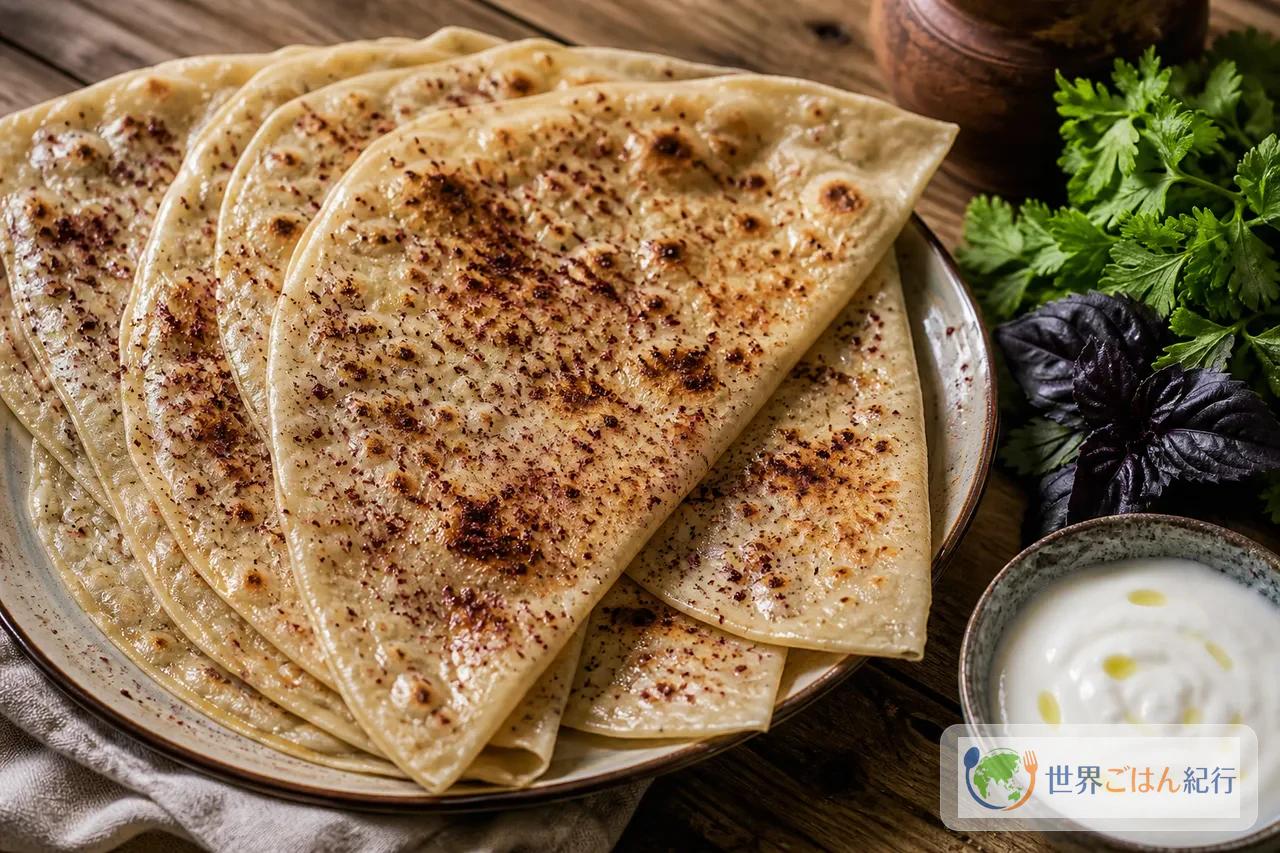
Stack the qutab once brown spots remain and the white floury look at the edge is gone, and brush thinly with melted butter while still hot. Use 20 g in total, not so much that oil pools on the plate. Scatter 2 tsp sumac over everything and serve with 5.5 oz (150 g) plain yogurt mixed with a pinch of salt. The finish takes 3 minutes, but if you leave them stacked for 5 minutes the dough turns slightly moist and easier to eat right to the edge.