Ingredients and steps on one page. Print it, or choose “Save as PDF” in the print dialog.
Sekai Gohan
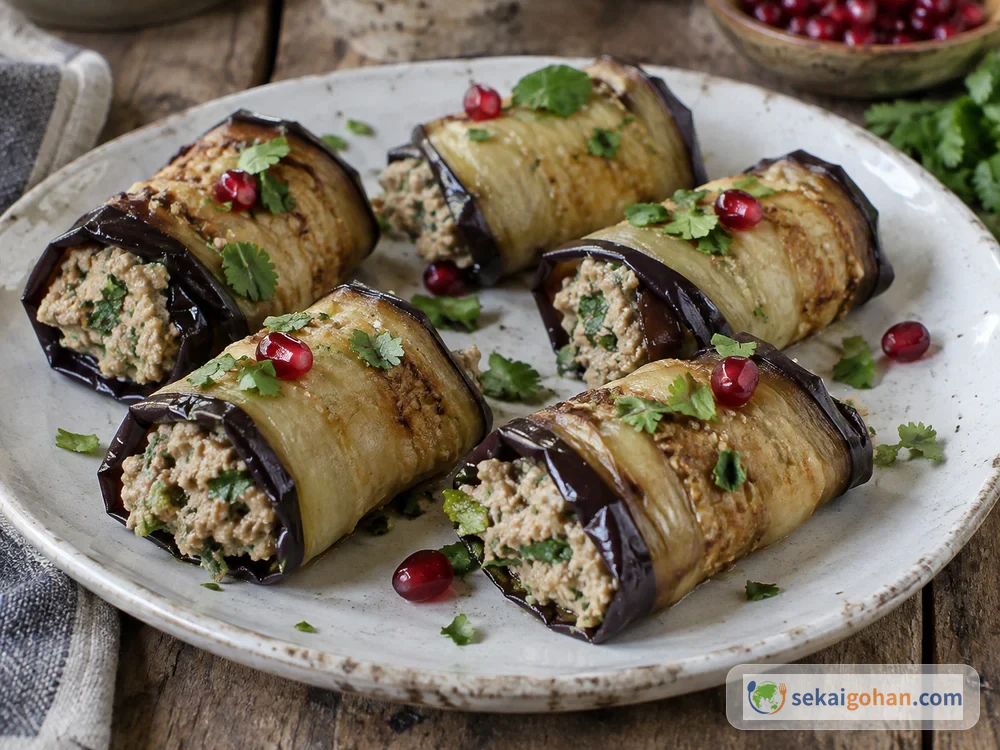
Badrijani Nigvzit: Georgian Eggplant Rolls with Walnut Paste
Ingredients
For frying the eggplant
| Ingredient | Amount | Substitutes & notes |
|---|---|---|
| Eggplant | 1 lb (500 g) | Edible portion with the stem removed. Long or ordinary eggplant both work |
| Salt (for prep) | 3g | Sprinkle on the eggplant, then wipe off the liquid that comes out and any excess salt |
| Vegetable oil | 2 oz (60 g) | About 5 tbsp. Divide among the frying rounds; leave any oil you don't need |
Walnut paste
| Ingredient | Amount | Substitutes & notes |
|---|---|---|
| Walnuts (unsalted, roasted) | 5.5 oz (150 g) | Unflavored. Grind fine in a mortar |
| Garlic | 6g | Weight peeled. Grate it |
| Ground coriander | 1 tsp | Ground from the seeds, not the leaves |
| Fenugreek powder | 1/4 tsp | Ordinary fenugreek powder. If using blue fenugreek powder, replace with 1 tsp and don't use both |
| White wine vinegar | 1.5 tbsp (20 ml) | 1.5 tbsp (20 ml) rice vinegar also works. The aroma changes |
| Water | 3 tbsp (45 ml) | Drinking water. Check the thickness and add up to a further 1 tbsp (15 ml), 1 tsp (5 ml) at a time |
| Salt (for the paste) | 2g | Use after tasting together with the prepped eggplant |
| Cilantro leaves | 10g | Finely chopped. If you dislike it, 10 g parsley; the aroma changes |
Finishing
| Ingredient | Amount | Substitutes & notes |
|---|---|---|
| Pomegranate seeds | 20g | For finishing. Omit if you can't get them |
| Cilantro leaves | 3g | For garnish. 3 g parsley also works |
Steps
1Slice the eggplant lengthwise and salt it
Remove the stem from the 1 lb (500 g) eggplant and cut it lengthwise into slabs about 0.25 inch (5 mm) thick. The cutting takes about 10 minutes. Cut so the skin stays on the sides, and re-slice any thick, all-skin end pieces thin. Scatter 3 g salt over both sides, lay the slices on a tray and leave 20 minutes. Wipe off the liquid that comes out and the excess salt on the surface with paper towels. Squeezing hard would break the slabs, so just press. If you rinse off spots with a lot of remaining salt under running water, wipe the drops off both sides thoroughly. Never put wet eggplant into oil.
2Grind the walnuts and make the paste
While the eggplant rests, grind 5.5 oz (150 g) walnuts in a mortar for about 5 minutes, until the fine grains are no longer noticeable and it is a moist powder. Don't leave any hard grains a few millimeters across. Next, grate 6 g garlic and chop 10 g cilantro leaves to about 0.125 inch (2 mm). Add the garlic, 1 tsp ground coriander, 1/4 tsp ordinary fenugreek powder, 2 g salt, 1.5 tbsp (20 ml) vinegar and 3 tbsp (45 ml) water to the mortar and mix. If you chose blue fenugreek, replace the ordinary fenugreek with 1 tsp instead.
After about 3 minutes of mixing, add the cilantro. Aim for a thick paste whose mound, scooped on a spoon, slowly slumps. If it is stiff, add extra water 1 tsp (5 ml) at a time, up to 1 tbsp (15 ml). Never add water until it turns liquid. The finer you grind, the more evenly it spreads, but there is no need to work it until oil comes out of the walnuts.
3Fry the eggplant on both sides
Divide the 2 oz (60 g) vegetable oil among the rounds. For the first round, spread about 20 g in the skillet, set it over medium heat, and arrange the eggplant without overlapping. Fry about 4 to 5 minutes on one side until pale golden, then turn and fry 4 to 5 more minutes. It's done when the center is soft and the edge bends when lifted. Frying in 2 to 3 batches takes about 25 minutes in total.
If the surface darkens while the center stays firm, lower the heat to medium-low. Take care not to scorch it black. Add a small amount of the remaining oil only where the pan has dried out and the browning is uneven. Even if the eggplant soaks up oil and the surface dries at once, never add all 2 oz (60 g) at once. Don't crowd it into one round; take out the cooked slices in order.
4Remove excess oil and cool the eggplant
Move the cooked eggplant one slice at a time onto a paper towel-lined plate, and cool it about 10 minutes without stacking. Lightly press and blot the oil floating on top too. It's ready when the flesh is soft enough to look translucent and cool enough to handle with your fingers. Replace the paper once it gets soaked with oil. Don't press hard and break the shape. Don't roll it while hot or force it down with your hand. Don't leave it at room temperature for long. As soon as the last slice has cooled, wrap the paste and move on to refrigeration.
5Wrap the walnut paste and chill
Assembly takes about 10 minutes. Lay out one slice at a time, and spread the thick paste from step 2 to a thickness of about 0.125 inch (3 mm). Spread a thin layer over all the slices first, then divide the rest, so it isn't uneven. Leave about 0.5 inches (1 cm) at both ends, and roll once from the near edge. For short or tearing eggplant, spread the paste on half and fold in two. Place them seam side down in a single layer in a clean, shallow container.
Cover and chill for 60 minutes in a refrigerator at 0 to 5°C (32 to 41°F). Serve with 20 g pomegranate seeds and 3 g garnish herbs scattered on top. It's ready when the paste stays on the eggplant and the eggplant bends softly. Refrigerate within 2 hours of cooking. Don't press hard to shape it, or the paste will squeeze out.