Ingredients and steps on one page. Print it, or choose “Save as PDF” in the print dialog.
Sekai Gohan
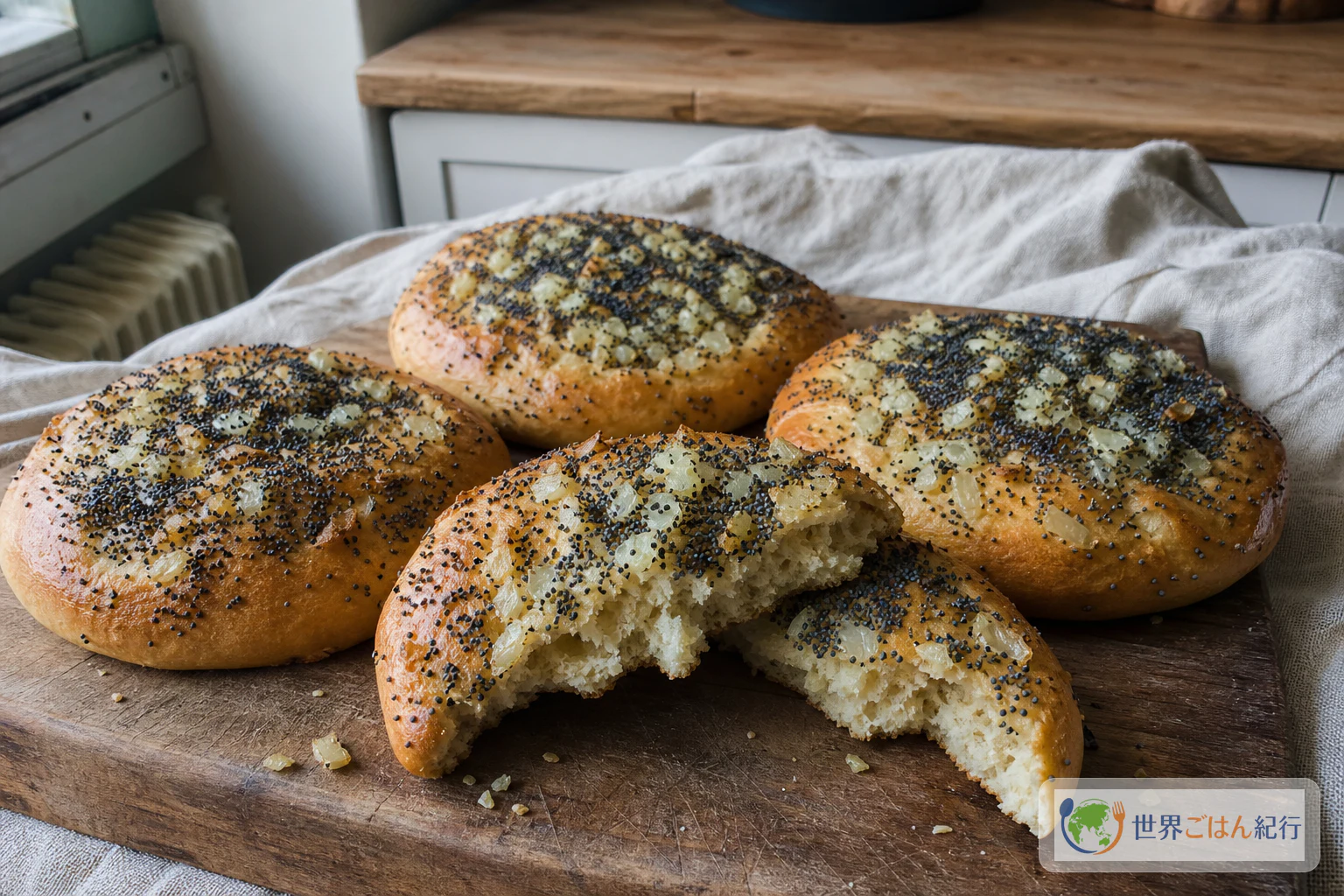
Cebularz Recipe: Lublin's Onion and Poppy Seed Flatbread
Ingredients
Dough
| Ingredient | Amount | Substitutes & notes |
|---|---|---|
| Bread (strong) flour | 12.5 oz (350g) | Provides rise and chew. If you can get medium-strength flour, 9 oz (250 g) bread flour and 9 oz (250 g) cake flour also works |
| Cake (soft) flour | 5.5 oz (150g) | Mixed in to lighten the rim. If using only bread flour, add 10–20 ml more water |
| Lukewarm water | 1 cup (270ml) | 35–38°C. If too hot it weakens the yeast |
| Instant dry yeast | 6g | 18 g if fresh yeast. Dissolve in the lukewarm water |
| Sugar | 12g | Helps fermentation and browning |
| Salt | 8g | For the dough. Measure separately from the onion's salt |
| Canola or rice bran oil | 1.5 tbsp (20ml) | Use an oil that is not too strongly flavored |
Onion and poppy seeds
| Ingredient | Amount | Substitutes & notes |
|---|---|---|
| Onion | 10.5 oz (300 g) | 0.25 inch (5–7 mm) dice. About 2 large |
| Poppy seeds (blue) | 18g | Black sesame changes the aroma. If you can't get them, limit white sesame to 8 g |
| Canola or rice bran oil | 1.5 tbsp (20 ml) | Toss with the onion to prevent drying |
| Salt | 4g | Draws out the onion's moisture and tightens the flavor |
| Black pepper | 0.5g | Not a traditionally essential ingredient, so only a little for aroma |
Finishing
| Ingredient | Amount | Substitutes & notes |
|---|---|---|
| Dusting flour | 20g | For the work surface and shaping |
| Brushing oil | 1 tsp (5 ml) | Brushed thinly on the rim before baking, just to add a little shine |
Steps
1Make the onion topping
70 min
Cut the onion into 0.25 inch (5–7 mm) dice, mix with 4 g salt, 1.5 tbsp (20 ml) oil, 18 g poppy seeds, and 0.5 g black pepper until the oil coats everything and it gleams, and rest for 60 minutes. If some liquid collects at the bottom, warm it over low heat for just 2–3 minutes and turn off the heat when the corners of the onion turn slightly translucent. Browning it deeply brings out bitterness rather than sweetness, so do not use high heat. Spread it on a tray and cool about 7 minutes so you do not put it on the dough hot.
2Knead the dough
15 min
Add 12 g sugar and 6 g yeast to 1 cup (270 ml) of 35–38°C lukewarm water, and after 5 minutes, when fine bubbles appear on the surface, add it to the flours, 8 g salt, and 1.5 tbsp (20 ml) oil. It looks floury at first, but after kneading 8–10 minutes it becomes a smooth dough that sticks only lightly to your hands. If it is stiff and cracks, add water 2 tsp at a time; if it slumps and spreads, add bread flour 2 tsp at a time to adjust.
3First proof
45–60 min
Put the dough in a thinly oiled bowl, cover with plastic wrap or a lid, and proof in a warm place around 82°F (28°C). Look for 1.6–1.8 times the size. When you press a floured finger in, the dent springs back slowly. If left a long time well above 86°F (30°C), the dough's aroma turns coarse, so in winter use the oven's proofing function and in summer watch it at room temperature.
4Roll into rounds
12 min
Divide the dough into 8 and round each, about 95–100 g each. After resting 5 minutes, roll out to 14–16 cm across, 6–8 mm thick in the center, and about 0.5 inches (1 cm) thick at the rim. Keeping the center thin and the surrounding a little thick makes the onion less likely to run when baked. Too much dusting flour leaves the bottom floury, so spreading a thin layer on the surface is enough.
5Add the onion
8 min
Place 35–40 g onion topping per piece, spreading it flat in the center and leaving 0.5 inches (1.5 cm) from the edge. If liquid has collected, scoop just the solids with a spoon. Piling the topping like a mound keeps the center from drying, so make the thickness of the center about 0.25 inch (5 mm). Finally press the center lightly with your palm to define the step down to the rim.
6Second proof
25–30 min
Cover with a large bag or loosely draped plastic wrap so they do not dry out, and leave around 82°F (28°C) until the rim has puffed about 1.2 times. Meanwhile, preheat the oven to 450°F (230°C). If using a pizza stone or thick baking sheet, leave it in the oven and preheat for 30 minutes. If the dough dries and a skin forms on the surface the rim cracks easily, so avoid places in a draft.
7Bake at high heat
12–15 min
Keep the oven at 220–230°C and bake on the middle rack. After 8 minutes, rotate front to back, and take out when the rim is golden, the tips of the onion are pale amber, and the bottom is lightly colored. If the center is white and moist, lower to 400°F (210°C) and add 2–3 minutes. A home oven can run weaker than its displayed temperature, so judge from the first piece's bottom color whether to move the sheet to the lower rack.
8Rest and eat
10 min
As soon as they are baked, move them to a rack to let steam escape from the bottom. You want to bite in while piping hot, but after 10 minutes the inside of the dough settles and the sweetness of the onion becomes clear. Rewarming for 2 minutes in a 350°F (180°C) toaster oven just before serving brings the rim back lightly.